
Previously, Balladeer’s Blog has covered several American privateer vessels of the Revolutionary War. As our 250th birthday approaches, I’ll take a look at one of our privateer ships from the War of 1812.
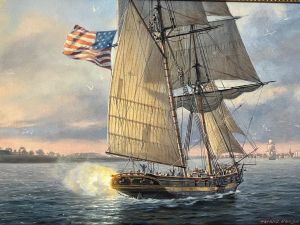 THE CHASSEUR – This vessel was granted its Letter of Marque to prey on British shipping and take prizes on February 23rd, 1813. The Chasseur had 16 cannon and a crew of 160.
From July 1813 to Christmas of that year, William Wade captained this ship as it ran through the British blockade the previous month and was looking for prey in the West Indies come July. The Chasseur seized between 6-11 British vessels during this cruise.
In July 1814, new Captain Thomas Boyle took the Chasseur out from New York after a legendary run of privateering as captain of the Comet in 1813 and earlier in 1814. From late July to October 24th, 1814 the Chasseur seized 18 vessels in the seas around the British Isles as well as the coasts of Spain and Portugal.
On August 27th of that successful cruise, Captain Boyle led his crew in taking the British merchantman ship Marquis Cornwallis. To further thumb his nose at the British, Boyle had the vessel sent back into an English port to deliver his irreverent “Proclamation of a blockade” around England to mock the “paper blockades” that the Royal Navy claimed to maintain around the U.S.
The “cheeky maneuver” as our British cousins might put it, became famous and the document was even posted in Lloyd’s Coffee House in London. The opening of Captain Boyle’s proclamation read:
Whereas, It has become customary with the admirals of Great Britain, commanding small forces on the coast of the United States, particularly with Sir John Borlase Warren and Sir Alexander Cochrane, to declare all the coast of the said United States in a state of strict and rigorous blockade without possessing the power to justify such a declaration or stationing an adequate force to maintain said blockade;
I do therefore, by virtue of the power and authority in me vested (possessing sufficient force), declare all the ports, harbors, bays, creeks, rivers, inlets, outlets, islands, and seacoast of the United Kingdom of Great Britain and Ireland in a state of strict and rigorous blockade.
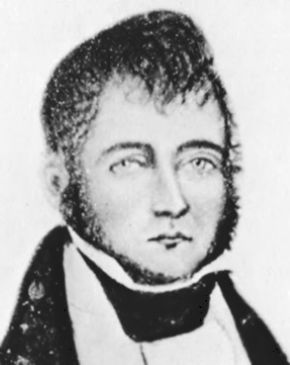
Captain Thomas Boyle
Astonishingly, this sarcastic taunt was taken seriously by the shipping community in England and resulted in several ships being pulled away from other duties to return home and help “secure British shipping” from Boyle’s mock blockade. Insurance rates soared as well.
The Chasseur set sail back to New York on October 24th as stated above. On December 24th it left New York on its final privateering voyage of the war. Technically, the Treaty of Ghent had ended the war in December 1814 but that was far from an age of instant communication.
Not only did the American victory in the Battle of New Orleans on January 8th, 1815 take place after the war’s end, but Captain Boyle and the Chasseur kept taking prizes in the West Indies into late February. On February 25th Boyle pounced on what he thought was a merchant vessel but turned out to be a Royal Navy cruiser, HMS Saint Lawrence.
Undaunted, the Americans attacked and defeated the British ship. The Brits suffered between 6 and 15 killed, & between 17 and 25 wounded. The Chasseur suffered 5 killed and 8 wounded and among the wounded was Captain Boyle himself.
He survived, however, and on March 18th, 1815 he brought his vessel back into Baltimore, ending the Chasseur’s War of 1812 career.


Ah obviously the shipping community had no sense of humor. and ah, the privateers of 1812. This was my first book’s ”hero’s backstory…..
LOL, no they didn’t! And yes, Captain Blackmoore! I’m buying your book The Unraveling of Lady Fury!
Fantastic. I never heard of the Chasseur before but found thiis engaging to read.
Thank you very much!
Great post. On a related note, if you want to hijack a liberal’s day:
That is hilarious!
If I learned of this ship in school, I don’t remember, as I did not appreciate history, nor fathom the sacrifices of our forefathers & other great individuals who aided in the sovereignty of our great country. I appreciate it all now and found this post so interesting. Have a beautiful semiquincentennial Independence Day!🎇
Thank you very much for such kind words! Happy 250th Birthday to you, too!
I can’t even imagine what they’re teaching kids in school nowadays about American history.
I know how you feel!
Moshiach as a wisdom k’vanna commandment: time-oriented positive Torah commandment.
I was not aware.