
Here’s a look at the six-Justice Supreme Court when the Court was first established.
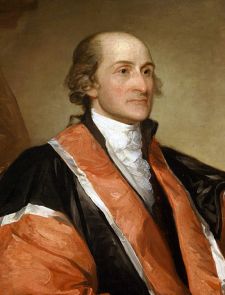 CHIEF JUSTICE JOHN JAY
Served: October 19th, 1789 – June 19th, 1795. (Resigned)
Some Highlights: West v Barnes, the first case which saw arguments take place before the Supreme Court. You want a quick turnaround? The arguments were heard on August 2nd, 1791 and the decision was published the very next day! In the 1794 case Glass v The Sloop Betsy, Jay’s Court ruled that France could not use its American Consulate as a prize court. Chief Justice Jay adopted a professorial role of sorts, writing explanatory items on procedures and the rudiments of federal governance at every opportunity for the benefit of lower courts and practicing lawyers.
Comment: During the Revolutionary War, John Jay served as a colonel in the 2nd New York Regiment.
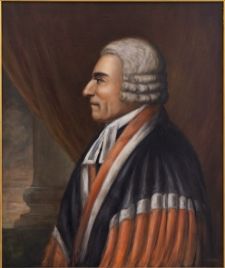 ASSOCIATE JUSTICE WILLIAM CUSHING
Served: February 2nd, 1790 – September 13th, 1810. (Passed away on that date.)
Some Highlights: Cushing was known for brevity in the decisions he authored, with his ruling on ex post facto laws in criminal cases vs civil cases in Calder v Bull (1798) running just TWO SENTENCES! William Cushing was named Chief Justice by President George Washington when the Senate rejected John Rutledge for the position. Cushing turned it down but remained on the court as an Associate Justice.
Comment: Cushing had served as Chief Justice of the Massachusetts Supreme Court from 1777 – 1789.
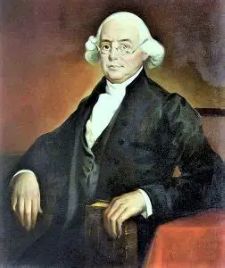 ASSOCIATE JUSTICE JAMES WILSON
Served: October 5th, 1789 – August 21st, 1798. (Passed away on that date.)
Some Highlights: Wilson authored the Court’s decision in Chisholm v Georgia (1793), which ruled that federal courts could hear disputes between private citizens and states outside of the one in which they resided. There was so much backlash to that decision that the Eleventh Amendment to the Constitution was passed to override it. James also participated in Hylton v United States, which held that a tax on carriages was constitutional.
Comment: Wilson had signed the Declaration of Independence. While serving on the Supreme Court, James Wilson twice landed in Debtor’s Prison, with George Washington visiting him as a morale booster during one of his sentences. Wilson was still being pursued by creditors when he passed away.
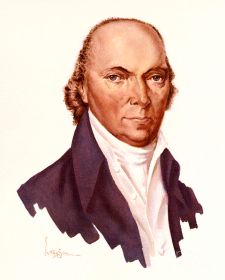 ASSOCIATE JUSTICE JOHN BLAIR
Served: February 2nd, 1790 – October 25th, 1795. (Resigned)
Some Highlights: Associate Justice Blair served mostly as a placeholder during his time on the court. He participated in early cases, of course, but did not distinguish himself in any way. I don’t write that to be insulting, it’s just that Blair was on the Supreme Court during its incredibly light case load so early in its history. He took part in technical rulings on Admiralty Law and Prize Law, so scholars of such affairs may find John Blair more interesting than I do.
Comment: Earlier in his career, Blair helped draw up Virginia’s Constitution in 1776 along with the Virginia Declaration of Rights.
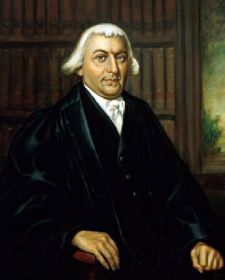 ASSOCIATE JUSTICE JAMES IREDELL
Served: May 12th, 1790 – October 20th, 1799. (Passed away on that date.)
Some Highlights: Iredell was the lone dissenting Justice in Chisholm v Georgia and was certainly vindicated by the country’s strong opposition to that court decision and it being overridden by the Eleventh Amendment. James’s concurrence in Hylton v United States went further than his fellow Justices in defining what constituted a Direct Tax.
Comment: In 1774, James Iredell authored To the Inhabitants of Great Britain, in which he laid out the Thirteen Colonies’ reasons for challenging direct rule by a Parliament that was an ocean away. He followed that up in 1775 with Principles of an American Whig, which anticipated some of the language in the Declaration of Independence, especially regarding the notion that government exists to secure freedom and happiness, and that people may alter or abolish a government if it becomes destructive to those ends.
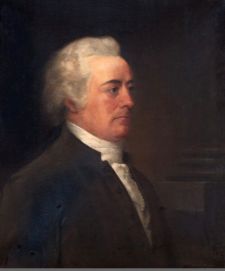 ASSOCIATE JUSTICE JOHN RUTLEDGE (Later Chief Justice for a brief period.)
Served: As an Associate Justice – February 15th, 1790 – March 5th, 1791. (Resigned) As Chief Justice – August 12th, 1795 – December 28th, 1795.
Some Highlights: Rutledge never quite got over his resentment that President George Washington had named John Jay the Chief Justice instead of him. On top of which he was bored with the Supreme Court’s low case load at the time and – like the other Associate Justices – he hated riding his Circuit as was required due to technological limitations of the era. In 1795, Washington made John the 2nd Chief Justice, replacing John Jay as a Recess Appointment, but the Senate ultimately rejected him by a vote of 14-10 and he had to step down, no doubt muttering “You won’t have Rutledge to kick around anymore!”
Comment: As Chief Justice, John Rutledge participated in United States v Peters, in which the Supreme Court ruled that Federal District Courts had no jurisdiction over crimes committed against American citizens in international waters; and in Talbot v Janson, in which the court ruled that a citizen did not forfeit U.S. citizenship if they renounced their citizenship of an individual state, and that dual citizenship of the U.S. and another country was legal.


Pingback: THE ORIGINAL SIX JUSTICES OF AMERICA’S SUPREME COURT – El Noticiero de Alvarez Galloso
Logged, thank you sir!
Fantastic post as always. I have never taken much of an interest in the history of America’s Supreme Court, but found your post engaging to read.
Thanks! I appreciate it!
With the justices being required to ride their circuit, the job certainly would be more taxing than it is today. Can you imagine being on horse or in a wood-and-iron wheeled buggy during most of the year?
Yes, that had to be a nightmare in those days!
That was very interesting. Sharing.
I’m happy to do it! Thank you!
Very interesting. Well shared 💐
Thanks very much!
💐
😀 😀
Torah constitutional doctrine of the 2nd commandment.
I understand.