
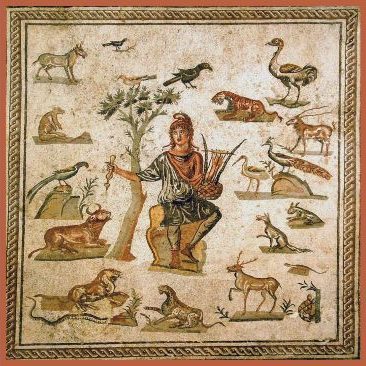
 It’s been years since I’ve written about the Orphic variations of mainstream Greco-Roman mythology. For anyone who is not familiar with the Orphic Hymns, Zagreus, etc. these fascinating offshoots of the myths we all grew up with feature a variety of differences.This version of the tale of Jason and the Argonauts won’t always match the more popular rendition.
 THE ORPHIC ARGONAUTICA – To avoid being too boring I will omit all the arguments about the exact time period in which this variation on the epic was first written. At any rate, as the “Orphic” part of these writings would indicate, this look at the Quest for the Golden Fleece is told from the point of view of Orpheus the musician, poet and keeper of the Mysteries.
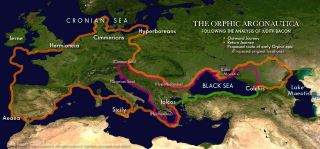 Our famous lyre-player Orpheus is approached in his cave at Thrace by the hero Jason. The hero tells Orpheus how he has gathered a crew that will take to sea in the Argo, the first vessel built specifically for ocean voyages. NOTE: Yes, the Orphic Argonautica depicts the Argo as the first ship ever built for a long-range journey. Various allegorical meanings are read into this, but I’ll spare you the details.
Jason explains that he needs to find and obtain the Golden Fleece of the sacrificed ram in order to mark his claim to the throne of Iolcus. He has named his crew the Argonauts. None of them are willing to risk the dangers of this quest unless Orpheus, he who braved the Netherworld and returned, is with them.
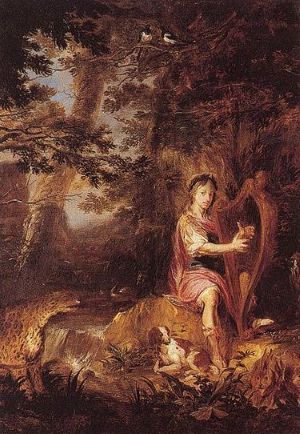 Orpheus agrees to join the quest and accompanies Jason. The great musician and poet meets his fellow Argonauts, beginning with Herakles and his male lover Hylas. Other members of the crew – both familiar and not:
The twins Castor and Pollux; Mopsos the augur, who reads meaning in the flights of birds; Peleus, father of Achilles; Argos, the builder of the Argo; Koronos, whose father Kaineus was born a woman until transformed by Poseidon.
Other standouts include Iphiklos, who could run fast enough to race over a wheat field without bending the stalks; Boutes and his golden sword; Kanthos, doomed to die in Libya; Phalerous, founder of the port city Phaleron; Amphidamus, Tamer of Both Sides; Zetes and Kalais, sons of the wind god, who flew on wings that grew from behind their ears; and Periklymenos, shape-shifter and grandson of Poseidon.
In the Orphic Argonautica there are fifty-two crew members, so I’ll introduce others as they become relevant to the storyline. Orpheus tells us that all of the Argonauts shared a massive meal at an incredibly long table, then set sail the next morning.
WITH THIS INTRO DONE, I’LL DIVE INTO THE MAIN STORY NEXT TIME.
 Balladeer's Blog
Pingback: THE ORPHIC ARGONAUTICA – El Noticiero de Alvarez Galloso
Logged, thank you sir!
Having been around sheep, I am not touching a dark brown or gold or yellow sheep skin.
Have you been down wind from 10 or 30 sheep? It is hardly better then being downwind from a pig farm.
LMAO! Well, surely a dead one with a fleece turned into gold by the gods would be odor-free.
Wonderful post. I don’t normally take any interest in Greek mythology but as always found your posts engaging to read. It brought to mind great medieval movies about Greek mythology that I have seen and loved.
That’s nice of you to say that!