
With Presidents Day approaching, here is another seasonal post.
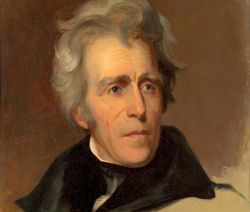 ANDREW JACKSON
Conflict – Revolutionary War: Service – In June 1780 the 13-year-old Andrew Jackson and his older brother Robert enlisted in the South Carolina Militia and saw action in Southern Theater clashes like the Battle of Hanging Rock.
In April 1781 Andrew and Robert became Prisoners of War and Andrew was slashed across the face and hand by a British officer’s sword. The facial scar is sometimes omitted from painted portraits of the man but is visible in the primitive daguerreotype photograph of an elderly Jackson.
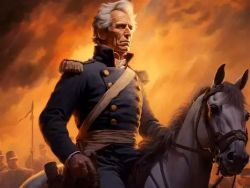 Conflict – War of 1812: Service – War was declared by Congress on June 18th and by November 1st, General Jackson was placed in charge of Tennessee troops for southeastern campaigns against the British and their Native American allies. By February 1813, his troops saw action all the way to Natchez.
In March and April 1813 Jackson led his men back to Nashville and by then had been nicknamed Hickory and/or Old Hickory by his troops. October saw General Jackson assigned to lead his men against the Red Sticks Creek Tribe, who were allied with England and Spain against the U.S.
Jackson and his forces fought the Red Sticks Creek for months, including battles at Tallushatchee and Talladega. January 1814 brought the Battles of Emuckfaw and Enotachopo Creek. In March, Jackson and his combined force of American, Choctaw, Cherokee and Creek Indians won a major victory over the Red Sticks Creek at Horseshoe Bend.
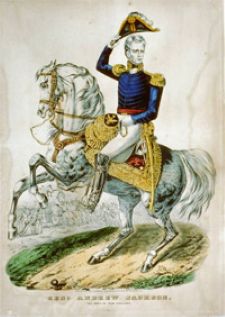 Jackson was promoted to Major General of American troops and by August 9th accepted the surrender of Native American William Weatherford, leader of the Red Sticks Creek. During the rest of August and September Jackson led his men in a campaign to take Mobile, AL where he also repulsed British attempts to take the city.
In October, Andrew began his invasion of Spanish-held Florida and took Pensacola in battle on November 7th. This knocked Spain out of the war. Before the end of the month he was ordered to leave Pensacola and defend New Orleans from the British.
During December 1814 Jackson’s troops were reinforced by Free Black Men, Tennessee Volunteers and Mississippi Dragoons. From December 23rd to 28th he led his men in repulsing repeated British attempts to take New Orleans. January 8th, 1815 saw the decisive Battle of New Orleans in which Jackson crushed the English.
Conflict – First Seminole War: Service – In December 1817 Major General Jackson was assigned by the Secretary of War to end the latest raiding by Seminole Indians who struck then retreated into Spanish Florida. Jackson felt the way to end the war was to stop covert Spanish support for the Seminoles. By May of 1818 he had seized Pensacola (again) and amid other victories ended the war, prompting Spain to sell Florida to the U.S. in 1819.
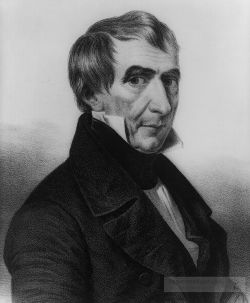 WILLIAM HENRY HARRISON
Conflict – Northwest Indian War: Service – Revolutionary War hero General Henry “Lighthorse Harry” Lee convinced the 18-year-old William to enlist in the army during the ongoing war in August 1791. Harrison distinguished himself under the overall poor leadership of General Arthur St. Clair and was promoted to lieutenant when General “Mad Anthony” Wayne took over St. Clair’s command in 1792.
During 1793, Harrison became General Wayne’s aide-de-camp and learned at the great man’s knee from there. William served all the way through Wayne’s 1794 victories at Fort Recovery and Fallen Timbers, the latter of which ended the Northwest Indian War.
Conflict – Tecumseh’s War: Service – Tecumseh’s growing alliance of Native American Tribes was being covertly supplied munitions by the British via Canada. While Tecumseh was traveling, his less savvy brother Tenskwatawa the Prophet prematurely started hostilities against the U.S. General Harrison commanded American troops in the area and on November 7th, 1811 soundly defeated Tenskwatawa at the Battle of Tippecanoe. Old Tippecanoe became Harrison’s nickname for the rest of his life.
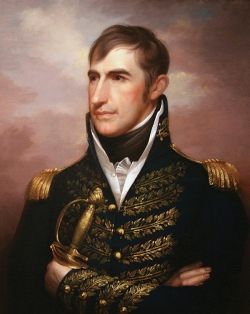 Conflict – War of 1812: Service – From September 5th to 12th, General Harrison defeated British-allied Potowatomi and Miami Indians at the Siege of Fort Wayne. On September 17th, Harrison was placed in command of the Army of the Northwest.
William led his men in establishing defensive positions along the Maumee River and defeated attacks by British General Henry Proctor in April 1813. After American naval victories on Lake Erie in September, Harrison went on the offensive against Proctor, winning battles in Indiana before retaking Detroit and Sandwich from the British.
Advancing into Canada, General Harrison drove enemy forces before him and defeated the British & their Native American allies under Tecumseh at the Battle of the Thames on October 5th. William and his men remained in control of the Lake Erie Land Theater from then on, but he resigned from the army in the summer of 1814 over disputes with the Secretary of War regarding the conduct of the war.
FOR PART ONE – WASHINGTON TO MONROE, CLICK HERE.
 Balladeer's Blog
Pingback: U.S. PRESIDENTS IN THE MILITARY (Jackson-Harrison) – El Noticiero de Alvarez Galloso
Logged, thank you sir!
I don’t normally take any interest in U.S. presidents in American history but always find your posts engaging to read.
Thank you. I appreciate it!
Except for the fact that Jackson was a Democrat, if he were alive today, he would surely be flogged.
Yeah, I know what you mean.
Good army leader. 👍well shared
Thank you very much.
😁😁😁🥰🥰
😀 😀 😀 😀 😀
😅😅😅😂😂
😀 😀 😀 😀 😀