
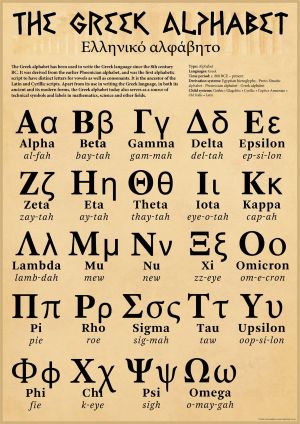
 THE PAGEANT OF LETTERS (c 402 B.C.) – Here is another examination of an ancient Greek comedy. This one deals with a subject that still affects a very large part of the world to this very day – our alphabet.
The Pageant of Letters (AKA The Tragedy of Letters and The Spectacle of Letters) was a comedy dealing with the Athenians officially adding four new letters to the Greek alphabet, making a grand total of twenty-four. Since twenty-four also happened to be the number of members in the all-important chorus of Attic Old Comedy, it presented an obvious subject for the Athenian stage.
 The addition of the four new letters (eta, xi, psi and omega) was causing a certain amount of confusion, as could be expected. Imagine if we suddenly added four new letters to the alphabet now, say, possibly single characters to express sounds formerly covered by two letters together, like “th” or “ph”.
Naturally everyday usage and ESPECIALLY official documents would be subject to all manner of confusion for quite some time. The Pageant of Letters dealt with the confusion the Athenians were experiencing because of the change. There is disputed authorship of this comedy and I’ll address that below.
THE PLAY
Each member of the chorus was costumed as a letter of the newly-expanded alphabet. Individual costumes for each member represented an extravagance but always made a big impression on the audience and the judges. Since the comedies (like the tragedies) competed against each other at festivals to Dionysus that was a crucial consideration.
Unfortunately The Pageant of Letters is one of the many, many examples of Attic Old Comedy that survive only in very fragmentary form so we know virtually nothing of the actual plot beyond what I already described. In addition to that we know that the comedy opened with each chorus member entering in alphabetical order by costume.
One particular gag from the comedy survives and seems to come from the rapid-fire episodes ( similar to our “black-out sketches”) that came near the end of these comedies. A woman (character name unknown) is pregnant and about to deliver.
She is using the new letters in her words and is trying to convey to a second figure (name and occupation unknown) that she is in labor. The second figure is failing to understand what she is saying because they haven’t mastered the new letters yet (Obviously the situation is just a wild exaggeration for comic effect).
The second figure eventually thinks the woman is trying to convey the information that she is about to express flatulence instead and immediately flees the scene. Ah, fart jokes! No matter what the time period they appeal to the ten-year-old child in all of us!
COMMENTS
 Obviously, my remark that the events that inspired this comedy affect a large part of the world to this very day comes from the fact that our own alphabet (in most of the western world) is based on the ancient Greek alphabet. For those new to the subject the Greeks started their alphabet with the letters alpha, beta, gamma and delta – corresponding to our own a,b,c and d (though not sound-wise for gamma).
In addition,the Greek zeta became our “Z”, kappa became our “K”, lambda our “L”, nu our “N” and so on all the way to Omega, which became our “O”. Two more letters were added over the centuries eventually giving us the twenty-six letter alphabet, which very word, you’ll recall, is short for “Alpha-Beta”.
The temporary confusion and disgruntlement over the whole affair once again lets us appreciate our shared humanity with the ancient Greeks, since we can certainly relate to it. Remember the general confusion and resentment when it temporarily looked like the U.S. was going to switch to the Metric System?
Since the alphabet is used for communication you might even stretch the parallels to include ongoing confusion at the ever-evolving technology of communication. Every time the internet, or facebook, or Twitter, and everything since comes along there is a period of adjustment and we all joke about the mishaps along the way to familiarity.
The ancient Athenians kept their laws available on public displays throughout Athens, so all of the displays would have needed updating, too. It’s hard to believe the author of The Pageant of Letters would have passed up a chance to have fun with such a situation in the play.
I mentioned above how there is disputed authorship of this comedy. In general, it is attributed to Callias the Second, to distinguish him from the Callias who wrote comedies several years before. Some scholars doubt the existence of a second Callias and consider the author unknown. A third school of thought goes that it was written by the original Callias, though there is no other evidence that he was still alive, let alone still writing comedies by this date.
A fourth theory (You know the academic world!) holds that the play was written by the original Callias years earlier, when the twenty-four letter alphabet was already being used by the Samians. (The four extra letters were not officially accepted by the Athenians, the Greeks who really mattered, culturally speaking, until roughly 402 B.C.)
For my fellow poetry geeks I’ll mention that this comedy was considered VERY influential in the way poetic meters would be used in both comedies and tragedies from then on. Antistrophic responsion and a closer marriage of the dialogue to the music in the choral segments in drama emerged from the pioneering efforts of whoever the author of this comedy was.
© Edward Wozniak and Balladeer’s Blog, 2012. Unauthorized use and/or duplication of this material without express and written permission from this blog’s author and/or owner is strictly prohibited. Excerpts and links may be used, provided that full and clear credit is given to Edward Wozniak and Balladeer’s Blog with appropriate and specific direction to the original content.
 Balladeer's Blog
Pingback: THE PAGEANT OF LETTERS (c 402 B.C.) ANCIENT GREEK COMEDY – El Noticiero de Alvarez Galloso
Logged, thank you sir!
Z,K,L,N all are interesting! Well shared
I appreciate it! Thank you!
🤩🤩
Ha! 😀 😀 😀
Thanks for describing what you know about The Pageant of Letters. Super interesting the way this comedy affected poetic meters!
Thank you very much! I love sharing this kind of information!
Great posts as always. I have never heard about this Ancient Greek comedy before but it definitely appears interesting. It brought to mind great movies set in Ancient Greece which I have seen and appreciate.
I really appreciate it!