
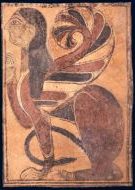
 The Etruscan people, who were a bit of a bridge between the ancient Greek world and the emerging Roman world long ago, remain a historical enigma in so many ways.
Fans of Jeopardy may recall that “Those Darn Etruscans” was the tongue in cheek title for categories dealing with these people whose works are not yet fully understood.
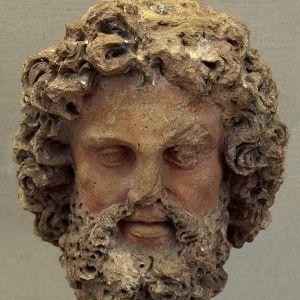 TINIA – The Chief of the Etruscan deities, like Zeus to the Greeks and Jupiter to the Romans. In the Etruscan creation myth Tinia separated the Earth from the sky and delineated borders between nations. Tinia ruled the sky and wielded three sorts of lightning bolts – one sort for warnings, one sort for intervening in affairs of gods or men for good or ill and one sort for inflicting catastrophes.
Unlike Zeus or Jupiter, Tinia needed the consent of a Council of the Gods (Dii Consentes) in order to wield the second and third categories of lightning bolts. There were separate deities who wielded other classifications of thunderbolts but they wielded only one category each, not three like Tinia.
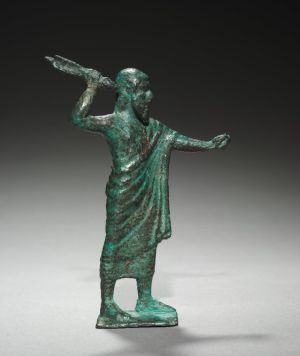 “Apa” or father is often used when referring to this god and is compared to the way “piter” in Jupiter also means father. Honoring borders and maintaining peace among gods and mortals were major preoccupations of Tinia’s. His name appears on stones marking borders. In Etruscan art he is depicted as younger than Zeus or Jupiter, sometimes to the point of being beardless, but clutches lightning bolts like those two.
Tinia’s wife was Uni, the Etruscan equivalent of Hera to the Greeks and Juno to the Romans. His daughter was Menrva, equal to the Greek Athena and Roman Minerva. One of his sons was Hercle, the Greek Herakles and Roman Hercules. Like all the deities in this pantheon, many aspects and epithets of Tinia are confused and contradictory because of how little is understood about the Etruscan language.
 UNI – Supreme goddess of the Etruscan pantheon, equal to the Greek Hera and the Roman Juno. With her husband Tinia and his daughter Menrva she was part of the ruling triad of Etruscan deities – the forerunner of the Roman Capitoline Triad. Uni was the goddess of marriage, fertility, family, and womanhood.
Like Hera and Juno, she was an enemy of her husband’s illegitimate son Hercle, the Etruscan Herakles/ Hercules. Tinia once tricked Uni into breastfeeding the infant Hercle, technically accepting him as her own.
 Typical of the uncertainty surrounding Etruscan myths, some sources say that “trick breastfeeding” incident increased her hostility toward Hercle, some say it reconciled the pair by taking place when Hercle was an adult and still others say it limited the degree of persecution Uni could inflict on Hercle.
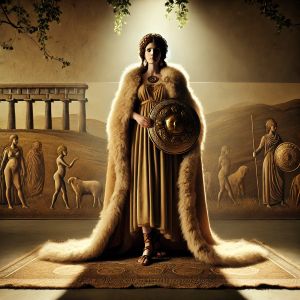
Uni was the patron goddess of the major Etruscan city Perugia and inscriptions on the gold plaques found at Pyrgi indicate that she was also identified with the Canaanite and Phoenician goddess Astarte. Uni was often depicted with a goatskin cloak and sandals while holding a shield or a branch with three pomegranates, or wearing a bridal veil, or completely nude.
 MENRVA – The Etruscan equivalent of the Greek Athena and the Roman Minerva. She was the goddess of wisdom, war, art and medicine. Some sources state that Menrva was the natural daughter of both Tinia and Uni but others indicate she sprang from Tinia’s forehead like Athena from the forehead of Zeus.
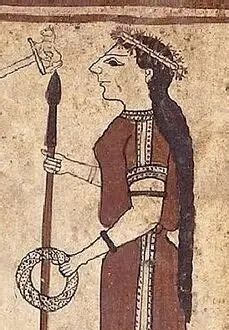 One area where Menrva stands out from both Athena and Minerva is the Etruscan depiction of her as a special protector of Hercle and Pherse (Perseus). Another example would be Menrva’s connection to medicine and healing, like her depiction tending to Prumathe (Prometheus) as he is unbound, side by side with Esplace (Asclepius) who is bandaging Prumathe’s chest.
Another purely Etruscan characteristic of this deity is her role as one of the above mentioned nine Etruscan lightning/ thunderbolt hurlers.
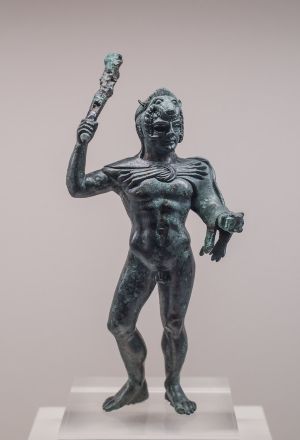 HERCLE – The Etruscan Herakles/ Hercules. Hercle was usually depicted as a muscular man wearing a lionskin and carrying a club like his Greek and Roman counterparts. He protected workers including shepherds.
In addition to the classical Twelve Labors of Hercules there are Etruscan works of art depicting Hercle battling monsters and accomplishing other feats not found in Greco-Roman myths. No accompanying stories have survived to explain those images.
 Unlike Herakles/ Hercules, Hercle did not die while lighting his own funeral pyre in order to ascend to full godhood on Mount Olympus.
Instead, Hercle participated in an adult reenactment of his infant self’s suckling at the breast of Uni, thus ascending to godhood while simultaneously reconciling with the goddess.
 TURAN – The Etruscan goddess of love, beauty, fertility, harmony and youth. While basically an Etruscan equivalent of the Greek Aphrodite and Roman Venus, Turan’s name is etymologically connected to the word tyranny. The goddess is regarded with a certain wariness because of the way passion can so thoroughly rule gods and humanity alike.
In surviving Etruscan art, Turan is often paired with her lover Atunis (Adonis). She is also winged, like her son Aminth/ Turnu, who is a cherub like Cupid. Turan’s retinue of lesser divinities were called the Lasas, and she was the patron deity of the Etruscan city Velch. Their month Traneus (our July) was named after Turan.
 AITA – The Etruscan equivalent of the Greek Hades and the Roman Pluto. In addition to ruling the Underworld and the realm of death, Aita is the god of subterranean fire and lava. In regard to his fire associations he is called Suri. This deity wears a wolf-head cap which lets him turn invisible.
Like Hades/ Pluto, Aita abducted his wife Phersipnai (Persephone). Some sources claim she is more accepting of her role as the Queen of the Underworld than Persephone or Proserpine. Phersipnai has snakes in her hair and is more frequently depicted at her husband’s side than her counterparts are.
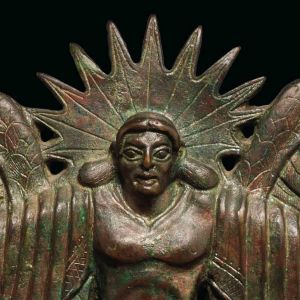 USIL – The Etruscan sun god, usually depicted with a halo of light around his head. Usil is a skilled archer and is the father of the goddess Catha. This sun god is one of the Etruscan deities who is depicted as male sometimes and female at other times. Not enough information has survived from the Etruscans to determine if Usil morphed between male and female or if he had two separate forms, similar to gnostic syzygies or the male-female gods in Shinto mythology’s Kojiki.
CEL – The Etruscan Earth goddess, like Gaia to the Greeks and Terra to the Romans. She is called “Ati Cel” or Mother Cel. This deity has a beautiful female body above the waist, but her lower body is made of vegetation. Most of her offspring were giants, some with snakes for legs. A work of Etruscan art depicts one of her giant children fighting the god of war Laran.
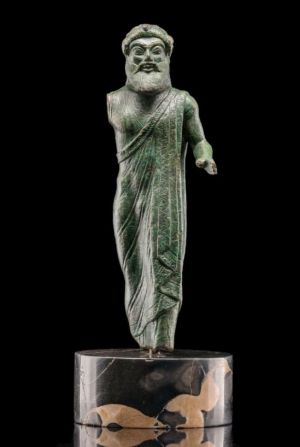 FUFLUNS – The god of vegetation, with a special interest in grape vines. He was the god of wine, like Dionysus was to the Greeks and Bacchus was to the Romans. Fufluns was associated with inebriation but his large retinue of revelers were not as wild or destructive as the followers of Dionysus.
The parents of Fufluns were Tinia and Semla, the Etruscan equivalent of the goddess Semele. Silenus as a little boy was present at the birth of Fufluns playing an aulos. The goddess Catha may be this wine god’s consort.
Fufluns’ myths largely parallel those of Dionysus and Bacchus, but there are some Etruscan variations. For one example, Fufluns and his mother Semla become lovers at some point but not enough information has survived to know the full context.
Another variation depicts Fufluns becoming romantically involved with Areatha (Ariadne), but in the Etruscan version he meets her after she gets abandoned by Eiasun (Jason) during his adventures with the Argonauts. Obviously it is Medea that Jason abandons in most presentations, not Ariadne, who met Dionysus after she was abandoned by Theseus following his slaying of the Minotaur.
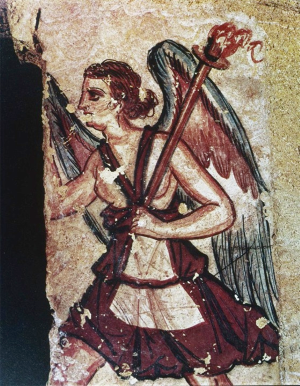 VANTH – Female psychopomp who accompanied Charun as he guided the dead. She is winged and is possibly his consort. Vanth carries scrolls with details about the soul’s deeds during life. She also holds a torch to light the way for the souls of the dead.
CHARUN – The Etruscan version of Charon in Greco-Roman myths. Unlike Charon who merely ferries the dead across the River Styx, Charun is a full psychopomp, accompanying the spirits of the dead all the way from their corpse to the Underworld. He had blue or green skin, a hooked nose like a bird’s beak and carried a hammer as well as snakes. Some sources claim he instead greeted souls at the entrance to the Underworld.
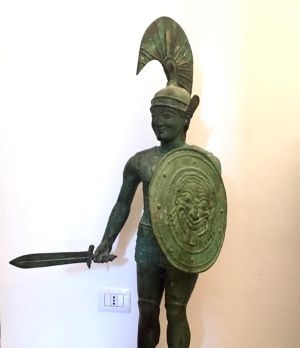 LARAN – The Etruscan god of war, equal to the Greek Ares and the Roman Mars. This war god is also another Etruscan figure who can wield one category of thunderbolts. One myth about Laran depicts him fighting the Earth goddess Cel’s giant son Celsclan.
Laran is associated with an Etruscan variation of the concept “peace through strength”. He is depicted with a shield, wearing armor or naked, and holding a sword, spear or lance. He has an attendant deity named Lurs but virtually nothing is known about him.
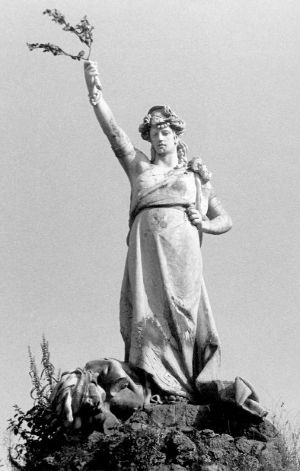 FERONIA – Etruscan goddess of prosperity, abundant harvests, and wild nature. She was like a forerunner of the Noble Savage concept because of her association with unchained nature, be it animal or human. She blessed freed slaves, who made offerings at her temple.
Feronia also preserved the civil rights of plebeians. This goddess so loved the wilderness that she would intercede to stop her devotees from moving her temple closer to the towns.
ARITIMI – The Etruscan equivalent of the Greek goddess Artemis and the Roman goddess Diana. Aritimi was an expert huntress like her counterparts.
APLU – The Etruscan Apollo, complete with lyre, bow and arrow plus his association with poetry and shepherds.
MANIA – Etruscan goddess of insanity and the mother of various deities of the dead with her consort Manth. Children were offered as human sacrifices to Mania.
ILITHIIA – The Etruscan goddess of childbirth and midwifery.
CATHA – Daughter of the sun god Usil. She does not appear very often in Etruscan artwork and very little is known about her.
ARIL – The Etruscan equivalent of Atlas, who holds up the sky.
NETHUNS – Etruscan deity of both bodies of saltwater and bodies of fresh water. Often considered an equivalent of Neptune to the Romans or Poseidon to the Greeks.
 Balladeer's Blog
Pingback: ETRUSCAN MYTHOLOGY – El Noticiero de Alvarez Galloso
Logged, thank you sir!
Excellent article; very informative and well-presented. 👍🙏
Thank you! I appreciate it!
Back I’m college I had a couple of classes that included mythology and actually included the Etruscans. A rich culture so many seem to dismiss. Love the write-up!
Thank you! I agree, they deserve more coverage.
Great posts as always. I don’t have much knowledge on Etruscan Mythology but as always found your post extremely interesting. It brought to mind great movies about ancient Greek gods that I have seen and love. For instance, the discussion of Greek Mythology brought to mind the wonderful comic book film “Wonder Woman”. Released in 2017, Patty Jenkins’ movie captured a demi-god heroine. One of my favourite comic-book films of all-time. It shares similar themes to the Mythology you discussed in this post.
Here’s why I recommend it strongly:
Thanks! Yes, Wonder Woman was an enjoyable film.
“piter” in Jupiter also means father–as usual, I’m learning from you.
Thanks for saying so!
Dear Balladeer
It is interesting to know a different point of view in this post.
🙏❤️
Thanks! I appreciate it!
I learned more about the Etruscans than I ever knew existed! Highly detailed and informative!
Thank you very much for the encouraging words! They help keep me motivated!
Beautiful story of Mythology. Well shared 💐 every country has some great mythology about God and Goddess
Thanks! And you are absolutely right, as usual!
💐
😀
Dear Balladeer
I read your post. My morning was pleasant & my day was made.🙏❤️
Thank you very much.
Years ago, we visited Villa Giulia in Rome—the leading Italian museum of Etruscan culture. The Etruscans were truly fascinating people: enigmatic, yet with a mentality that felt remarkably close to our own.
I was told there is a museum perhaps even better that that in Rome – in Florence – but have never had the chance to visit it.
That must have been great visiting that museum. I agree, the secrets of the Etruscans add to their appeal.