
This blog post looks at Dionysalexandros by Cratinus. For my post providing background info on ancient Greek comedies click here: https://glitternight.com/2011/09/22/at-long-last-my-ancient-greek-comedy-posts-begin/
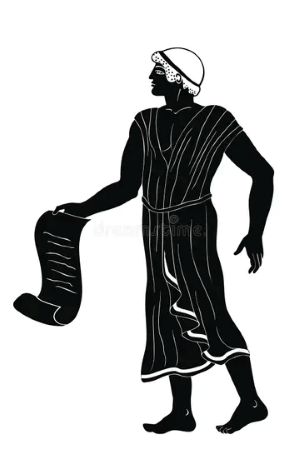 Cratinus was one of the Big 3 in Attic Old Comedy along with Aristophanes and Eupolis, both of whom were much younger than he was. From the fragmentary evidence available on Dionysalexandros, it appears to be a possibly unique hybrid of Attic Old Comedy and traditional Satyr Plays.
THE PLAY
In Dionysalexandros Cratinus pushed the envelope by blurring the line between comedy and Satyr Plays, which were the traditional mythical burlesques that the ancient Greek tragedians wrote as a comical piece after each of their tragic trilogies.
Satyr plays always featured Dionysus’ followers the satyrs, the drunken Silenus and often Dionysus himself. As in the comedies Dionysus would be depicted in Satyr Plays as a bumbler and a coward, because though the tragedies and comedies were part of the festivals devoted to that god he was able to laugh at himself.
At any rate the tragedians would write the satyrs and their divine leader into traditional myths for comic effect. Think of Simpsons episodes where the characters were written into classical stories or movies. Satyr Plays were, according to some scholars, the origin of the word satire, but others dispute this. (Scholars arguing over something? Big surprise!)
In Dionysalexandros Cratinus used the Satyr Play format for political commentary about Pericles, his conduct of the war (see below), his mistress Aspasia and her new lover Lysicles. Dionysus was impersonating the shepherd Paris and his satyrs were impersonating Paris’ subordinate shepherds.
The opening fragment of the comedy has not survived, so it is not known why they were doing this. Dionysus as Paris (AKA Alexander, hence the title) is mistaken for the real thing and is enlisted to make the milestone Judgement of Paris, deciding which Olympian goddess deserved the golden apple inscribed “To the most fair”.
The comedies and Satyr Plays performed in the Theater of Dionysus were the only arena in which such disrespect for the gods was permitted and the ancient writers threw themselves into crafting comic versions of various sacred moments from their own belief system.
For this burlesque of the Judgement of Paris Cratinus had the competing goddesses try to sway “Paris” with sarcastic twists on their actual bribes from that myth. Hera, who offered him the rule of the world in the myth was here depicted as offering to make our impersonator dictator for life with wry jabs at the type of abuse of power Pericles was often accused of.
Athena, who offered the real Paris success in warfare was depicted as instead offering the trembling impersonator the basic courage just to be able to face the battlefield, a poke at Dionysus’ depiction as a coward in the comedies.
Aphrodite keeps true to her offer of “the greatest beauty in the world” but the comic twist on that offer is that Dionysus, in his usual vain, fey way in comedy thinks she is instead offering to MAKE HIM the greatest beauty in the world. Unable to resist such an offer, Dionysus/Paris judges Aphrodite to be the most fair.
More comedy results from the imposter ending up with the voluptuous and emminently desirable Helen instead of the physical beauty he wanted for himself. This would be played for the type of laughs that a modern audience would get out of the tableau of (insert name of the most famous gay guy of the moment) ending up with (insert name of the most famous female sexpot of the moment).
Dionysus, like most Greek deities, oinked and boinked with both men and women, but in comedy he could be portrayed as just going “one way” to make whatever kind of joke the comic author wanted.
To begin to wrap things up, the Greeks are depicted as marauding all over the countryside near Mt Ida trying to recover the shanghaied Helen and punish her captor, causing the cowardly Dionysus to transform himself into a donkey in order to hide from the search parties. The ancient Greeks were so skilled at stagecraft I would love to know by what means this transformation was presented. It probably brought down the house.
The real Paris shows up, figures out what has been going on, and turns the reluctant Dionysus over to … somebody. From the fragmentary evidence some claim he is turned over to the Greeks but others claim he is turned over to the competing goddesses from earlier to face punishment.
Whatever fate is in store for him, his satyrs pretend they will share it with him, only to abandon him, as Pericles’ hangers-on and unfaithful associates abandoned him when trouble arose. Helen tells the real Paris she doesn’t want to go back to her husband Menelaus, and so, presumably with a leer, Paris agrees to take her with him to Troy, where as we all know, the Trojan War will be waged for the next 10 years.
COMMENTS
Cratinus was considered “the grand old man” of comedy by Aristophanes and Eupolis’ generation. In the ancient sources he is credited with having imposed some organization over the anarchic emerging art form of comedy following Susarion’s (supposed) pioneering of the craft around 500 BC or earlier. He may have written as many as 29 comedies in a career that spanned from approximately 457 BC to 423 BC.
Typical of academic arguments over the precise facts behind activity in ancient Athens some sources state that Cratinus, who usually attacked his targets openly, was forced to use Dionysus as an allegorical equivalent of Pericles in Dionysalexandros. The reason for that would be that the comedy was (or was not) written during the period in which the brassy Greek comic poets were briefly forbidden by Hyperbolus to attack public figures by name.
Putting Pericles in the role of Paris, the person whose desire for Helen was most responsible for the outbreak of the Trojan War, was a comedic way of attacking Pericles for embroiling the Athenian Empire in either the Peloponnesian War or the Samian War, depending on which scholar and which assigned date for the comedy you go along with.
Public sentiment in Athens often blamed Aspasia, Pericles’ mistress, for being the statesman’s motive for winding up at war. Full explanations would take too long but suffice it to say she was considered by some critics to have too much influence over Pericles’ policies, especially where her homeland of Mileta was concerned. Thus, “Helen” in this comedy would have represented Aspasia, just as Dionysus/Paris represented Pericles.
Dionysus’ cowardly reluctance to go forth and face the hostile army is a joke about Pericles’ disastrous policy during the early years of the Peloponnesian War of simply withdrawing behind the gates of Athens rather than face the attacking Spartans in the open. This policy of Pericles, founded on the statesman’s belief that Athenian armies stood no chance against Spartans in the open field, meant that the Spartan armies were free to ravage the towns and homes in the Athenian countryside for a few months every year.
Pericles felt that Athens could instead use its naval superiority to Sparta to win the war through battles on the open sea or by naval and marine corps raids on the city- states allied with Sparta during the war. Of course, for people who date the comedy to the Samian War instead, those jokes are figments of the first group’s imaginations. Ah, academia!
For scholars who maintain that Dionysalexandros was not written until after Pericles was dead, many jokes are interpreted as jabs at Lysicles, the public figure that Aspasia took up with soon after Pericles’ death. Aspasia was rumored to have coached Lysicles on his speaking style as she had, according to some sources, coached Pericles before him.
And for all my ancient Greek comedy posts click here: https://glitternight.com/ancient-greek-comedies/
© Edward Wozniak and Balladeer’s Blog, 2011. Unauthorized use and/or duplication of this material without express and written permission from this blog’s author and/or owner is strictly prohibited. Excerpts and links may be used, provided that full and clear credit is given to Edward Wozniak and Balladeer’s Blog with appropriate and specific direction to the original content.
 Balladeer's Blog
I think it’s ancient Greek comedy mythology. Good story 😂 well shared
Thank you very much.
👍🏼
😀 😀
I am writing my next book 😄😄
Terrific! Please keep me updated!
Yes absolutely 😁😁😃
😀 😀 😀
https://youtube.com/@pritilatanandi2010?si=CSS3DA-tAL2pIDjM. Today is daughter’s birthday 🎈
Wow! Happy birthday to your daughter!
Thank you 🙏🏼
You’re welcome!
That’s truly fascinating and insightful—thank you so much! 🤙
Glad to do it! Thanks for commenting!
Very interesting! Would be fun to see this live as a theatre show!
I agree, but sadly only eleven of Aristophanes’ comedies have survived in complete enough form for stage presentations.
💛
I appreciate it!