
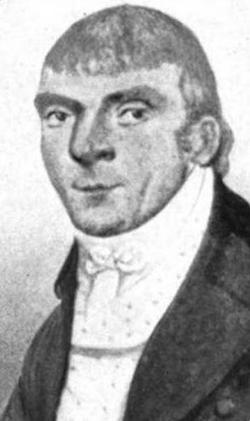
 THE SALAMANDER – The 4th of July is fast approaching! As another seasonal post Balladeer’s Blog examines the Revolutionary War career of Captain Jonathan Haraden, nicknamed the Salamander because of “his ability to withstand fire.”
Haraden’s rise to fame began when he was serving as First Officer under Captain John Fisk on the American commerce raider the Tyrannicide, launched on July 8th, 1776. This ship, crewed by 75 men, was a 14-cannon sloop which preyed on British targets from July of 1776 until August 14th, 1779. After its launch from the Salisbury Naval Shipyard the Tyrannicide made Salem, MA its homeport.
 The Tyrannicide wasted no time, battling the HMS Dispatch on July 12th. The Dispatch boasted 20 cannons but after an hour & a half battle fell to Fisk and Haraden’s crew. The commerce raider towed this prize into Salem by July 17th and soon set out for more.
August of 1776 saw the ship working the waters off Cape Sable and Nantucket. During that time three more prizes fell to Tyrannicide – the Glasgow, the Saint John and the Three Brothers.
The Tyrannicide claimed yet another prize but while towing it back to Salem a British frigate attacked. In the ensuing battle the American ship was nearly captured, even after abandoning its recent “catch.”
After that this renowned vessel was refitted and undertook a raiding expedition to the West Indies in late October. Between then and February of 1777 the Tyrannicide seized the brig Henry & Ann, the snow-brig Ann, the Three Friends (100 tons) and the John (140 tons).
Upon returning to Salem, Captain Fisk was reassigned to command the Massachusetts, while the Tyrannicide’s First Lieutenant Jonathan Haraden was promoted to be the new Captain. On March 24th the vessel set out with the Massachusetts to prey on British shipping along the Atlantic lanes all the way to the coast of England. Haraden and the Tyrannicide were about to become even more famous.
Before the end of March the Tyrannicide captured the Eagle and plundered the snow-brig Sally from London. On April 2nd the Chalkley‘s cargo of mahogany from Honduras fell into the hands of the Americans.
April 8th saw the Tyrannicide in a THREE HOUR battle with the FIVE HUNDRED TON barque Lonsdale, defeating that British ship in the end. Captain Haraden teamed up with his former commander Captain Fisk on April 22nd when the Tyrannicide and Massachusetts picked off a straggler from a British convoy crossing the Atlantic.
This storied vessel finished out its active April of 1777 on the 30th by capturing the Trepassy. The inevitable happened on May 17th when Tyrannicide and Massachusetts happened to be in the wrong part of the sea at the wrong time. The American ships fell foul of an entire squadron of British vessels and had to flee.
The Brits kept up the pursuit and eventually the two American raiders got separated from each other. The Tyrannicide barely beat its pursuers to Bilbao, Spain, a feat it accomplished only by tossing all guns and supplies overboard to lighten themselves enough to outrace the British.
By August 30th Captain Haraden and his ship were back in American waters and put in at Boston. After another refitting the Tyrannicide joined the Hazard in setting off for another West Indies voyage on November 21st.
December 13th saw Tyrannicide capture the Alexander and its cargo of oil, fish, lumber and other building supplies. Unfortunately, much later the HMS Yarmouth recaptured the Alexander off Barbados but not before Captain Haraden and his crew had towed it in.
Between December 22nd 1777 and the end of March 1778 the Tyrannicide captured the Good Intent, the Polly and the Swift along with their cargoes of fish, oil, wood and flour. On March 30th the vessel set sail for Massachusetts and put in at Boston in May for another round of refitting.
Our man Captain Haraden moved on to become the commander of the privateer ship General Pickering with John Allen Hallett being named the Tyrannicide‘s new captain. (For the rest of the Tyrannicide‘s service in the war click HERE.)
Haraden’s reputation would fly even higher as he earned the nickname “The Salamander,” a play on words regarding his ability to withstand fire.
Jonathan captained his new craft on voyages which saw him serving as a virtual blockade runner and smuggler on his outgoing trips, transporting American goods for his syndicate to be sold in Europe. On the return trips the General Pickering would capture a prize or two for the usual division of shares that made privateering very, very lucrative.
Always a consummate swashbuckler, Haraden would sometimes capture a British prize even while transporting a cargo across the Atlantic. Off Sandy Hook, NJ on October 13th, 1779 the good captain added to his legend by taking on THREE British privateer vessels at once. The Brits outgunned the 16-cannon General Pickering by 14, 10 and 8 cannons but the Salamander coolly emerged triumphant and towed in all three defeated craft.
Near the West Indies Captain Haraden took on an armed Royal Mail ship bound for England. After a prolonged and vicious battle the General Pickering pulled back for repairs then resumed the chase. By this point Jonathan’s vessel had barely enough gunpowder left for one cannon shot but Haraden maneuvered alongside his prey and bluffed that he would unleash a broadside if the Brits did not surrender. The Royal Mail ship gave in.
Captain Haraden’s most famous escapade on the General Pickering came in June of 1780, by which point his name was nearly as infamous to the British as John Paul Jones. The opening episode of that action-packed adventure happened when the General Pickering and the 22-cannon British brig the Golden Eagle encountered each other on a moonless night.
Running a James T Kirk-style bluff Captain Haraden claimed to be a United States frigate and demanded that the British vessel surrender. Jonathan played the bluff to perfection and the captain of the Golden Eagle did indeed surrender but was furious when daybreak came and he realized that his Yankee opponent was really a smaller craft.
Captain Haraden placed a prize crew aboard the Golden Eagle and began to tow it into the Spanish port at Bilbao. The captive Brits felt they were about to see the General Pickering suffer its own defeat when – just off Bilbao – it came across the British privateer ship Achilles.
The Achilles boasted forty-two cannons to the General Pickering’s 16, and a crew of 140 men to the American craft’s mere 45. Still, the unflappable Captain Haraden calmly prepared for battle.
In Bilbao word had spread that a clash was imminent between an American and a British vessel. People poured into the city to watch. Spectators sat on rooftops, leaned out of windows, climbed trees and hundreds even set out in small boats to witness the battle at closer range. It was the Revolutionary War’s version of the Civil War’s clash between the USS Kearsarge and the CSS Alabama.
On the morning of June 4th, 1780, the battle commenced. Over the next three hours the fight raged as Captain Haraden took advantage of his ship’s smaller size to maneuver around the Achilles and rake her. Eventually the British vessel was all but crippled. Still spirited, though, the Achilles did not surrender but DID retreat, acknowledging the American victory.
The General Pickering put in at Bilbao, where Haraden and his crew were the toast of the town. Jonathan himself was picked up by the cheering crowd and carried around the streets for awhile. The Captain eventually took care of business, turning over his cargo of sugar and negotiating shares for the captured Golden Eagle, which the Achilles had failed to free.
On the return voyage from that milestone victory over the “rulers of the waves” the General Pickering encountered three armed British merchant ships. The steely Captain Haraden expertly negated their numerical advantage by combining maneuvers and precision gunnery to separate the trio. The American privateer vessel then defeated each of the three in turn and towed them all into Salem, MA to great acclaim.
On February 3rd, 1781 the British under Admiral George Rodney and General John Vaughan captured the Dutch-owned Caribbean Island of Saint Eustatius, a notorious port used by American privateers as well as pirates of many nations. Admiral Rodney and General Vaughan were later censured for the way they bickered over splitting all of the loot from the seized American and French ships in port.
(The greedy pair even had merchant’s graves dug up because they were convinced that Dutch and Jewish merchants had themselves buried with much of their wealth.)
Accounts vary as to whether the General Pickering was one of the ships seized in early February or if it later lucklessly sailed into Admiral Rodney’s clutches before word had spread that the island was in unfriendly hands. Accounts also vary if Captain Haraden escaped British custody on his own or if he was freed when the Dutch retook Saint Eustatius late in the year.
In any event in 1782 Jonathan was back in New England and set sail in command of a new privateer vessel, the 14-cannon Julius Caesar. The British convoy system made prizes tougher to come by than earlier in the war, but Haraden made do with a capture here and there.
The Salamander had lost none of his courage, and in June of that year he and the Julius Caesar did battle with a pair of British ships sporting 18 and 16 cannons respectively. After two and a half hours of furious action Captain Haraden was forced to grit his teeth and flee to avoid capture. His opponents pursued him until he was able to lose them under cover of the night.
After the war, Jonathan Haraden passed away on November 16th, 1803. He is buried in Broad Street Cemetery in Salem, MA. A World War One and World War Two vessel were named for this colorful and accomplished sea dog. +++
FOR MORE:
REVOLUTIONARY WAR BATTLES BEFORE JULY 4th
QUICK FACTS ON ALL THE SIGNERS OF THE DECLARATION
 Balladeer's Blog
Nice read
Thank you
Aharon N. Varady
the Open Siddur Project ✍ פְּרוֺיֶקְט הַסִּדּוּר הַפָּתוּחַ
I didn’t know.
Pingback: “SALAMANDER” HARADEN: COMMERCE RAIDER AND PRIVATEER OF THE REVOLUTIONARY WAR – El Noticiero de Alvarez Galloso
Logged, thank you sir!