
Balladeer’s Blog presents another examination of an ancient Greek political satire. In this case it is one of those works of Aristophanes which have survived only in very fragmentary condition.
MERCHANT SHIPS
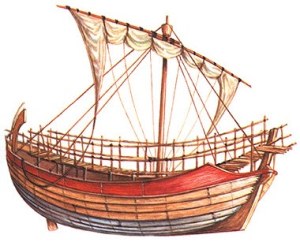 Merchant Ships was written and publicly staged in approximately 424 B.C. to 421 B.C. according to the available data. It was another of Aristophanes’ comedies protesting the pointlessness of the Greek city-states warring among themselves instead of uniting against the encroachments of the Persian Empire.
Aristophanes’ most popular surviving comedy about this topic is of course, Lysistrata, in which the women of Athens and Sparta unite to withhold sex from their men until those men agree to end the war. Merchant Ships has more in common with another of Aristophanes’ Peace Plays – The Acharnians, in which a separate peace with Sparta is made by an Athenian man named Dikaiopolis. (I always picture Rowan Atkinson in full Blackadder Goes Fourth mode playing him.)
In the case of Merchant Ships it’s more than just one person establishing a personal peace treaty with Sparta.
In this comedy the captains of two separate merchant ships – one from Athens and one from their foe Sparta – have grown weary of the pointless conflict and make a separate peace with each other. They and their crew members get to spend the play enjoying the food and drink from their cargoes and living out a metaphorical return to the prosperous days before the Peloponnesian War when peace reigned among the various Greek city-states.

Franchises aka Merchant Ships
If enough of Merchant Ships had survived to be staged, in a modern-day adaptation (as opposed to a straight translation) the situation could be depicted by having a Chick Fil-A restaurant right next to a Starbucks coffee shop. The managers and employees of these stereotypically Republican (Chick Fil-A) and stereotypically Democrat (Starbucks) establishments could grow tired of the political feuding, especially since both political parties often call for boycotts of the opposing business.
The managers and employees of the two franchises (in fact Franchises would be an ideal title) would make a truce separate from their home offices.
The characters would all thrive and recognize each other’s shared humanity and turn against the two corrupt and self-serving political parties that had them at each other’s throats. They would recognize that they have more in common with each other than they do with the Democrat and Republican party leaders who exploit their voters while feathering their own nests.
The ending of Merchant Ships has not survived so unfortunately, we do not know how the situation was resolved.
INDIVIDUAL LINES AMONG THE FRAGMENTS
* The Athenian ship captain commiserates with the other by saying ”By Mount Olympus, Spartan, how foul and cumbersome our mutual problems have become.”
* A “Wayland Smithers”-type toady for one of the captains is described as someone who “scratches his dandruff for him and is forever plucking out the gray hairs from his beard.”
* “Ah, Sparta, what then shalt thou suffer today?”
* “The other day, when I was hosting the dining club, I made soup.”
Here is a quote from an ancient commentary about the comedy Merchant Ships – ” Everywhere he (Aristophanes) pleaded his case, ridiculing Cleon the demagogue, who opposed peace, and constantly attacking Lamachus the war lover.”
* THERE ARE FRAGMENTS AND THEN THERE ARE FRAGMENTS *
Merchant Ships provides a nice opportunity to make clear how truly fragmented the scarce remains of these ancient Greek comedies can be. This is all that can be made out on some of the fragments of this particular play:
* “When I got to the place I was going to for wood …”
* “Spearheads are being fitted and the whetted shaft …”
* “I’ll run a careful finger over it”
* “… having drunk brine …”
* “jars of wine”
* ” … a drachma’s worth …”
* “partridge cage” (My personal favorite.)
And many other such disjointed phrases.
FOR MORE ANCIENT GREEK COMEDIES CLICK HERE: https://glitternight.com/ancient-greek-comedies/
© Edward Wozniak and Balladeer’s Blog, 2015. Unauthorized use and/or duplication of this material without express and written permission from this blog’s author and/or owner is strictly prohibited. Excerpts and links may be used, provided that full and clear credit is given to Edward Wozniak and Balladeer’s Blog with appropriate and specific direction to the original content.
 Balladeer's Blog
Pingback: MERCHANT SHIPS (424-421 B.C.) ANCIENT GREEK COMEDY – El Noticiero de Alvarez Galloso
Logged, thank you sir!
Hard to believe the ending isn’t known, but I believe it. Love the modern-day comparison.
Thank you! Yes, it’s so tantalizing when the endings of these comedies haven’t survived.
Love your comparison of Chick Fil-A restaurant right next to a Starbucks coffee shop; that made me laugh out loud! 😂
Ha! Thank you very much!