
Inuit mythology is almost criminally neglected. I’ve enjoyed covering it here at Balladeer’s Blog since 2011. Here’s a review of their top three deities. For nine more on top of that click HERE.
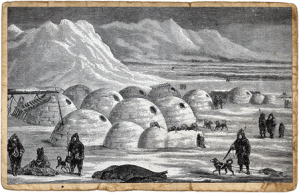 3. SILA – The god of the weather and of the animating life-force, frequently manifested as the winds, which were looked on as the “breathing of the world.” For this reason he was also the deity governing the breathing of humanity and animals as well, since breath flows like wind in and out of us all. The life force was said to come from Sila and flow back into Sila after death, and then, through the lesser deities, was eventually sent back into the world via reincarnation. Because singing, humming and tale-spinning are also done with the breath Sila was also seen as the god of songs, tales, music and other creative inspiration.
In addition it was through him that shamans ultimately derived their powers. Intuitive warnings, especially on the part of children, were said to be the whisperings of Sila. The nagging of one’s conscience was also attributed to Sila. This god was said to be always with us but always far away. In some traditions it is said Sila sculpted the first humans from wet sand and breathed life into them.
Bad weather like wind, blizzards, etc was caused by Sila punishing humanity for violating taboos and the god would inflict disease on anyone guilty of mistreating game animals. If someone suffering from disease was appealing to Sila to heal them they would need to abandon all their earthly possessions and go off in solitude. Once possessed of nothing but their “breath soul” Sila would consider healing them.
Breath souls and the animating life force came from Sila, free souls from the goddesses Nunam, Pukimna and Sedna. In some traditions the way Sila creates snow is by whittling walrus tusks with the shavings falling as snowflakes. The rare times Sila was depicted he was clean-shaven but with long flowing hair, standing with his fur coat open to display his bare chest, a sign of his imperviousness to the elements he commanded.
 2. TATQIM – The moon god. The moon is his partially burned out torch that he carries to light his way as he perpetually and lecherously chases his sister, the sun goddess Seqinek, whose fully lit torch is, of course, the sun. In addition Tatqim plays a very significant role in the Inuit cycle of reincarnation. When the human and animal souls in the supercelestial afterlife called Udlormiut are ready to be reincarnated, the goddess Tapasuma instructs the moon god to transport them to Earth, further instructing him what type of life form each soul should be reborn as.
Tatqim takes these souls to Earth in his divine dogsled pulled by four huge dogs (or just one REALLY huge dog in some versions) and does this on the moonless nights each month. This task he performs at Tapasuma’s command accounts for the moon’s absence from the sky on such nights. Tatqim’s control of the tides was crucial for the coastal Inuit because without ebb tides they could not gather the seaweed from where the tides had retreated, seaweed being an essential food item in the far north, where other forms of vegetable life are often very scarce.
The tale of the moon god’s creation of vaginas and anuses goes as follows: long ago animals did not have either orifice, so the disemboweling goddess Ululijarnaq used to take her ulo knife and carve babies and waste matter out of people’s insides as needed. (Sort of like the Tooth Fairy but with a lot more disemboweling) Seeing how inefficient that was, Tatqim took his hunting knife and cut vaginas into all female life forms and anuses into all living things.
Women continue to bleed for a time from this wound monthly to this very day. This association with the vagina is how the moon god first attained his reincarnation duties, since the vagina is the portal through which animal life enters the world. The disemboweling goddess was reassigned to her current role guarding the approach to the supercelestial afterlife. Barren women would pray to the moon god for children and he would sometimes come down and impregnate them personally.
When you add Tatqim’s role as the god of hunting he certainly seems to occupy a more significant place in Inuit myths than many other lunar deities from around the world do in their pantheons.
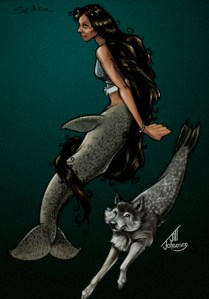 1. SEDNA – The sea goddess and the most celebrated deity in the Inuit pantheon. Even mythology books that cover no other figures from Inuit myths will usually have an entry on her. She was the daughter of the god and goddess Anguta and Isarrataitsoq and, like countless female figures in Inuit myths, she refused all prospective husbands. Sedna instead had sexual relations with dogs and the “freakish” offspring of these unions were said to be white people and Native American tribes that the Inuit were often at war with.
A ghoulish twist to the story is how Sedna took to using her parents as food (a recurring theme in Inuit myths because of the scarcity of food in the frozen north at times and how instances of cannibalism during such famines were much-discussed). Sedna devoured both of her mother Isarrataitsoq’s arms and had finished eating one of her father’s arms before he was able to subdue her and take her out to sea in his canoe, intent on banishing her to the sea. Continuing to struggle, Sedna clutched the sides of the canoe as her father tried to submerge her, prompting him to take his long knife and cut off her fingers.
Since, to the Inuit, loss or mutilation of the hands was often seen as a horrific transformation into something new, the myth states that Sedna now embraced her fate, transforming her now-fingerless hands into flippers and transforming her severed digits into the various species of sea animals. When the one-armed Anguta returned to shore, where his still-armless wife awaited, Sedna, now fully realized as the sea goddess, caused a massive wave to wash over her parents, dragging them down to her new home to serve in her subaquatic court.
This subsea realm is called Adlivun, and it is also the place where the souls of the coastal Inuit and the game animals they thrive on go after death to be eventually reincarnated (similar to how the souls of the Inuit from the interior and the souls of their game animals go to the supercelestial afterlife called Udlormiut when they die and are reincarnated, though the moon god does not seem to play a role in the rebirth of souls from Adlivun).
Sedna’s home in the deep is said to be constructed of a whalebone frame with walls made of all the clothing of people who have drowned at sea and furnishings fashioned from their bones and sunken ships.
The sea goddess’ father Anguta oversees the punishment of dead souls for taboos they violated in life, eventually purging them from the taint of their wrongdoing. After that the souls are free to dwell with the other deceased spirits until they are ready to be reincarnated. Sedna retained her preference for bestiality, taking the giant sea-scorpion god Kanajuk as a husband, a spouse she shares with her armless mother. The god Kataum guards the entranceway to Sedna’s undersea dwelling and also keeps an eye on taboos being violated by the coastal Inuit.
The god Sila uses Sedna to enforce the taboos (as he uses the goddess Pukimna to enforce the taboos for the Inuit of the interior), and, to counteract Sedna’s recalcitrant nature, does this by causing the breaking of taboos to manifest as knots and filth in Sedna’s hair. When the sea goddess’ hair becomes so polluted that she can no longer stand it she orders the godling-child Unga to act as a shepherd and round up all the game animals of the sea. This causes a scarcity of game for the coastal Inuit, a problem resolved only by a shaman traveling to Adlivun in their astral body to comb the knots and filth from Sedna’s hair, thus appeasing her. (She cannot comb her hair herself because she has flippers, not hands)
 Balladeer's Blog
Pingback: THE TOP THREE DEITIES FROM INUIT MYTHOLOGY – El Noticiero de Alvarez Galloso
Logged, thank you sir!
These are always interesting.
Thank you!
A really cool post about these deities from inuit mythology! I could do with the influence of Sila in my life; maybe then I’d feel more creative!
Thank you! Yes, Sila could light a creative fire under all of us!
💛💚💙
Thank you so much!
Realmente fascinante. Un saludo
Thank you!