
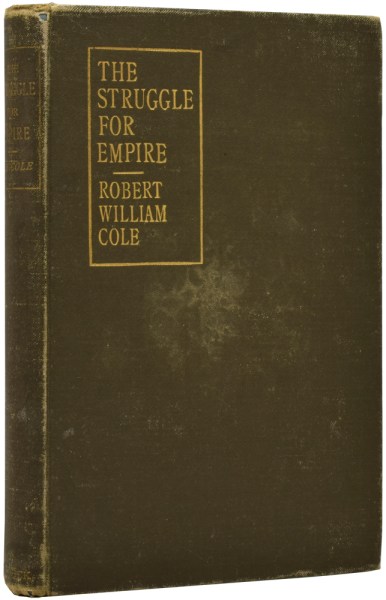
 THE STRUGGLE FOR EMPIRE: A STORY OF THE YEAR 2236 (1900) – Written by Robert W Cole. I left out the first half of the title for the headline, since The Struggle For Empire sounds like a mundane history book. In reality this novel was a very, very early example of the Space Opera sub-genre.
In 2236 A.D. Earth’s dominant geopolitical entity is the Anglo-Saxon Federal Union, consisting of Great Britain, the United States and Germany. This union of nations came about during a World War that was fought during the early Twentieth Century. That conflict pitted the Americans, British and Germans against the French and the Russians.
The Anglo-Saxon Federal Union emerged triumphant, with France carved up and lost to the mists of history. (The author was British.) London, now a megalopolis spreading out for hundreds of miles, is the Earth’s capital city. It also serves as the capital for the star-spanning empire which Earthlings have established.
 Initially the Earth colonized and inhabited the planets and certain moons of our own solar system all the way out to Neptune. (Pluto was not discovered until 1930.) In a quaint quasi-Steam-Punk way, all of those planets and moons have Earth-like atmospheres and conditions.
The perfection of anti-gravity and other technology led to the construction of space ships that could fly at the speed of ten million miles per hour. Robert W Cole takes H.G. Wells’ colonialism analogy from War of the Worlds into space, as humanity is depicted settling and colonizing planets in multiple star systems.
Earthlings also stripped uninhabitable planets of all their minerals, precious metals and other natural resources. Power and greed rule the zeitgeist. Complications arise when humanity at last encounters another intelligent race in the 23rd Century.
That semi-humanoid race of aliens is called the Sirians because their home planet is Kairet, a satellite of the star Sirius. From that world the Sirians had established their own galactic empire.
After First Contact, the Earthlings and the Sirians co-exist peacefully but with each race warily monitoring the other’s technology and colonial acquisitions. Brief hostile encounters flare up from time to time but all-out war is avoided.
That changes when the two empires challenge each other for possession of a newly-discovered planet overflowing with all manner of priceless resources. The Sirians declare war on the Earthlings.
The rival empires have been pretty evenly-matched in terms of science but now go into overdrive with their war efforts, trying to achieve an edge.
An Earthling fleet of 4,000 warships plus countless smaller spaceships head for the Sirius system, only to learn that the Sirians’ fleet vastly outnumbers our own. Weaponry on both sides consists of explosive missiles plus beams of a type of energy called Ednogen.
The first major space battle lasts for weeks and results in the almost total destruction of humanity’s fleet. The Sirians advance, routing Earth’s forces in a magnificent battle around Neptune, then defeating us again at the fallback position around Jupiter.
This pattern continues and eventually Earthlings and Sirians clash army to army on the Moon. We lose again and the alien forces soon begin seizing key locations on Earth itself.
After a time only London still resists the Sirians, but is surrounded and besieged. London ultimately falls and is reduced to ruins by the alien invaders.
Organized Earth opposition no longer exists but in the caverns of Kentucky a scientific genius named James Tarrant leads a human resistance group. Tarrant’s brilliance has allowed him to invent Ednogen-guns which can negate the systems of the Sirian ships.
James and his allies mount these guns on small Earth spaceships and manage to disable and destroy all of the alien ships on Earth, leading to humanity rallying and retaking our planet. In a new military campaign the Earthlings drive the Sirians out of our solar system.
Time goes by and Earth’s tattered but persevering forces build a new fleet of starships armed with James Tarrant’s Ednogen guns. This fleet heads for the Sirius system and after 6 more years of warfare forces the aliens to surrender unconditionally.
In an ending which eerily presages the follies of the post-war Paris Peace Conference in 1919, the triumphant Earthlings impose harsh, even merciless terms on the Sirians. Their home planet is evacuated and turned over to humanity’s empire, with James Tarrant installed as Kairet’s ruling prince.
In addition, the Sirians must withdraw from any and all disputed planets and moons PLUS pay an enormous indemnity to Earth’s empire, an indemnity meant to prevent the aliens from ever again outdoing humanity in ships or science.
This is presented as a happy ending, but I think we can all imagine how this ultimately laid the groundwork for a second and even more destructive interstellar war.
Robert W Cole could not possibly be aware of any of this, naturally, but I can’t help but think of the potential consequences of his “happy ending.”
In terms of human drama, James Tarrant romances and marries the former fiancée of Earth space officer Alec Brandon, given up for dead during the war. Brandon survived, actually, but gets a happy ending of his own with the woman who nursed him back to health after his ship was destroyed.
Other technology featured in the novel included space-suits plus a hologram/ illusory “fleet” of starships which distracted a large number of Earth vessels away from the actual site of the first major battle until it was too late.
Unforeseen consequences of this first known interstellar war between intelligent species included damage caused by “the ether vacuum,” which I like to think of as a forerunner of the Quantum Vacuum. Humanity’s tampering with the ether vacuum during the war caused two moons of Jupiter to collide, destroying both.
And how about those caverns around Kentucky? This is the third work of ancient science fiction examined here at Balladeer’s Blog which featured those caverns playing a major role in the story.
Despite my levity, this novel was obviously far ahead of its time and if only it had been more well-known it could have inspired a generation of E.E. “Doc” Smiths decades earlier than his Lensman series came along. What impact this might have had on the future of science fiction storytelling can only be speculated upon. +++
FOR WASHINGTON IRVING’S 1809 depiction of an invasion from the moon click here: https://glitternight.com/2014/05/05/ancient-science-fiction-the-men-of-the-moon-1809-by-washington-irving/
© Edward Wozniak and Balladeer’s Blog 2020. Unauthorized use and/or duplication of this material without express and written permission from this blog’s author and/or owner is strictly prohibited. Excerpts and links may be used, provided that full and clear credit is given to Edward Wozniak and Balladeer’s Blog with appropriate and specific direction to the original content.
 Balladeer's Blog
Pingback: ANCIENT SCIENCE FICTION: A STORY OF THE YEAR 2236 (1900) – El Noticiero de Alvarez Galloso
Logged, thank you sir!
Interesting that even back then they understood France. This could be good, Ed!
Hilarious!
❤
Thanks!
Why does T’NaCH Judaism absolutely flat out reject Greek metaphysics while Xtianity and Islam behave as a whore in heat and passionately embrace Monotheism?
Food for thought.
I love your Ancient Science Fiction write-ups!
Thank you, Cap’n!
Randomly stumbled upon this while searching for the Visual Novel “2236 A.D.“, now I’m wondering whether the choice of year is a coincidence or whether it took any actual inspiration from the novel. It doesn’t sound like it would have, based on your description, but still… I guess I’m now forced to read the whole thing.
Oh wow. That does make you wonder. Maybe.