
HAPPY EASTER SUNDAY!  Yes, Happy Easter, ladies and gentlemen! Balladeer’s Blog helps celebrate by combining the holiday with my passion for silent films. I’m providing the following list of silent movies – both shorts and feature films – about Jesus Christ.
Here they are in no particular order:
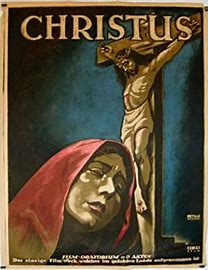 CHRISTUS (1916) – Directed by Giulio Cesare Antamoro, this is a fascinating look at Jesus, from the Angel visiting Mary through his Resurrection and subsequent visit with his Apostles. Christus runs 88 minutes and features some inventive variations on Biblical tableaux. The Star of Bethlehem is depicted as a comet; when Mary finds young Jesus preaching to his teachers His shadow appears as a cross; and Judas gets three visions of the Devil – first urging him on to betray Jesus, then taunting him when he regrets that betrayal, and finally welcoming him into Hell, which opens up under Judas’ swinging corpse.
And purists who blanche at such liberties may take even greater exception to the way this film presents the Devil’s temptations of Christ taking place before He’s even been baptized by John! Antamoro shot this movie in Egypt and couldn’t resist inserting a non-canonical segment that shows off that location filming.
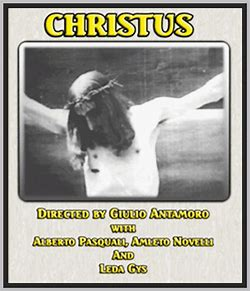 That segment features Jesus practicing His oratorical skills by secretly traveling back to Egypt and preaching to the masses there. This portion provides incredible footage of the Sphinx as it was around 1916, when it was still largely mired in sand before it was fully dug clear in 1925. The pyramids also make an appearance as do other Egyptian monuments as they were at the time of filming.
Christus also depicts the Doubting Thomas episode after the Resurrection, unlike so many other cinematic treatments of Jesus. Disappointingly enough, Alberto Pasquali’s portrayal of the Messiah is lackluster and underplayed.
 CHRIST AMONG MEN (1906) – This obscure Australian film runs 20 minutes and depicts events from Peter’s Three Denials, the Trial, Public Scourging, Journey To Calvary, plus the Death and Resurrection of Jesus. Christ Among Men really wowed audiences. One of the surviving reviews from September 1906 called it “the most remarkable moving picture in existence.”
That same review said “One could easily imagine himself back in Jerusalem, an actual eyewitness of the most stirring and potent incident the world has known.” Another compliment went “no sermon, however powerful, could convey its lessons with a tithe of the directness and force possessed by the pictures.”
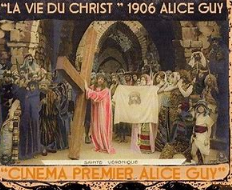 THE BIRTH, THE LIFE AND THE DEATH OF CHRIST (1906) – A French film from female director Alice Guy-Blache, seemingly the ONLY woman directing films from 1896-1906.
This movie has a running time of 33 minutes and presents twenty-five tableaux from the Gospels. Unlike the 1902, 1903 and 1907 Jesus films produced by the French studio Pathe Freres, each of which began with the Virgin Mary being informed by an Angel that she was bearing Jesus, Guy-Blache begins with Mary and Joseph’s arrival in Bethlehem.
She does, however, add an episode not depicted in the earlier film, the Good Samaritan. Oddly, Alice’s movie omits scenes like the Wedding Feast at which Jesus turned water into wine and young Jesus schooling His instructors.
CROWN OF THORNS (1917?) – This was an Italian movie about the Crucifixion. However, only reduction prints of it have survived and I am unable to provide further information at this time.
 CHRIST WALKING ON WATER (1899) – The iconic French filmmaker and silent movie pioneer George Melies made this roughly minute-long short.
A cloud or mist is shown forming on the water’s surface and that mist slowly coalesces into Jesus Christ. Jesus then proceeds to walk on the water. No plot or storyline is involved here, just this brief look at Melies’ usual trailblazing special effects work.
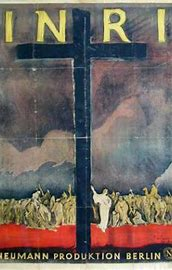 I.N.R.I. (1923) – A German film directed by THE Robert Wiene of 1919’s The Cabinet of Dr. Caligari fame.
And speaking of that earlier work of German Expressionist filmmaking from Wiene, you’ll remember how the director’s original meaning was undercut by added footage showing Dr. Caligari as a mental patient in an insane asylum sharing his delusions with other inmates.
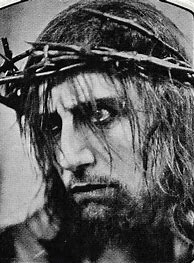 Well, in I.N.R.I. Wiene included his own modern-day framing device in which he delivered an anti-communist message by equating Judas with Anarchists and Bolsheviks. Many disliked the modern-day intrusion on the story of Jesus Christ so for some of its screenings in Germany it was shown with just the scenes depicting the Passion of Christ. Here in 2024 you can still see both versions if you like, with the unedited version running one hour and forty-two minutes.
In its truncated form, the only trace that remains of the full-length I.N.R.I. is the overtly political nature of Judas, whose betrayal of Jesus stems from disappointment that He refuses to lead an armed uprising. Other than that, viewers will get the standard Biblical treatment.
LE CHRIST EN CROIX (1910) – This was a French short film. Other than the fact that it was directed by Louis Feuillade and one of the stars was named Nadette Darson no other information has survived about this lost movie.
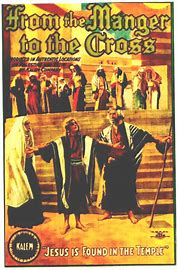 FROM THE MANGER TO THE CROSS (1912) – Another production filmed on location in the Holy Land. This film runs 71 minutes and, as the title indicates, covers crucial moments in the life of Jesus Christ from His birth to His fate on the cross. The actual Resurrection is not dealt with in this work but a later reissue stole Resurrection footage from Christus and tacked it on to the end!
One of the minuses in this movie’s location filming is the intrusion of too many modern buildings showing up in some scenes. Like the later Christus, From the Manger to the Cross catches certain landmarks and monuments in the background. One scene is duplicated and the order of Christ’s miracles is not canonical.
Nothing spectacular in this production, but people who aren’t all that into Silent Films will probably prefer its shorter run time compared to some of the other versions. From the Manger to the Cross was expanded to 99 minutes in 1916 and re-released as Jesus of Nazareth.
 LIFE AND PASSION OF JESUS (1898) – France’s Georges Hatot and the iconic Lumiere Brothers presented this primitive effort which ran just under 11 minutes. Thirteen chapters from the Holy History Catechism come to life on screen.
Most of the expected episodes from the Christ story show up but obviously in pretty streamlined form. Hatot and the Lumieres deserve more love. The fame of Georges Melies too often overshadows them.
 LIFE AND PASSION OF JESUS (1902, 1903, 1907) – French film pioneers the Pathe Brothers (Pathe Freres) released a film of this title in 1902, then added additional footage in 1903 before remaking the production in 1907.
All of these versions can be viewed online and cover the Annunciation through the Crucifixion. The mixing and matching of scenes by Pathes Freres over the years means different run-times are often listed for the “same” versions, from 44 minutes and longer.
The evolving project is sometimes dismissed for consideration as a feature film because of the episodic construction over the years, sometimes using the same footage, sometimes not. Silent film geeks like me debate the issue but casual viewers obviously don’t and can just enjoy watching whichever versions their online search comes up with.
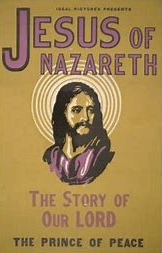 JESUS OF NAZARETH (1928) – Screenwriter Jean Conover got her only known directing job with this low-budget film. Jesus of Nazareth runs 80 minutes and starred Philip Van Loan as Christ and Anna Lehr as the Virgin Mary.
The movie begins with the Annunciation and covers the usual territory from Jesus’ birth to the Flight to Egypt to Teaching his Instructors, to various miracles, the Crucifixion and Resurrection. It’s one of the few Silent Films to depict Jesus walking on the water.
Despite being released when Silent Film production values were at their height, Jesus of Nazareth suffers from its low budget and seems like a crude product of the teens.
 THE KING OF KINGS (1927) – Cecil B. DeMille’s version of the story of Jesus Christ is easily the best-known Silent Film adaptation. The King of Kings has been justifiably praised to the rafters and I can’t really heap any accolades on it that haven’t already been heaped. For newbies to Silent Films I will provide a general summary. The King of Kings can be watched online at plenty of sites, so if my synopsis appeals to you, please check it out. Just be forewarned, it runs 2 hours and 37 minutes.
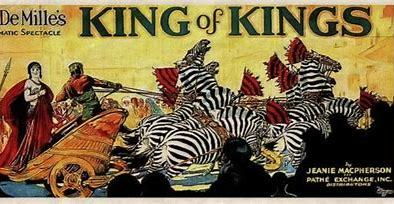
This cinematic milestone starts out with Mary Magdalene being displeased to hear that Judas will be missing her latest party because he has taken to following a charismatic preacher named Jesus. Mary calls for her zebra-drawn chariot and heads off to see what is supposedly so great about this Jesus of Nazareth.
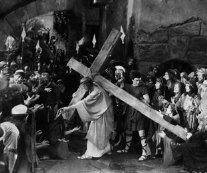 The Magdalene arrives just after Jesus has healed a child and asks Judas what charms this preacher has that top what she has to offer. Judas tells her he is riding Jesus’ coattails to what he assumes is Christ’s goal of political conquest. Jesus drives the Seven Deadly Sins out of Mary in multiple exposure special effects and she becomes a follower, too.
From there Jesus performs healings, raises Lazarus, enters Jerusalem on Palm Sunday and the remaining Passion elements play out from there. After the Resurrection and other events, the final image is of a giant, ghostly Jesus regarding a modern-day metropolis beneath Him.
Among its other distinctions, The King of Kings was the first film to premiere at Grauman’s Chinese Theater. FOR SILENT FILMS ABOUT SAMSON AND DELILAH CLICK HERE.
 Balladeer's Blog
Happy Easter !
Thank you! Same to you!
Thank You ! 🙂
😀
Happy Easter !🕊️
Thanks! Happy Easter to you, too!
Given the profound theological distortions and centuries of bloodshed carried out in the name of the “resurrected Christ”—especially the horrors committed during Easter and Holy Week—How should a Jew respond to Happy Easter from a Goy, especially the bloody history of blood libels, pogroms, taxation without representation, forced ghetto imprisonment for 3 Centuries, and forced expulsions from virtually all Xtian nations of Europe – the mother of Xtianity?
Intriguing.
Hi balladeer how was your day today?
It was pretty good. How was yours?
Penned what I consider an excellent refutation of the historical argument for JeZeus. 🙂
Wow! Pretty iconoclastic for an Easter Sunday post!
thank you
You’re welcome.
From Yeroboam to Paul: Legal Innovations and Covenant Abandonment.
Most scholars date Luke–Acts to 80–90 CE, though some push it even later (up to 110 CE) during the reign of Domitian. Possibly written in Antioch (Syria) or Asia Minor (modern-day Turkey). Some scholars even propose Rome itself. This would explain the connection between Luke and Mark.
The key to understanding how Luke reworks Mark and positions his narrative within the post-Temple, Roman imperial world. Luke doesn’t just “echo” Mark—he copies large portions of it (often verbatim in Greek), but modifies the tone, theological emphasis, and political implications. Luke penned a more polished, philosophical, and Roman-friendly gospel.
I hadn’t heard that before.
In Hebrew Yeshiva talk, its called a chiddush, a novel idea.
I didn’t know that.
Here’s my latest rant on the UN
UN Resolutions like 242, 338, 446, and 2334 reflect an imperial logic that attempts to redefine Jewish sovereignty not on the basis of national independence, but on external moral frameworks crafted by global elites. Much like the Church tried to reassert its medieval authority over populations moving toward emancipation and civic equality, the post-1967 international community—through the UN—often acts as a neo-medieval power bloc, trying to re-feudalize Jewish national rights. Through the propaganda of “International Law” the UN seeks to redefine the Jewish People as Feudal subjects of the UN, mantain the protectorate status, and not acknowledge Israel as part of the Middle East voting block of “nations”. A political Apartheid policy directed against Israeli Jews.
I understand!
Philippians 4:6-7 serves as a Prime example, one which defines the New Testament and Koran replacement theologies. The great US vs. Them Divide. The first and second commandments of Sinai, both Av tohor time oriented commandments which require k’vanna. Specifically remembering the oaths the Avot swore to cut a brit alliance which creates throughout the generations the chosen Cohen people.
Interesting take.
Happy Easter 🕊️🕊️🕊️
Thank you! You too!
🙏🌹🙏
😀
Cool post! Interested in INRI, as The Cabinet of Dr Caligari is on my to watch list for silent movies! Happy Easter 🐰😊
Happy Easter to you, too! Glad you’re back! If you do watch it I hope you enjoy INRI and Cabinet of Dr. Caligari, too!
Happy Easter!
haha, sunshine we have plenty of – we have a drought going.
Oh oh! Hang in there! Ha!
Amen 🙏🏼🤗 He Is Risen 🙏🏼🤗
Happy and Blessed Easter
Thank you very much and the same to you and yours!
Passion of Joan of Arc (’28) is an awesome film. Also, noticed one of your other guests mentioned Cabinet of Dr Caligari which is not just a fave silent film but an all-time fave film! Caligari like Nosferatu, The Golem and Phantom Carriage are some good and creepy films! Hope you’re enjoying the Easter weekend! I’ll see ya around the Great River Internet. As always, take care, be cool and peace out…
Always great to hear from you, Cap’n! We go back a long way at this point! Happy Easter and peace to you, too!
Yes sir we do! Although time is squirrelly thing these days! I can’t even guess how long I’ve read your movie posts! I’ll be around more often now as I am going to start uploading aka blogging my various musings. So, if you happen to see my posts and have helpful criticism please by all means do so. It’s so strange to think over the years how we communicate with others, having never met face to face, and yet call each other friend! Take care my friend!
Glad to hear you’ll be posting more of your own stuff! I think it’s been about 12 or 13 years or so since we started commenting to each other and you’re right, it’s a friendship! Take care!
Happy Easter! Great posts as always. Have never heard of these films but they all sound interesting. I enjoy watching films about religion. I have always felt strong association with my religious identity. The movies you listed here brought to mind the recent Oscar-winning film “Conclave”. It tells the story of a religious pope that is under pressure to organize an election in his church. Ralph Fiennes is amazing in a role for which he was nominated for an Oscar. While it’s not about Jesus, it shares the strong religious themes with the movies you discussed here.
Here’s why I recommend it strongly:
Thank you! I should watch Conclave.
Happy Easter!
Happy Easter to you as well!
Excellent! Happy Easter to you as well! I wish you and your loved ones a wonderful holiday.
Thank you very much! I wish you the same!