
While we’re still in that “Christmas into New Year’s” week here’s a look at a terrific seasonal silent movie.
 SANTA CLAUS (1925) – This 28 minute and 44 second movie was directed by Frank Kleinschmidt, the famous explorer and documentary filmmaker. Santa Claus has an irresistible charm and with its short running time might be the ideal way of introducing silent films to modern day viewers who are unfamiliar with them.
Kleinschmidt filmed this project in Alaska, so viewers get plenty of snowy scenery plus animal life from the far north. The movie presents some very clever lore surrounding Santa and his activities.
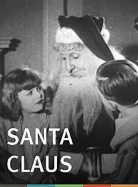 Santa Claus opens with Saint Nick himself welcoming us with arms spread wide. The story proper gets underway as we join two children – a brother and sister – who sneak out of their beds overnight to wait for Santa in their living room.
That right jolly old elf eventually materializes in the children’s home like he’s “beamed down” on Star Trek. The boy and girl hug Santa and want him to explain what he does the rest of the year.
Saint Nick does so to reward the siblings over an act of kindness he saw them commit once when he was watching them through his large, long telescope in the north.
Some cruel children on a city street were roughing up a blind beggar to steal his dog and the money he had raised that day. The brother fought off the street punks while the sister picked up the blind man’s money which got scattered on the sidewalk during the fray.
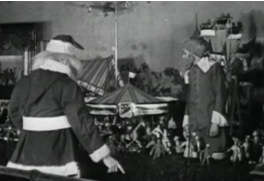 The rest of the short features fun, imaginative depictions of Santa’s life the other 364 days of the year accompanied by dialogue boards of Santa’s narration.
Kris Kringle explains that, instead of the North Pole, he lives in the Land of Winter, on the rim of the Polar Sea. The accompanying footage depicts Alaskan glaciers plus snowy hills and fields for as far as the eye can see.
Next, our title character explains that his border is guarded by “sea goblins”, which the film footage shows us are really walruses – a large number of walruses, in fact. A polar bear is described by Santa as “the Monarch of the Arctic” who patrols his domain as we see wonderful video of the animal meandering around and even swimming at one point.
The children learn that blizzards in Santa’s territory are caused by Layluk the North Wind shaking snow off his blankets, causing the intense wind and snowfall. Santa Claus is shown driving his sleigh (on the ground) through the storm, pulled by six reindeer. (I’m an Inuit mythology geek so I was wishing they had instead shown the more frequent “cause” of snow – the god Sila carving walrus tusks with the shavings falling on the mortal world as snow.)
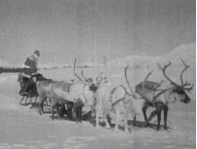 Eventually, our hero and his reindeer arrive back at his Castle of Snow, a nicely constructed place formed of countless squares of snow-bricks. A few elves greet Santa and see to the deer while Claus himself goes to the castle’s workshop to check on the toys being made.
More little people show Santa how things are going amid spectacular footage of vintage toys that collectors would give their proverbial eyeteeth for, including mobile ones like Ferris Wheels, model trains and cars that children can sit in and drive around.
There are so many toys shown that the scene should be checked out rather than just described. Like so many surviving silent films, Santa Claus can be viewed for free online.
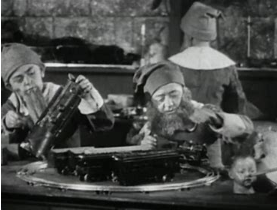 We see Santa with some elfin aides keeping records on who’s naughty and who’s nice based on Saint Nick’s telescopic observations. All the while, toy construction continues and viewers meet one “elf” who is as tall as Santa, plus a toy train expert named Tweedeedee. (No, not Tweedledee, Tweedeedee.)
As the childrens’ Q&A with Santa Claus continues, he reveals the enormous size of his reindeer herds. This “Santa as rancher” portion also features Kris Kringle’s problems getting the ornery Donner used to the harness. We also see Santa’s flashback about saving the small, trembling calf that he named Blitzen.
At the end of each hard day, Santa relaxes with a glass of reindeer milk, and we are shown Inuit ranch hands of our hero milking the deer and handing him a warm glass straight out of the teat.
Next, we ride along with Santa on his regular Saturday visits to Inuit children of Alaska, whose proximity to Saint Nick means they get to meet with him in person and tell him what they want for Christmas.
Brief footage of the annual summit between Santa Claus and the Easter Bunny (an actual rabbit) is included as the pair discuss the behavior of deserving children around the world. We also learn that our title character uses Ptarmigans to deliver letters from children to him.
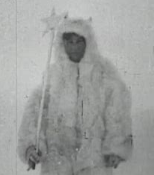 Saint Nick tells the children that his closest friend is Jack Frost, played by an Inuit man in a body-length white fur coat holding a wand with a star-shaped tip. Santa calls Jack the greatest artist in the world and we get some fun footage of Mr. Frost making some of his dazzling designs with his wand.
At last, on Christmas Eve itself, the Warder at the Castle of Snow blows his silver trumpet and the elves – and gnomes we’re told this time – hurry to load up Santa’s sleigh.
Then, our man settles into his sleigh and takes off – always on the ground – pulled by his reindeer which number six in some shots and only four in others, but NEVER the now-canonical eight. And obviously, Rudolph the Red-Nosed Reindeer did not come along until 1939.
We are shown flashback footage of how an evil elf named Hard Times sometimes succeeds in sabotaging or upsetting Santa’s sleigh before he can even leave the north, thus ruining Christmas for countless children. I found this to be a nice touch to justify less-than-bountiful Christmases to children.
After that, viewers see that another perk of living in the far north is that Santa and his reindeer first visit all the Inuit children in their igloo homes to give them their gifts. From there he begins his deliveries to the rest of the world by hitting Nome, Alaska.
 Santa finishes his Christmas Eve journey after overcoming some obstacles caused by uncared-for chimneys, then at last returns to his Castle of Snow in the Land of Winter, where tiny female fairies sing him to sleep. The dancing fairies are depicted in a good special effects shot.
NOTE: Like the special effects for Tinkerbelle in the previous year’s Peter Pan movie, we see proof that the problems that 1950s schlock films had depicting really small or really large characters interacting with “normal-sized” objects was due to low budgets, not lack of special effects technology.
Santa Claus is, in my opinion, a great silent short to share with the kids. Santa may be a bit thinner than we’re used to in this film, but the overall production is a great look at some alternate Santa lore.
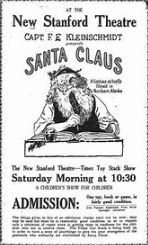
And since the poster above right says the movie is “a children’s show for children” I’m assuming there was a children’s show for the elderly later in the day, but I’m kind of weird.
 Balladeer's Blog
Pingback: SANTA CLAUS (1925) A SILENT SHORT IDEAL FOR CHILDREN – El Noticiero de Alvarez Galloso
Logged, thank you sir!
I have not seen it but I think it was one of the best movies for kids. Beautiful story well shared 💐
Thank you very much for saying so!
🥰
😀
😱
Ha! You’re so funny!
🙉🙉🙊🙈
You proved it again!
😆😆
Ha!
Wishing you a very happy new year 🎊
Thank you! The same to you!
🖐️🖐️🖐️
😀 😀 😀
😂😂😂
There ya go!
Great posts as always. I have never heard of this short film before but it does sound very promising to me. While I don’t celebrate Christmas, I do love movies that have been made about the season. There are several great movies about Christmas worth seeing that this short film reminded me of. For instance, it brought to mind the film “Arthur Christmas”. Released in 2011, Sarah Smith’s movie offered an engaging animated celebration of Christmas. Another great film celebrating Santa Claus that children would enjoy. It’s one of my favourite films of 2011.
Here’s why I recommend it highly:
I really appreciate it, thank you!
A silent film with a wonderful educational and humanitarian story. How it motivates children to do good and adults as well. Thank you very much for sharing. My best wishes and prayers for you Balladeer
Thanks so much! I’m happy to share it! Best wishes and prayers for you too!
🤗🙋🏼♀️
😀
🙏🏻🙋🏼♀️
😀