
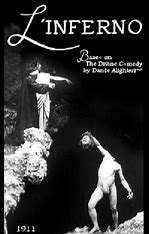
 L’INFERNO (1911) – This 71-minute movie was an adaptation of Dante’s epic poem Inferno, one-third of his Divine Comedy along with Purgatorio and Paradiso. It was also Italy’s first feature-length film, beating Cabiria to theaters by three years.
Three directors collaborated on this production – Francesco Bertolini, Giuseppe de Liguoro and Adolfo Padovan. Obviously, L’Inferno is a very condensed version of Dante’s work but the special effects are impressive for the time period.
Even if I wasn’t a silent film geek aspects of this movie would have stood out to me. First, it was made in Italy toward the end of the Belle Epoch, lending it a certain poignance as the global conflict was approaching an oblivious world.
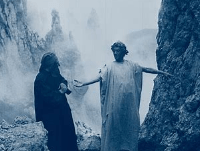 Second, L’Inferno has a certain grandeur from being filmed in Italy itself, the home of Dante Alighieri and his guide through Hell, Virgil. And third, nearly all of the footage set in the realm of the damned was filmed amid extinct and semi-extinct volcanoes in Italy, adding immeasurably to the infernal atmosphere.
The story starts out faithfully, with Dante (Salvatore Papa) having lost his way in life and encountering the allegorical Three Beasts in a forest. From Heaven, Dante’s late love Beatrice sees the poet’s peril and visits the soul of the late pagan poet Virgil (Arturo Pirovano) to ask him to come to Dante’s aide.
The ghostly Virgil appears to Alighieri and leads him away from the Three Beasts, explaining the journey ahead. From there it’s on to the entranceway of Hell with its infamous “Here the way to eternal sorrow” greeting which ends after several lines with the immortal words “Abandon all hope, ye who enter here.”
Virgil introduces Dante to the souls of the other Virtuous Pagans, who do not suffer but because they lived and died before Jesus and were never baptized they know they can never enter Heaven. After leaving Homer, Julius Caesar and the others behind, Dante and Virgil move on to Minos, whom Alighieri depicted as one of the judges in Hell.
Next, Virgil leads Dante into the Circle of Hell reserved for souls whose most prominent sin was lust. These souls suffer by being incessantly blown around by fierce winds, symbolic of how they allowed their carnal hunger to sweep them before it in life.
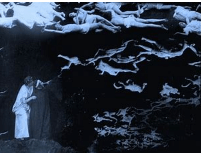 The special effects here aren’t the greatest, as the damned seem to be floating around rather than being blown by fierce winds. I’m not sure if viewers who weren’t familiar with the source material would understand what was happening. At any rate, the process shots in this Circle of Hell are better than many from cheap 1950s movies!
Another element preserved from Alighieri’s poem is the bit with the damned lovers Francesca and Paolo. Their suffering is a tiny bit lessened by at least getting to share their damnation with the one they love. It’s all in keeping with Dante’s theme of Love being the force that moves the sun and all the stars. Lust is the sin closest to approximating love, so these souls suffer the least.
We even get a flashback reenactment of Francesca and Paolo being moved to consummate their love while reading about Lancelot and Guinevere.
The excellent treatment given these first few portions of Hell stands out compared to the rest of the movie. After this, L’Inferno gets very inconsistent with how much time it devotes to the remaining circles AND with which interactions it preserves between Dante and the damned souls.
If the movie devoted as much time and patience the rest of the way as it did to the opening segments it would be even greater than it is. However, we only get scattershot conversations with no rhyme or reason and flashbacks that are often VERY uncinematic, which I grant you is because of this film’s status as a pioneering production just feeling its way.
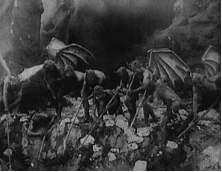 In the comparative rush to get to the lowest Circle of Hell, there are still highlights. The winged devils who oversee the torment of the damned are acceptably presented and probably blew away 1911 audiences.
In the Circle of the Gluttons, Dante converses with a fellow citizen of Florence when he was alive – Ciaccio. In keeping with the poet’s fusion of Christian and Pagan elements, figures from mythology are among the demons of Hell, like Pluto, Cerberus, the Furies and Antaeus, whose segment is unintentionally funny.
On the minus side, unfortunately, is the way that the period clothing on Dante often makes him look like he’s Ebenezer Scrooge in his nightgown and cap, with Virgil as one of the Christmas Spirits. It’s a minor thing but it made me laugh a few times.
L’Inferno retains only ONE of Dante’s fainting spells during the journey through Hell, so that’s on the plus side. On the other hand, I was very disappointed with the scene in which an Angel is sent by God to force open the gates to Hell’s Inner Circles when the demons put up some resistance. I was looking forward to it, but it’s handled in the blandest, least memorable blink-and-you’ll-miss-it way.
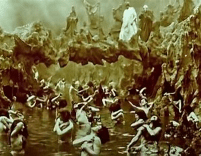 I also missed the poem’s attention to the lingering damage that Jesus wreaked on Hell when he invaded it after his Crucifixion. I understand the need to cut any reference to Malebolge further on to avoid having the movie be three hours long, but aspects of the Harrowing of Hell were left out in favor of monotonous flashbacks to the damned when they were alive.
The special effects are barely Melies-level in the Circle reserved for thieves as they are bitten by creatures that they then transform into. Even for 1911 this bit was disappointing.
The Forest of Suicides is well done for the time period as those damned souls slowly and painfully transform into trees which infernal wildlife chew on and worse. The Circle with atheists and heretics roasting in stone coffins went on a bit too long, though, eating up time that could have been better spent elsewhere.
Muhammad is shown in Hell with his chest torn open and we get sufficient time devoted to him and his suffering. Unfortunately, the film prominently presents Bertran de Born beheaded, walking around his Circle of Hell carrying his head in front of him but never mentions who he is. This was either laziness or an assumption that audiences knew who he was and why he was carrying his head. Odd.
The 9th and lowest Circle of Hell is depicted in all the icy dreadfulness that Dante described it. As Virgil leads Dante across the frozen-over sea with suffering souls mired in it up to their necks, we get the ugly tableau of Count Ugolino forever gnawing on the head and neck of his fellow sufferer imprisoned in the ice – Archbishop Ruggieri, the man who starved him and his sons to death.
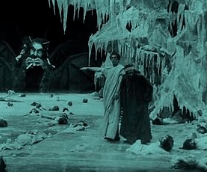 And at the very center of Hell we get a very good depiction of Lucifer trapped in the ice up to his torso. This was one of my favorite bits of business in the Inferno. Rather than present Satan/ Lucifer as if he is some grand monarch ruling over Hell, he is instead shown to be defeated and pathetic, trapped and unable to move no matter how hard he tries. I prefer this to any other classical depictions of Satan.
The special effects remain decent for the way Lucifer’s three giant heads each chew on a different soul damned for betrayal. L’Inferno is again faithful to the written work by having Lucifer’s central head chewing on Judas Iscariot with only his legs dangling from its mouth twitching in agony.
The other two heads chew on Brutus and Cassius but with their lower bodies in the mouths and their heads and arms hanging out as they suffer. I always roll my eyes at the thought of having two betrayers of Caesar in Lucifer’s mouths as if that betrayal is close to the same level as Judas’ treachery.
At any rate, the huge Lucifer gnawing on Judas, Brutus and Cassius must have horrified the 1911 theater-goers. (Partly because they wouldn’t have been distracted by how much this Lucifer looks like Jack Elam.) From there Virgil leads Dante through the exit of Hell and back up to the surface.
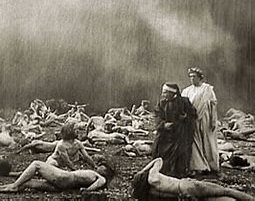 Sadly, there were no sequels to L’Inferno, so we never got to see what these directors would have done with the two poets traveling up the Mountain of Purgatory, and Beatrice’s shepherding of Dante through Heaven.
Obviously, as a silent movie geek I’m more charitable toward this film’s shortcomings than others would probably be. Even so, I would imagine that many non-fans of the silent movie era would find L’Inferno worth at least one watch.
FOR TWENTY-FOUR CLASSIC SILENT HORROR FILMS CLICK HERE.
 Balladeer's Blog
Wonderful!
Thank you very much!
Great introduction! I didn’t know about this masterwork. Thank you. 🙏🤙
Glad to do it! Thank YOU!
Another excellent review. I’m actually not familiar with silent movies at all but this one sounds intriguing to me. The concept behind the film reminds me a lot of the film “Gladiator”. Ridley Scott’s Oscar-winning epic capture the lives of gladiators fighting to death in Ancient Rome. I think both movies share quite a few similarities such their Italian setting, hero’s journey and medieval costumes. The main difference is that one is silent while the other is in sound. So, I’ll keep “L’Inferno” on my watchlist. Thanks for the recommendation.
Here’s why I loved “Gladiator”:
It is one of the many, many silent films that are terrific. On my way to your Gladiator review right now.