
 THE MYSTERY OF THE LEAPING FISH (1916) – Regular readers of Balladeer’s Blog may remember that I’m a geek for Silent Movies. Last week’s look at Douglas Fairbanks’ swashbuckler films from the silent era was so well received that I decided to post a review of Doug’s often overlooked “drug comedy.”
In this roughly 25-minute comedy short, Fairbanks played a detective named Coke Ennyday as a reference to Sherlock Holmes’ addiction to injections of cocaine in his original stories. Yes, I’m serious.
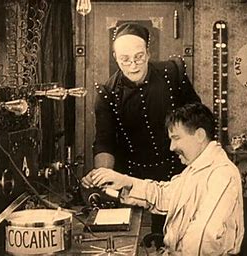 The short’s comedic approach to cocaine, opium and more demonstrates the “anything goes” attitude before film codes were implemented to ban certain content from the big screen. In the pre-internet years, The Mystery of the Leaping Fish was a film that people refused to believe existed until you had them sit down and watch it with you.
The notion of a theatrical comedy about drug use in 1916 seemed utterly impossible to them, and you could win a fair amount of bets with skeptics who insisted there is no way such a film would have been allowed to be made. The fact that it was written by THE Tod Browning shocked them, too.
THE STORY:
We viewers meet an almost unrecognizable Douglas Fairbanks as Coke Ennyday, a so-called “scientific detective” of great renown whose aid is often requested by law enforcement from around the country. He sits in a chair smoking his trademark pipe in his laboratory/ office.
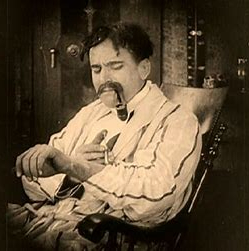 Every few minutes, Coke grows languid and injects himself with some of Sherlock Holmes’ notorious Seven Percent Solution of cocaine. The detective immediately perks up and acts deliriously happy until that injection wears off and he uses another needle from his bandolier of needles to inject himself again.
The overall effect of Doug doing physical comedy while supposedly high is like watching a silent screen version of Mark Blankfield’s drugged-out character the Pharmacist from the comedy show Fridays. (The guy who was so far gone he could barely perform mundane tasks, all while reassuring himself “I can handle it, I can handle it.”)
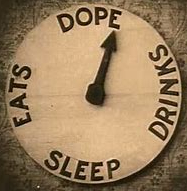 Coke Ennyday even has a makeshift “clock” on his wall that marks off four divisions of time labeled EATS, DRINKS, SLEEP and DOPE. His assistant is not a Dr. Watson pastiche but a man dressed like an old commissionaire (?) whose duties include periodically mixing up a big batch of what I guess is supposed to be morphine and then injecting a HUGE needle-full of it under Coke’s tongue.
Soon, Ennyday receives a request from the police to investigate a suspicious man who is hanging around the local beach spending a lot of money but having no visible means of support. Donning a comedic checkerboard design version of Sherlock Holmes’ jacket and deerstalker cap, Coke has his sidekick drive along with him to the scene.
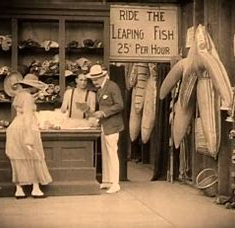 The Leaping Fish of the title are novelty flotation devices made to look like cartoonish fish. Apparently such items were big among beachgoers in 1916 because they are depicted as the must-have item for seaside frolicking.
Bessie Love portrays the girl who inflates each of the dozens of Leaping Fish being sold by blowing them up herself. She is even called the fish blower and I have no idea if sexual slang at the time made that label and undertaking a built-in risqué joke like they would be today.
At any rate, the shady character that Coke was asked to investigate isn’t just rolling in money (literally, in a sight gag) but he has goons who accompany him everywhere. The villain and his thugs lean on the owner of the shop that rents out Leaping Fish to make Bessie Love’s character agree to a forced marriage. They even rough up Bessie herself to make her cooperate.
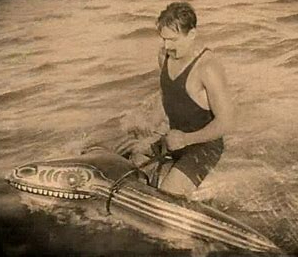 Fairbanks arrives on the beach and begins his investigation. Doug gets to use his always impressive athletic abilities to do what we today would call “stoner humor” as the high detective reels and stumbles his way through several scenes, even riding a Leaping Fish a few times. (And injecting it with cocaine, which simply causes it to sink from the needle puncture.)
In the end, Coke Ennyday lucks into the resolution of the case. The shady Big Spender runs a drug ring which smuggles opium in through the local beach, using several Leaping Fish to conceal his shipments. Naturally, Coke can’t resist sampling some of the opium for even more drug humor.
Doug rounds up and subdues the bad guys, with the feisty Bessie Love beating up one of them herself. Along the way to the ultimate victory of the good guys, we get comical fight scenes like Coke injecting the villains with cocaine as well as blowing powdered cocaine in their faces.
 The villains have nowhere near Coke Ennyday’s tolerance for narcotics and are easily overcome. Coke and Bessie embrace for the “good guy gets the girl” ending.
THEN – we get a brief “meta” finale in which we see that the story was a pitch meeting among Fairbanks, Love and some studio bigshots. (Insert your own “Super easy, barely an inconvenience!” and “Meta endings from the Silent Movie era are TIGHT!” jokes if you want.)
The studio execs reject the idea and tell Doug to just stick to acting.
The Mystery of the Leaping Fish is not at all typical of Fairbanks’ comedies before he switched to swashbuckling, but the bizarre premise never fails to make an impression on disbelieving modern day viewers.
 Balladeer's Blog
Reblogged this on El Noticiero de Alvarez Galloso.
Thank you, sir!
Anytime
😀
Yes
You know it!
Yes
😀
👌👌
Thank you very much!
You are very welcome ☺️
😀
🧟🧟🥶🥶🥶
Very colorful!
😍😍😍😍🤭🤭🤭
You are too much!
🤨🤨🤨🤨🤨🤨🤨😁😁😁
You proved it again!
🤥🤥🤥🤥🤥😏😏😏😏😏😶🌫️😶🌫️😶🌫️😶🌫️🤑🤑🤑😉😉
Wow!
🤨🤨🤨🤨
You are a character!
😛😛😛
%%%
🤔🤔🤔🤔🤔
I can’t compete with your emojis so I tried something else.
Ha ha ha 🤕🤕🤕
😀
🥲🥲🥲🥲
%%%%
¶¶¶¶¶¶¶¶¶
@@@@@@@@@@
££££££££
()()()()()()
🥦🥦🥦
“I found the writing style to be engaging and easy to follow. It kept me interested throughout.”
Hey please subscribe my blog support view ,likes thanks…!!!
💙💙💙
Thanks!
This sounds hysterical! “I spent the last few years building up an immunity to iocane powder” would seem to apply here …
Ha! It certainly would!
😀 😀 😀
Thank you!
You are welcome! 😀
😀
very very nice
Thank you.