
Balladeer’s Blog resumes its examination of the macabre 1868 French language work The Songs of Maldoror. WARNING: This part is not for the weak of stomach.
A THRONE MADE OF EXCREMENT AND GOLD
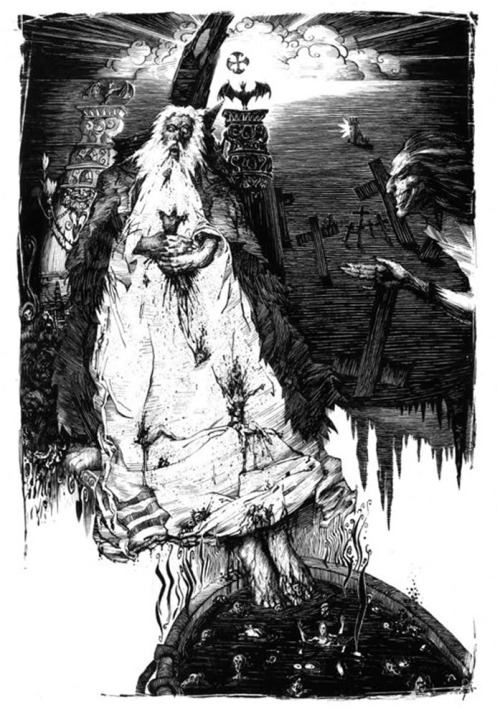 This stanza starts out with the supernatural being Maldoror describing the visceral reaction he has to the sound of a human voice singing. His eyes are filled with the flame of his loathing and his ears feel assaulted as if by cannon fire. By comparison when he hears the sounds of musical instruments unaccompanied by voices he feels ineffably ecstatic.
Those observations provide a segue-way into yet ANOTHER contradictory account of Maldoror’s past. I will say it again: Maldoror lies, then lies about the lies.
This time around our malevolent main character tells us he was born deaf and didn’t learn to speak for several years and even then it was with great difficulty. He was beautiful in his youth (or was born with his horrific facial scars if you believe his previous accounts) and that beauty was admired by everyone who encountered him.
Despite his deafness Maldoror’s overwhelming intellect and the angelic natured hinted at in his eyes soon brought him an almost religious reverence from other people. Eventually the figure grew weary of life among his human inferiors. As he became more and more aware of his greatness compared with other earthly life forms he began to contemplate the skies above.
Flying ever higher Maldoror entered Heaven itself and came face to face with the Creator. The deity, robed in unlaundered hospital sheets filthy with disease, dirt, semen, blood and other bodily secretions sat upon a throne made out of excrement and gold.
Maldoror tells us God gleamed with the pride of an idiot and as the gigantic figure sat there he chewed gluttonously on the decaying corpse of a human being that he held in one hand. Like a ritual, the deity would hold the body he was devouring up to his eyes to scrutinize it, then would sniff it and then chew off another morsel of flesh.
God’s clawed feet soaked in a lake of boiling blood at the base of his throne. Human beings were trying to avoid drowning in the boiling blood, suffering from the temperature and struggling to get an occassional gasp of air before one of God’s clawed feet would viciously kick them back under the surface. Maldoror compared their writhing to the slithering of tape-worms in a chamberpot.
 Whenever the gluttonous deity had finished eating the human body in his hand one of his clawed feet would pluck another victim out of what Maldoror describes as “the delicious sauce” that his feet soak in. Grabbing the screaming figure from his claw with his hand God would devour it like he had the previous body – first the head, then the legs, the arms and the trunk – bones and all.
Periodically the deity would taunt its victims by screaming down at them “I created you! Hence I have the right to do what I will with you! You have done me no harm I admit. I make you suffer for my own pleasure.” Then God would resume his neverending feast.
Noting that the Creator’s beard was spattered with human brains from his meal, Maldoror’s mouth began to water and he reflected on his own fondness for tasty, fresh human brains. Continuing to watch the grisly spectacle before him, our vile protagonist nearly falls to his knees overcome with emotion but all three times he regains his balance before genuflecting.
Maldoror feels his anger over the tableau before him rising in him like lava in a volcano until at last it erupts in the form of a long scream and this scream becomes the first thing that he (in this version of his past) ever hears. (Kind of a Tommy feel to it, almost.) Tying this in with the beginning of the stanza our narrator tells us this is why he loathes human voices so much.
Even though his observation of humanity’s cruelty has tempered his disgust with the Creator, Maldoror still maintains that the sound of a human voice reminds him of his own scream that day, which reminds him of his epiphany about God’s “true” nature, which fills him with pain, which justifies his torturing and murdering his own victims. He warns humanity to keep silent around him for their own good.
He further reflects that the sound of an avalanche killing its victims, or a lioness mourning its young after its mate devours them or an octopus singing of its victories over its prey are all more beautiful than the sound of the human voice. +++
One of the things I find most interesting about this section of The Songs of Maldoror is the way it makes clear that it is our main character’s destiny to be the way he is. Even in a world where he is born beautiful instead of ugly, and admired instead of ostracized, we see the cycle repeating itself. Our protagonist will, after noting what he perceives as his own superiority and after observing man’s inhumanity to man and ESPECIALLY after divining what he feels is the “real” nature of God, will inevitably discover “his inner Maldoror” as it were.
Given the metaphorical and metaphysical chess match that is played between Maldoror and God it’s tempting to look at this stanza as another strategy employed by the Creator against his foe. In The Lash of Lightning Across My Brow we were reminded that even if God inflicts enough damage on Maldoror to kill him Lucifer will simply refuse to take him to Hell out of fear that Maldoror will overthrow him. And so, Maldoror’s soul/malign essence/ alien intellect/ whatever remains in his physical form by default.
Following this train of thought we can choose to see A Throne Made of Excrement and Gold as that alternate strategy I mentioned. Thought of this way even if God doesn’t destroy Maldoror’s physical form but instead had simply forced him to reincarnate as a beautiful, revered figure instead of an ugly and reviled one our main character would STILL wind up “seeing through” God’s universe, taking us back to square one in their conflict.
(The above would also put us back in a Sethian Gnostic view of Ducasse’s work.)
For readers who – conditioned by television and other forms of pulp fiction – like to see things in terms of overall continuity, think of this stanza this way: God “warped reality” to see if he could prevent Maldoror from becoming his arch foe by stuffing our main character’s soul/ malign essence/ alien intellect/ whatever into matter in the form of a beautiful child. Unfortunately for this strategy the supernatural being eventually sees through this “Matrix” as well and discovers his inner Maldoror, as I called it above.
And as always, it can just mean nothing at all since it’s a work of art and not reality.
I WILL RESUME THIS LOOK AT THE SONGS OF MALDOROR SOON. CHECK BACK ONCE OR TWICE A WEEK FOR NEW INSTALLMENTS.
FOR PART ONE CLICK HERE: https://glitternight.com/2015/02/28/maldoror-a-neglected-masterpiece-of-surreal-horror/
FOR OTHER PARTS OF MALDOROR CLICK HERE: https://glitternight.com/category/maldoror/
© Edward Wozniak and Balladeer’s Blog, 2015. Unauthorized use and/or duplication of this material without express and written permission from this blog’s author and/or owner is strictly prohibited. Excerpts and links may be used, provided that full and clear credit is given to Edward Wozniak and Balladeer’s Blog with appropriate and specific direction to the original content.
 Balladeer's Blog
A Maldoror video game would be awesome!
Hey, why not?
Too creepy too scary too evil.
I certainly understand how someone might feel that way!
Psychotic and Satanic.
Attorneys at Law?
I didn’t need to eat for the next year or so anyway.
Ha! I see.
Creepy and blasphemous.
I understand.