MULWINDA – The goddess who protected the royal clan. Each of the 46 clans of Bunyoro had its own protective deity. They each also had their own totem-name which could be an animal, e.g. Kiroko (hippopotamus) or a plant, e.g. Bulo (millet), a utensil, e.g. Kaibo (basket), or a part of the body, e.g. Amara (stomach). No one was Continue reading
Tag Archives: mythology
MYTHOLOGY – THE BUNYORO GODDESS MULWINDA
Filed under Mythology
THE TOP NINE DEITIES IN MUSCOGEE CREEK MYTHOLOGY
Balladeer’s Blog presents its latest examination of a neglected pantheon of deities. In the Americas alone I have previously written about gods and goddesses of the Navajo, Inuit, Hawaiians, Choctaw, Iroquois and Aztecs.
Those familiar with the Creek people are aware of how many different sub-classifications there are, so I will remind readers that this article deals only with the deities of the Muscogee Creek. In the future I will eventually do examinations of the gods of the Tuckabatchee, Yuchi, Tuskegee and others generally regarded as Creek.
9. NEREHVURESSE – The Muscogee Creek moon goddess. She was the wife of the sun god and, as with the moon goddess of the Choctaw people, it was said that she spent moonless nights having sexual relations with her husband. The differing phases of the moon were explained as Nerehvuresse covering her face in varying degrees of embarrassment over Continue reading
Filed under Mythology
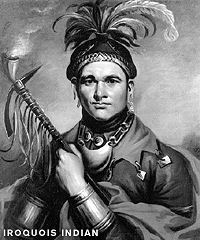
SIX MORE IROQUOIS DEITIES
The reaction to my latest look at a neglected pantheon of deities has been through the roof! I’ll soon be examining an epic myth from Iroquois mythology but in the meantime here’s a look at six more deities of the various tribes in the Iroquois Confederation.
6. SHAGODIAQDANE – The Iroquois goddess of the summer. She was depicted as an old woman sitting cross-legged in the forest and she sang a song that only birds could hear and their own chirping and singing was considered to be their response to the goddess’ song. As summer started to turn into autumn the entourage of the evil winter god Tawiskaron began to return. First the Continue reading
Filed under Mythology
MYTHOLOGY: THE INUIT DEITY KALLAK
KALLAK – Kallak was the first-born son of the Inuit Earth goddess Nunam and the wind and weather god Sila. When he came of age Nunam mated with Kallak and the two had a daughter. When that daughter came of age Kallak mated with her and the pair produced all of the original Inuit people.
This myth is at odds with another myth which claims that Kallak and his daughter’s union produced the race of giants who warred with Sila and were killed by him in the end. Nunam brought the slain giants (who are her brothers, not her children in some versions) back to life. Sila insisted they be punished however, and shrunk the giants, who became the Ishigaq, the one meter tall Inuit version of elves.
Still another Inuit tradition says that Continue reading
Filed under Mythology
MYTHOLOGY: TWO MORE CHOCTAW DEITIES
As a followup to my earlier list of The Top 12 Deities in Choctaw Mythology here’s a look at two additional figures from that same pantheon.
IMMA – The Choctaw goddess of war. Unlike most war deities Imma did not participate in actual combat herself, but was the idealized woman to whom Choctaw warriors dedicated all their battlefield heroics. She was the most beautiful goddess in the Choctaw pantheon and, like her husband, the hunting god Hatakachafa, Imma was originally a mortal raised to godhood in the afterlife by the supreme deity Nanishta. He did this after Imma died from grief after Hatakachafa was given up for dead during his year-long struggle to return home to her. When Imma’s true love at last returned home astride his giant white wolf and learned she was dead he too died of grief. The two were reunited in the afterlife as husband and wife.
OKLATABAHSHIH – The patron god of Continue reading
Filed under Mythology
SHINTO GODDESS: FUNADAMA
FUNADAMA – Shinto goddess of ships and boats. Like Toyota she was a daughter of the sea god Watatsumi. (Remember, I mostly go by the Kojiki and the Nihongi, the earliest written accounts of Shinto myths. Those two books refer to the humanoid Watatsumi as the god of the sea. Ryujin the dragon god of the sea came from later traditions. )
Sailors, fishermen and all travelers by sea, river or lake would pray to her Funadama for protection and there is still a Continue reading
Filed under Mythology
SHINTO GODS: IZANAGI AND IZANAMI
IZANAGI AND IZANAMI – These two parents of most of the rest of the deities in Shinto myths always need to be mentioned in one entry. Before life on Earth existed the two of them stood on Ukihashi, the floating bridge between Earth and Takamagahara, the High Plain of Heaven where the gods lived. From there they stirred the primordial juices here on Earth with a jeweled spear and created the Japanese islands and a shrine still stands on Onokoro, the tiny island that legend held was the first landmass created by the duo.
Their first coupling spawned either one slug-like creature or all of the demons and monsters in Shinto mythology (accounts vary). Beginning with their second mating the woman, Izanami, began giving birth to Continue reading
Filed under Mythology
SHINTO MYTHS: HACHIMAN, THE GOD OF WAR
HACHIMAN – The Shinto god of war. As Emperor Ojin he was born to the Empress Jingo, who was said to be carrying the child within her womb for three years while she finished successfully conducting her late husband’s war against the three kingdoms of Korea. (This is an interesting parallel to the birth of the Vietnamese god Thach Sanh, who was also said to be gestating for three years) The Korean invasion referred to when Jingo’s husband the Emperor Chuai died would be the one of approximately 200 C.E.
Hachiman was seen not just as a god of proactive, offensive war but also as the protector of children and as the deity of the general prosperity that was thought to come from military strength. He might also be said to embody the concept known as “peace through strength”. Oddly to us in the West, white doves are a symbol of this god of war and are often his messengers in Shinto myths. Hachiman was also Continue reading
Filed under Mythology
THE TOP “DEITIES” IN WILD WEST MYTHOLOGY
The exaggerated stories that surround the figures of the American West appeal to me as a classic example of the human tendency toward embellishment. In my non-believer’s heart I genuinely feel this tendency lies at the core of nearly all the superstitious nonsense in each of the world’s “holy” books and in all of ancient mythology.
After all, these figures of the Wild West were in action less than 200 years ago, yet look at all the superhuman deeds that are ascribed to them and the outrageous drama that we’re told their lives were filled with. These real-life characters who were often just thugs and criminals have been posthumously transformed into icons whose sagas now bear little resemblance to their actual lives.
I feel that serves as a blueprint for how all mythic belief systems operate. When you magnify the distortions of just 200 years by 10 times or more you can see what tiny little kernels of truth may actually lie buried in the accounts of gods and demigods who are said to have roamed the world ages ago.
All of which Continue reading
Filed under FRONTIERADO, Mythology
SHINTO DEITY: KONOHANA
KONOHANA – Also called Sengen-Sama, Konohana was the goddess of flowers and cherry blossoms and
is the wife of the god Ninigi.That god had come to Earth from Takamagahara, the High Heavenly Plain, at the command of his grandmother, the sun goddess Amaterasu.
Konohana’s father, the mountain god Ohoyama, offered Ninigi a choice between Konohana and his other daughter, Ihanaga, the goddess of stone which endures for ages.
If Ninigi had Continue reading
Filed under Mythology