
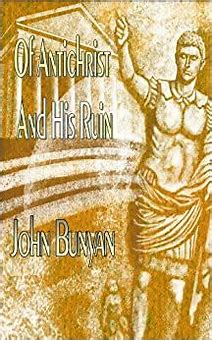
 OF ANTICHRIST AND HIS RUIN (1692) – Last week Balladeer’s Blog reviewed John Bunyan’s often neglected work The Holy War (1682). This time around I’ll take a look at Bunyan’s Of Antichrist and His Ruin, published posthumously in 1692.
Bunyan depicts the Antichrist as a religious leader who poses as a Christian at first, then gradually replaces “God’s Word” with his own and distorts religious teachings. The Antichrist cons his followers into believing that he is preaching the true religion and that other faiths are evil.
Ironically, even though the Puritan John Bunyan made it clear that he was referring to the Catholic Church and its Pope (especially claims of papal infallibility), he doesn’t seem to realize that this description could also be applied to Martin Luther, who launched the Protestant Reformation which Bunyan championed.
This book’s Antichrist is described as a three-part entity – the devil as the head, the huge numbers of Antichrist’s followers as the body, and the Antichrist itself as the animating spirit of that mob of followers. Continue reading
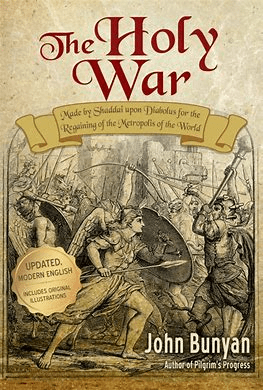 THE HOLY WAR (1682) – The work that John Bunyan is most well-known for is The Pilgrim’s Progress, but given the theme of Balladeer’s Blog, rather than write the 2 billionth review of that book I decided to take a general look at one of Bunyan’s often overlooked writings on mythology/ allegory.
  (Hey, it’s John Bunyan. If you’re looking for subtlety, let me introduce you to Mr. You-Won’t-Find-It-Here. Still, his works can be entertaining and thought provoking in a quaint, fairy-tale way.)
 Balladeer's Blog