
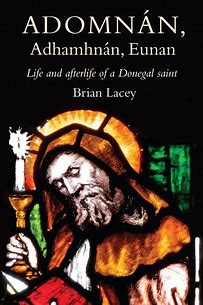
 THE VISION OF ADOMNAN – Dated to the late 600s A.D., This was a tale of the vision that Saint Adomnan supposedly had during his lifetime (c 679-704 A.D.). Several centuries before Dante’s Divine Comedy (Inferno, Purgatorio, and Paradiso), The Vision of Adomnan depicted the future saint being conducted through Heaven, Purgatory, and Hell so that he could share this “vision” with others.
Dante was guided in a different order by the dead poet Virgil, but Adomnan is being guided by his Guardian Angel.
I. On the Feast of Saint John, Adomnan feels as if he has died and his Guardian Angel leads him through the Afterlife. The first stop in Heaven is the Land of the Saints, a realm of eternal fair weather where dwell the saints, all of them clad in white cassocks with white hoods.
Oddly, the saints are placed according to the four cardinal directions – those who were from the north when alive dwelt in the north of the Land of the Saints, those who were from the south when alive dwelt in the south of the Land of the Saints and so on.
Positioned the closest to God in the center of the realm are the Virgin Mary and the Twelve Apostles, then come the other significant figures in Christian beliefs. Angels are all around, and the music of bird-choirs is always heard.
The innermost circle is where sits God’s throne, formed like a canopied chair with four columns of precious stones supporting it. Three birds are perched on the throne, staring in adoration at God while they mark the 8 canonical hours. Along with birds, horses are also depicted in Heaven. Continue reading
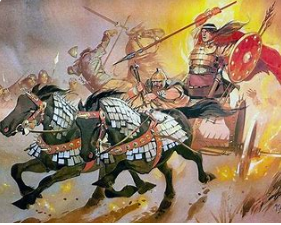 THE PHANTOM CHARIOT OF CUCHULAINN (Siaburchapat Con Culaind) – This tale is dated to around the mid-400s A.D. because of the presence of St. Patrick.
 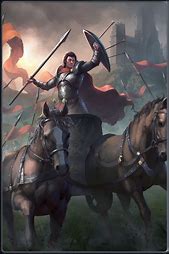 The next day, St. Patrick and King Loegaire are both on hand at the appointed place when Cuchulainn appears, riding in his chariot driven by his usual charioteer Laege. The demigod’s two horses – the Dub Sainglend (black horse of Saingliu) and the Liath Macha (gray horse of Macha) – are pulling the chariot.
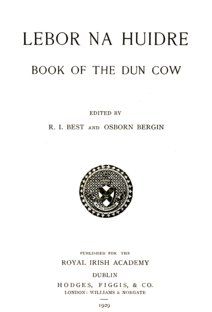
  PART ONE – This opening segment examined the Six Ages of the World section, a mythological look at the history of the world from Creation to the coming of Jesus Christ. The Book of the Dun Cow contains a mix of pagan and Christian materials, and in Part One I also reviewed its presentation of myths regarding Great Britain, legends of Saint Columba and its version of the story of Tuan mac Cairill, the only non-Ark survivor of the Great Flood and who chronicled the ancient races of Ireland like the Tuatha de Danaan, Fir Bolg and Milesians. Click
  PART TWO – The four sections covered in Part Two: Two Sorrows of the Kingdom of Heaven, featuring Elijah and Enoch in Heaven and their observations regarding the Antichrist, the end of the world and the Final Judgment; The Intoxication of the Ulstermen, about the Samhain partying of the Ulstermen and the peril it led to; The Raid on Dartaid’s Cattle, about a raid to rustle the cattle of the she-warrior Dartaid; and The Raid on Fliodhaise’s Cattle, featuring Queen Maeve, King Ailill, Fergus mac Roich and Queen Fliodhaise, her lusty ways and her cattle. Click
  THE STORY IMPLYING THAT MONGAN WAS FIONN MAC CUMHAILL REBORN AND HOW HE AND HIS NEPHEW KILLED FOTHAD AIRGTHECH (Scel asa mberar combad hé Find mac Cumaill Mongáin ocus aní día fil aided Fothaid Airgdig) – Ireland’s Prince Mongan, whom
  Eventually Forgoll insists his knowledge has been insulted by Mongan’s contrary claim and threatens to curse and ridicule Mongan unless Mongan gives him his wife by way of reparations. An elderly, decrepit stranger arrives on the scene.
 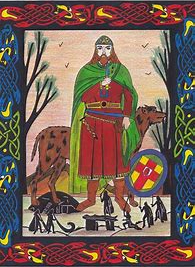 THE CONCEPTION OF CUCHULAINN (Compert Con Culainn) – One of the versions of the birth of the demigod Cuchulainn. This version begins as Ulster’s King Conchobar mac Nessa (at left) goes on a hunt for magical birds with several nobles of Ulster and his daughter Deichtine, his charioteer. (In the later and more popular versions Deichtine is King Conchobar’s sister, not his daughter, and most of the Cuchulainn myths refer to him as Conchobar’s nephew, not grandson.)
 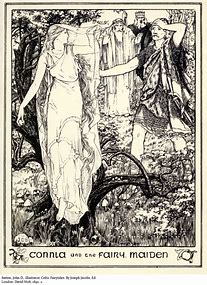 THE ADVENTURE OF CONNLA THE BEAUTIFUL, SON OF CONN OF THE HUNDRED BATTLES (Echtra Condla Chaim meic Cuind Chetchathaig) – Amid the monuments and landmarks on the Hill of Uisnech in central Ireland, Connla and his father Conn, a High King of Ireland, are relaxing with several of their troops around them.
 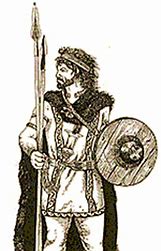 King Conn and others nearby ask Connla who he is speaking to, because only he is able to see her. As the smitten Connla continues “chatting her up” his father and others hear the woman speaking but still cannot see her. She makes it clear that she is inviting Connla to come with her to Mag Mell forever, prompting the panicked Conn to call for his Druid Corann.
  THE FEAST OF BRICRIU (Fled Bricrenn) – The Book of the Dun Cow version of this tale is dated to around the 700s A.D. and is considered the forerunner of the story of Sir Gawain and the Green Knight in British legends.
 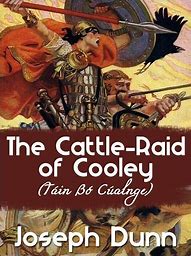 THE CATTLE RAID OF COOLEY (Tain Bo Cuailgne) – Because this is easily the most well-known tale from Irish Mythology I will be brief and I will also include another section of the Book of the Dun Cow in this same blog post.
 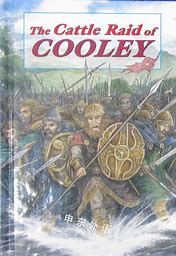 III. As Queen Maeve and her army approached Ulster, most of the Ulstermen were incapacitated by labor pains, a curse from the goddess Macha that they would be thus afflicted for nine generations whenever Ulster faced peril. The only man of Ulster not affected by the curse was the demigod Cuchulainn,
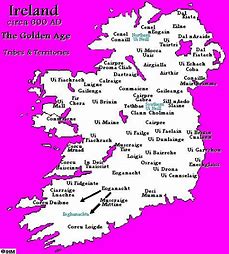
 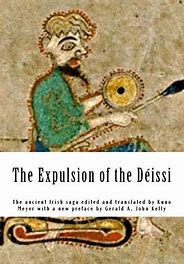 THE EXPULSION OF THE DEISSI (Tucait innarba na nDessi i mMumain ocus aided Chormaic) – Once believed to be a genuine historical narrative, The Expulsion of the Deissi has long been recognized as yet another case of mere quasi-historical myth-making.
  THE VISION OF ADOMNAN (Fis Adomnain) – This was a tale of the vision that Saint Adomnan supposedly had during his lifetime (c 679-704 A.D.). Several centuries before Dante’s Divine Comedy (Inferno, Purgatorio, and Paradiso), The Vision of Adomnan depicted the future saint being conducted through Heaven, Purgatory, and Hell so that he could share this “vision” with others.
  Balladeer's Blog