
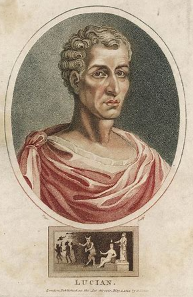
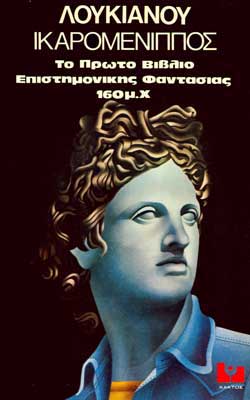
 These two works were written by Lucian, the Greek philosopher and satirist who lived in the 2nd century A.D. Lucian was noted not just for his philosophical observations but also for two works that defied definition by his contemporaries but would easily fall into the category of science fiction today. Both works are from roughly 150 A.D. and feature trips to the moon by pseudo-scientific means.
1. ICAROMENIPPUS – The title, obviously, was inspired by the myth about Icarus using wings crafted by his father Daedalus to fly too close to the sun, which hubristic act led to his death. In this work Lucian depicted his hero Menippus using one wing from a large eagle and one from a large vulture to fly to Mt. Olympus, and from there to the moon.
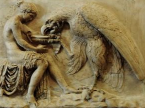 He discovered that the moon (on which he could breathe just like on Earth) was populated by the souls of the deceased (roughly twelve hundred years before Dante’s Paradiso). From the moon Menippus made the astonishing observation that the Earth was round and not flat, in a wry addition to the then-ongoing philosophical debate about the subject. Continue reading
 the moon (on which he could breathe just like on Earth) was populated by the souls of the deceased (roughly twelve hundred years before Dante’s Paradiso). From the moon Menippus made the astonishing observation that
  Balladeer's Blog