
St. Patrick’s Day continues with this tale from Ireland’s ancient Book of the Dun Cow (Lebor na hUidre) in which the demigod Cuchulainn helps the saint convert Ireland to Christianity. Interesting blend of Christian and pagan elements. For more from the Book of the Dun Cow click HERE.
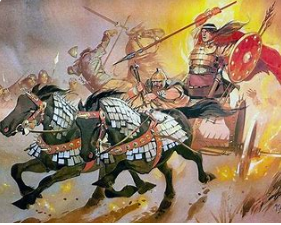 THE PHANTOM CHARIOT OF CUCHULAINN (Siaburchapat Con Culaind) – This tale is dated to around the mid-400s A.D. because of the presence of St. Patrick.
The story goes that St. Patrick pays a visit to the stubborn Loegaire mac Neill, a High King of Ireland, again entreating him to convert to Christianity. Loegaire tells Patrick that he will not believe in the God of Christianity unless that God can raise Cuchulainn from the dead and have him pay a visit to and converse with him (the king).
God immediately sends an angel to tell King Loegaire and St. Patrick that God will raise Cuchulainn and send him to converse with Loegaire near the ramparts of the fortress at Tam.
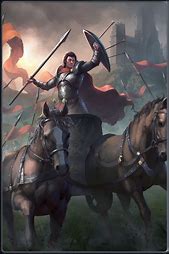 The next day, St. Patrick and King Loegaire are both on hand at the appointed place when Cuchulainn appears, riding in his chariot driven by his usual charioteer Laege. The demigod’s two horses – the Dub Sainglend (black horse of Saingliu) and the Liath Macha (gray horse of Macha) – are pulling the chariot.
Cuchulainn stops to interact with the two living men. To help kill King Loegaire’s skepticism, the demigod performs assorted feats that only a being who was more than human could perform. Continue reading
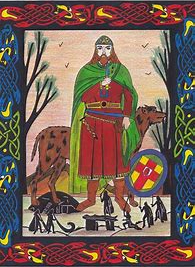 THE CONCEPTION OF CUCHULAINN (Compert Con Culainn) – One of the versions of the birth of the demigod Cuchulainn. This version begins as Ulster’s King Conchobar mac Nessa (at left) goes on a hunt for magical birds with several nobles of Ulster and his daughter Deichtine, his charioteer. (In the later and more popular versions Deichtine is King Conchobar’s sister, not his daughter, and most of the Cuchulainn myths refer to him as Conchobar’s nephew, not grandson.)
  THE CATTLE RAID OF COOLEY (Tain Bo Cuailgne) – Because this is easily the most well-known tale from Irish Mythology I will be brief and I will also include another section of the Book of the Dun Cow in this same blog post.
 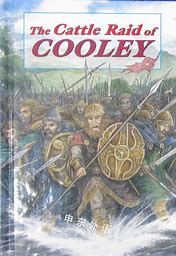 III. As Queen Maeve and her army approached Ulster, most of the Ulstermen were incapacitated by labor pains, a curse from the goddess Macha that they would be thus afflicted for nine generations whenever Ulster faced peril. The only man of Ulster not affected by the curse was the demigod Cuchulainn,
  Balladeer's Blog