 A FANTASTICAL EXCURSION INTO THE PLANETS (1839) – Written by an unknown author. The anonymous narrator of this novel is taken on a visit to assorted planets and other celestial bodies. The figure who transports him is a winged, rainbow-colored sprite whose face and body constantly change slightly, allowing no lasting impression to be made out.
MERCURY – The narrator discovers Mercury to be a sunny but not scorching planet of pleasantly aromatic meadows and trees. The inhabitants are beautiful, angelic creatures of indeterminate gender whose light-weight bodies permit them to virtually float around like feathers.
These beings devote all their time to frolicking, singing and making music on other-worldly stringed and wind instruments that the narrator compares to lyres and flutes. The closest thing to actual labor that the Mercurians do is to cultivate flowers then weave them into chaplets and garlands with which to adorn themselves.

BALLADEER’S BLOG
VENUS – Next our narrator and his winged guide visit Venus. This planet is covered with roses, myrtles, amaranths and asphodels plus alien flowers flaunting colors unknown on Earth. The flatlands are all covered in short green grass which smells of lilies and violets.
Trees are plentiful, the air is tropically balmy and the rivers and streams sound like music. Birds sing during the daylight hours, birds which sound like doves and nightingales but are of Venerean species (the narrator says “Venerean” instead of “Venusian”). Our main character proves unable to catch any of these winged creatures to study them more closely.
Continue reading →

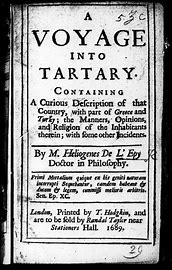 A VOYAGE INTO TARTARY (1689) – The real author of this work is unknown. It is a fictional encounter with a lost race, advanced technology and more. It’s possible that the writer wanted anonymity due to his then-blasphemous attitudes toward religion.
 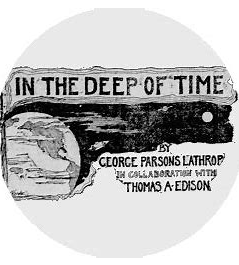 IN THE DEEP OF TIME (1897) – This story was written by George Parsons Lathrop, who also wrote the libretto for Walter Damrosch’s opera version of The Scarlet Letter. Though Lathrop credited an interview with Thomas Edison for the scientific concepts in this tale, it is NOT an Edisonade. In the Deep of Time is instead one of the many 19th Century stories about “present day” characters waking up in the far future.
  The multi-step procedure begins with Gerald being administered a drug that prepares his body for suspended animation, followed by another drug (mortimicrobium) that renders his body germ-free at all levels. Next, Bemis is placed in a glass cylinder at body temperature to “sleep” away the centuries.
 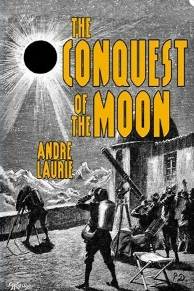 THE CONQUEST OF THE MOON (1887) – Written by French author Paschal Grousset under the alias Andre Laurie. This work ranges from absurd to fascinating, with – for people looking for science fiction – WAY too much time devoted to the fighting in the Sudan during 1884 and 1885.
  THE AIR BATTLE: A VISION OF THE FUTURE (1859) – Written by an unknown author using the name Herrmann Lang. (Ignore the misspelling on the cover to the left.) Speculation has it that the author was British despite the German pseudonym and despite the narrator’s claim that he is a black man.
  A VOICE FROM ANOTHER WORLD (1874) – Written by W.S. Lach-Szyrma. The 1874 date marks when a selection of stories that Lach-Szyrma had written beginning at some point around 1865 in untraced magazines were finally collected in novel form. The author penned more novels in the series as the years went by.
  Eventually during his years traveling among human beings, “Dr. Posela” rescues a friendly Englishman who is among those trapped in the Siege of Paris during the Franco-Prussian War. The Earthling gets returned to England, and is delighted with Dr. Posela and his philosophical observations about humanity and his theories that life certainly exists on many other planets.
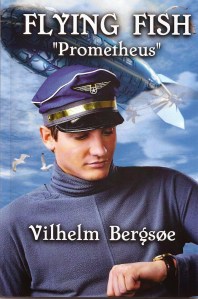 MEMOIRS FROM A JOURNEY WITH THE FLYING FISH “PROMETHEUS” (1870) – Written by Danish author Vilhelm Bergsoe. I shortened the title in the heading for this blog post. Some editions shorten it even more, to just Flying Fish Prometheus.
  William’s American colleagues send the new airship Prometheus to fetch him. The Prometheus is cigar-shaped (like so many UFOs would be described decades later) and sports wings plus propellors. Our man Stone boards the airship in Koege, along with other passengers including his love interest Anna Blue.
  THE FORGOTTEN LAND (1917) – Written by H. H. Knibbs. This writer was much better known for his poems about the American West. The Forgotten Land ventured into science fiction and “future history.”
  Konstantin Eduardovich Tsiolkovsky did real-life work crucial to space-flight and is one of the neglected pioneers of Science Fiction. Balladeer’s Blog takes a look at a few of his works.
  These flying plant-people from the Asteroid Belt obtain nourishment through chlorophyll and solar radiation. They also have advanced technology like the harnessing of dismantled asteroids into rings, resulting in lower gravity for manufacturing work.
  OUT OF THE EARTH (1920) – Set in the year 2017 A.D. this tale features what readers are told is the first manned flight to the moon, some 48 years AFTER it happened in real life.
 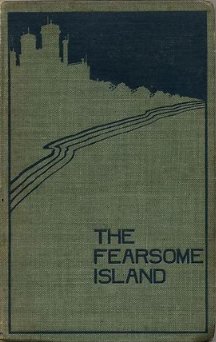 THE FEARSOME ISLAND (1896) – Written by British author Albert Kinross. An unusual work with a multi-layered narrative. The entire novel was penned by Kinross, but it is one of the countless works of fiction presented as if it is a rediscovered manuscript relating the “true” adventures of Silas Fordred from the 1500s. Kinross adds another layer by explaining the sci-fi devices that Fordred could not comprehend and put down to sorcery and the supernatural.
