
 A DARWINIAN SCHOONER (1893) – Written by William Alden. With the latest Planet of the Apes movie hitting many theaters today I figured it was a good time to post a review of this story that’s in a similar spirit.
The tale starts on board a 22-man ship called the Jane G Mather. This vessel is 500 miles or so east of Cape Saint Roque in Brazil when the 2nd Mate – Mr Samuels – catches sight of a schooner barely a mile off.
The schooner has full sails on but keeps listing to and fro almost as if its crew were novices or drunk. After two hours the Captain – Bill Simmons – takes an interest in the careering ship in the distance since it is clearly a potential threat to sea traffic.
Captain Simmons has Mr Samuels round up an away team consisting of Samuels himself and four other men. They are to board the errant vessel and advise the captain to get his crew and his ship under better control. Soon, Samuels and his four men pull alongside the schooner and are shocked to see nothing but large monkeys – baboons, Samuels guesses – aboard the ship.
The 2nd Mate of the Mather is unnerved at the sight and by how calmly the baboons watch him and the rest of the away team board the ship. The primates make no sound and do not jump around or otherwise behave like real monkeys, if you know what I mean and I think you do. Continue reading
 THE ABYSMAL INVADERS (1929) – Written by Edmond Hamilton. This is a nice mish-mash of elements that are part Creature Feature, part Doctor Who and part Jurassic Park. Hamilton gets bashed as a hack but his stories are harmless fun.
 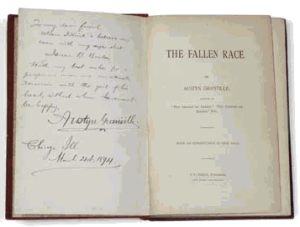 THE FALLEN RACE (1892) – Written by Austyn Granville. If you’ve ever thought to yourself “How come nobody ever combined science fiction, H. Rider Haggard-style Lost Race tales AND kangaroo rapists” then THIS is the story for you. (And please stay away from children.)
  THE SHIP OF SILENT MEN (1920) – Written by Philip M Fisher. The crew of a ship called the Lanoa set out from Hawaii. A few days later an abnormally powerful electrical storm strikes, leaving the area unusually cold in its wake.
 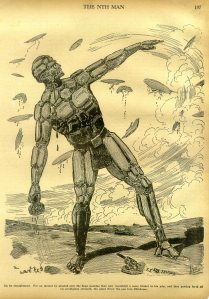 THE Nth MAN (1920 – 1924?) – Written by Homer Eon Flint, who died in 1924. Though this short novel was not published until 1928 many fans of the author argue that it was actually written in 1920.
  FUNGUS ISLE (1923) – Written by Philip M Fisher. Fungus Isle has the same proto-Creature Feature feel to it that The True Inheritors (qv) had. In the case of the previously reviewed story it was a forerunner of various giant spider flicks. In the case of Fungus Isle it seems like the inspiration for Attack of the Mushroom People, aka Matango, the Fungus of Terror.
 PSI CASSIOPEIA, or STAR: A MARVELOUS HISTORY OF WORLDS IN OUTER SPACE (1854) – Written by Dr Charlemagne Ischer Defontenay, a French M.D. and author. Long before J.R.R. Tolkien churned out obsessive amounts of fine detail about his fictional Middle Earth, Defontenay produced this volume of history, poetry and drama from his fictional planets in the star system Psi Cassiopeia.
 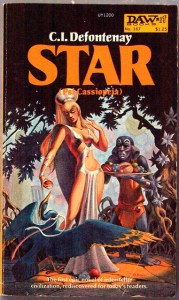 The system where that planet is located is a three-star system. Ruliel is the large, white star at the center, around which orbit the two lesser stars Altether (green) and Erragror (blue). The planet called Star is orbited by large planetoids/ moons named Tassul, Lessur, Rudar and Elier. Throwing all science to the winds the planet is also orbited by a small red star called Urrias.
  THE MAN FROM SATURN (1890) – By an unknown author. This work also appeared under the title Willmoth the Wanderer, a cutesy reference to the classic Melmoth the Wanderer. A young, unnamed American encounters Willmoth, a male humanoid who states he is from the planet Saturn and is hundreds of thousands of years old.
  THE WAR UNDER THE SEA (1892) – Written by Georges Le Faure. This sci-fi work was intended as an escapist societal salve to a French public still smarting from their loss to Germanic forces during the Franco-Prussian War just over two decades earlier.
 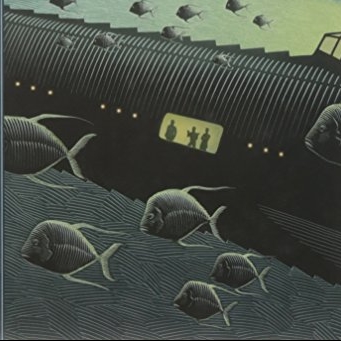 Interestingly enough, despite this threat the Germans are not depicted as being any more bloodthirsty than the alleged “heroes” of this story as we will see. Though the Count and his allies prove equally callous about large-scale killing (and worse) their attitude is romanticized and approved of by the narrative since Andre and the others are fighting France’s traditional Continental foes the Germans. Instead of Film Noir think of this novel’s approach as callous enough to be called World Noir. Or at least Politics Noir.
  Balladeer's Blog