
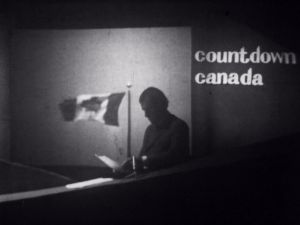
 COUNTDOWN CANADA (1970) – Here at Balladeer’s Blog I am amazed that this vintage Canadian Television work of speculative fiction hasn’t received renewed fame in 2026. Countdown Canada uses the approach of the Orson Welles War of the Worlds radio broadcast and the later television production Special Bulletin. Throw in other examples like James Burke’s After the Warming if you like.
Though this aired on Canadian television in 1970 the story is set in 1979. The current head of Canada’s government won election on a campaign of holding a referendum on Canada officially joining the United States, and its provinces each becoming new states in the union. All except for Quebec, which in this fictional 1979 achieved independence earlier in the decade.
The referendum to become part of the United States resulted in a victory for the “yeas” and Countdown Canada is set a few years later as all bureaucratic and constitutional red tape has been dealt with and the last day of an independent Canada has arrived.
This drama is presented as an hour-long newscast covering the official ceremonies including speeches by the U.S. President and the outgoing head of state of independent Canada. His office is dissolved as part of his last official act on this day. (Sort of a Gorbachev feel from our perspective today.)
In addition to diplomatic events, the news anchor cuts periodically to talking head debates about the events leading up to the referendum as well as to a few rowdy crowds who are still opposed to the union with America. In an interesting touch, many anti-annexation Canadians have fled to Quebec, which will remain on its own.
Watching the debates about whether Canada is making the right move is interesting, as the anti-union side calls for Canadian Nationalism and vows to fight for a new referendum to try breaking away from the U.S. and restoring an independent Canada.
In Quebec, there’s no talk of referenda, just violent resistance to what the Cuban Revolutionary-looking political leaders are calling U.S. “occupation” of Canada. They ignore the fact that the move was voted on, not achieved by military conquest.
Further hypocrisy on the part of the Quebec politicians is depicted by their lip service to democratic forms while some of them wear combat fatigues and one symbolically uses the butt of the rifle he’s holding like a gavel to call for order when the political meeting gets a bit chaotic.
Lest anyone think that means that Rob Fothergill, the creative force behind this drama, was anti-leftist the truth is both sides get a pretty fair hearing. In contrast to the gung-ho Quebec characters, there are also reasonable anti-annexation figures from around Canada. In fact, the prevailing air is one of hostility to the U.S.
 Obviously, given the time period when Countdown Canada was made, one of its weaknesses is the way it reeks of the issues and attitudes of 1970. The Vietnam War, for instance, gets a little too much attention and even some older talking heads hold the late-sixties/ early seventies belief that simply being young and a student automatically makes someone right.
For Canadians, the fact that this special aired in September 1970 – so just before the October Crisis and War Measures Act – will no doubt lend this drama much greater cultural relevance.
Person on the street interviews reflect a variety of viewpoints, including a woman who feels that the vote was made and that America’s political system bears enough resemblance to Canada’s that life for the average citizen won’t change by very much.
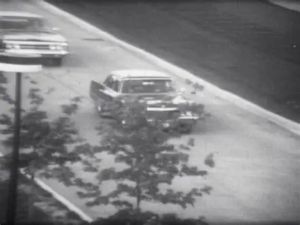
It would not be realistic to tell this story without violence breaking out at some point, and Countdown Canada has that happen at the Rainbow Bridge at Niagara Falls. Anti-union forces form a human chain blocking the cars of the Canadians and Americans who were set to cross what was no longer going to be an international border.
From the human chain the “antis” spread out to overwhelm the police and the media covering the events at the Rainbow Bridge. The mock “news special” cuts away from the unstable situation and back to the show’s anchor, leaving that situation unresolved.
An intriguing story element is the enigmatic reference to “the memory of Pierre Trudeau”, but we’re not told how he died in this alternate future. And for verisimilitude the talking heads in the debates often talk over each other and lose their patience.
For a brief take on the conflicting points of view presented in Countdown Canada:
*** The pro-union side feels that joining the U.S. will be good for the economies of Canada’s former provinces and for the working class and was inevitable. The anti-union side calls for Canadian Nationalism in the George Grant sense and argues that Canada will lose its National Pastime of criticizing the United States once it becomes part of it instead. (Okay, I’m paraphrasing that last part.)
The major flaws of this drama are the references to so many political names that young viewers won’t recognize, and the fact that the ceremonial music in the opening scenes is so loud it often drowns out what is being said by the mock newscaster.
SPOILERS (such as they are):
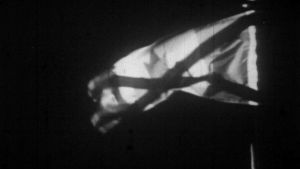 Countdown Canada ends with the Canadian flag in Ottawa being lowered as Oh, Canada is played. Then the American flag is raised in its place while the Star-Spangled Banner plays. The violence at the Rainbow Bridge is not referred to again, and the feel as the credits roll is that it remains to be seen if a Greater United States will prove positive or negative for former Canadian citizens.
I enjoyed this piece of entertainment but I’m guessing that the overwhelming majority of viewers would find Countdown Canada too talky and boring.

