
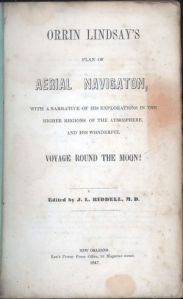
 Full Title: ORRIN LINDSAY’S PLAN OF AERIAL NAVIGATION WITH A NARRATIVE OF HIS EXPLORATIONS IN THE HIGHER REGIONS OF THE ATMOSPHERE AND HIS WONDERFUL VOYAGE ROUND THE MOON (1847) – This work was written by J.L. Riddell.
The tale is presented as if Riddell himself is delivering an educational lecture about Orrin Lindsay’s incredible scientific accomplishments. Lindsay, a Cincinnati native who resettled in Natchez, concocted a formula which renders objects immune to gravity.
Orrin did this by proceeding from the work of scientist Michael Faraday and working with amalgamated mercury and steel treated by magnetic fields. For his first experiment using his anti-gravity plates he temporarily floated a dog in a box.
Next, he himself floated in a larger box to accommodate his greater size. His test was conducted by keeping himself connected to the ground by a lengthy rope. This success inspired him to try floating free of any anchor to the ground.
To that end, Lindsay constructed a ten-foot-long box made of wood coated with his anti-gravity plates. Orrin organized things so that he could manipulate the plates via controls on his aircraft to adjust their positions, even turning them away from the ground below to allow gravity to once again affect the vessel.
After several more successful test flights, Lindsay dares to fly as high as 26,000 feet, taking measurements with the scientific instruments which he has installed in his craft.
 The inventor now builds a larger vessel with which he hopes to fly even higher through assorted upgrades to the windows, hull, gaskets and the remote controls which let him manipulate the antigravity plates.
He devises tubes which hold compressed oxygen so that he can breathe at incredible heights. Orrin also establishes a hose which can pump out of the ship the carbon dioxide that he exhales.
NOTE: There are science fiction stories from the 1880s and 1890s which pay less attention to how its characters could breathe in space. Riddell was far ahead of his time.
At length, Orrin Lindsay and an assistant named Joselin fly 70 miles above the Earth, where they experience weightlessness and make several observations about our planet’s atmosphere. Next, they decide to fly to the moon.
Riddell depicts the voyage to the moon taking roughly 90 hours. When Orrin and Joselin reach the moon they orbit it several times, noting that it supports no life and has neither an atmosphere nor water. This makes them decide not to land and they fly back to the Earth.
Plans to possibly try for Mars next are discussed but there was no sequel story. Riddell supposedly performed this tale as a lecture in New Orleans, treating it as if it was a true story at first.
Overall, I found this tale very enjoyable. Some may find it dry, but I loved the attempts at hard science to support the story. Riddell’s restraint in not depicting life on the moon is even more impressive when you consider it was just 12 years since the New York Sun newspaper published their infamous hoax series about life being discovered on the moon.
FOR MORE “ANCIENT” SCIENCE FICTION CLICK HERE.


I really love these stories! As a kid I was a huge scifi fan. I read my way through almost everything by Asimov, Heinlein, Clarke, Bradbury and Herbert. I consumed scifi like pizza! But most if not all of this series of yours I am unfamiliar with. I love it!!
Thank you! I appreciate the kind words and I’m happy to share these obscure stories.
Pingback: ANCIENT SCIENCE FICTION: ORRIN LINDSAY’S WONDERFUL VOYAGE ROUND THE MOON (1847) – El Noticiero de Alvarez Galloso
Logged, thanks!
Fascinating story. He truly was ahead of his time. Thanks for sharing this interesting post!
I’m happy to do it! Glad you found it interesting.
Wonderful. As a huge fan of the sci-fi genre, I found “Orrin Lindsay’s Wonderful Voyage Round the Moon” extremely entertaining.
Thank you for saying so!
This sounds like quite an experimental book in terms of format and being advantgarde! What a cool find!
Thanks! I agree, it deserves to be much better known.