
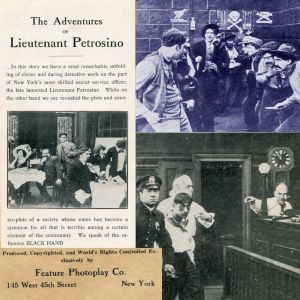
 THE ADVENTURES OF LIEUTENANT PETROSINO (1912) – This 47-minute silent movie was a rushed look at the career of New York City Police Detective Joseph Petrosino, who specialized in fighting organized crime. I meant to cover Petrosino years ago, but other topics kept taking priority.
Petrosino has become all but forgotten here in 2026, but he was once so popular that hundreds of thousands attended his funeral, which was declared a holiday in New York. He was murdered by organized crime in 1909, and his posthumous fame made him the hero of Dime Novels like old west figures Buffalo Bill Cody and others.
I’ll do more detailed examinations of Joseph Petrosino in the near future, but for now I will review this 1912 flick while peppering in a few notes about the man’s real-life saga which was far too broadly presented on the big screen.
 THE REEL PETROSINO – Still in uniform, Joseph has made a name for himself as a tough cop capable of dealing with Italian gangs like the Black Hand, the Mafia and the Camorra. When Mafia bank robbers humiliate a pair of policemen who try taking them in, the storied Petrosino is sent for.
He quickly finds the gang, subdues them and drags two of them in to be booked as the others flee. The arrested criminals rat out their colleagues. That night at the dinner table, Joe brags to his wife Adelina about his exploits.
THE REAL PETROSINO – Born in 1860, Joseph Petrosino joined the New York City Police Department as a uniformed cop in 1883. He made excellent use of his fluency in Italian to solve crimes in Italian-American neighborhoods that were easy prey for organized gangs from the Old Country.
Petrosino employed a combination of investigative savvy and the freer hand that the police had to get rough with criminals in that period to rise in the department. Though today the ethnic slur would cause an uproar, when expertise in fighting Italian organized crime was needed, NYPD officials would make with the cry “Send for the Dago!”
THE REEL PETROSINO – Joe protects the law-abiding members of the Italian-American community from the criminal element. He becomes beloved by the former and hated by the latter.
Promoted to plain clothes detective, Petrosino solves several cases against organized crime. This film uses the names Black Hand, Mafia and Camorra interchangeably because society in general was less well-versed in the distinctions back then compared to now.
The gangsters are almost comically depicted meeting in seedy joints with skull and crossbones flags on the walls and greet each other with hand gestures that are a mix of the Sign of the Cross and an “I’ll slit your throat” gesture. Hey, it’s a 1912 flick.
 THE REAL PETROSINO – In 1895 the new, reform-minded Police Commissioner – future president Theodore Roosevelt – promoted Petrosino, whom he met when he was an Assemblyman, to detective in charge of New York’s Homicide Division.
Some spectacular cases were in store for Joe including higher and higher organized crime figures and at one point a case where Petrosino talked singer Enrico Caruso into cooperating with the police against gangsters threatening his life.
While dealing with New York anarchist groups, the detective became aware of an anarchist plot to assassinate President William McKinley. He passed the word to the Secret Service but they and McKinley himself chose to ignore the possibility despite then-Vice President Roosevelt’s recommendation to listen to Petrosino. As we all know, McKinley was assassinated by anarchist Leon Czolgosz in September of 1901.
THE REEL PETROSINO – Some of the gangsters that our hero is depicted sending to prison earlier in the movie launch a breakout and flee to Palermo, Sicily, where they are welcomed into the ranks of the home-grown gangster families.
Petrosino, now in charge of the NYPD’s elite organized crime squad, gets assigned to travel to Sicily in 1909 to track down the escapees. He goes, despite his wife’s misgivings, and winds up recognized and shot to death by the criminals he is trailing.
New York City holds an enormous funeral for the public hero and now martyr, with his wife assuming the special position that she and Joe’s daughter & granddaughter would hold at funerals for fallen officers from then on.
 THE REAL PETROSINO – During his career, Joseph Petrosino did indeed bring down several organized crime aristocrats and got many deported. He really did head New York City’s elite organized crime squad, which was openly called “the Italian Squad” back then.
His 1909 assignment in Sicily was far more complex than the movie depicts, and involved a push for cooperation between U.S. Police and Italian Police in fighting the Mafia and Camorra in both countries. Petrosino was indeed recognized in Palermo by gangsters he had had deported and was shot to death.
Various organized crime figures in New York and Sicily were arrested regarding Petrosino’s murder, with Paolo Palazzotto considered to be the actual trigger man. Joseph’s widow, daughter and granddaughter did indeed represent the Petrosino Family for decades at high profile funerals and other ceremonies involving the NYPD.
THE MOVIE ITSELF – In pure cinematic terms, The Adventures of Lieutenant Petrosino is pretty poor. It was made during the period when silent film directors lazily relied on too much dialogue-board-free pantomime to convey their stories.
Dialogue boards became more frequent in the years ahead, and thespian and directorial efforts became more refined. A Petrosino film made during the late teens or early 1920s would have had much higher quality. Other American movies about Joseph Petrosino were made in 1934 (Joe Petrosino), 1950 (Pay or Die) and 1973 (The Black Hand).
Multiple novels have incorporated Petrosino as a character and two television dramas were produced in Italy depicting his crusade against organized crime.
 Balladeer's Blog
Love your illuminating comparison between the real Petrosino and the reel one! The 1909 assignment in Sicily sounds move riveting in real life than on screen!
Thank you! Yes, it was too detailed for movies back then to handle.
Wonderful post as always. I have never heard about the silent film “The Adventures of Lieutenant Petrosino” before but as always found your posts engaging to read. It brought to mind memorable television shows about detectives that I have seen and loved.
Thank you! I appreciate it!
Thanks for this summary of the work and end of Lt. Petrosino (along with a comparison to the movies his life spawned). This is an interesting dichotomy.
Glad to do it! Thank YOU!