
This weekend’s escapist and light-hearted superhero post from Balladeer’s Blog looks at Spider-Man co-creator Steve Ditko’s iconic Mr. A, warts and all.
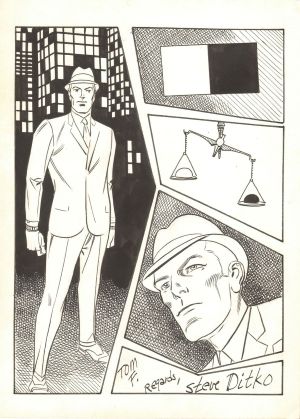 MR. A
MR. A
Secret Identity: Rex Graine, reporter for the Daily Crusader newspaper.
First Appearance: Witzend #3 (1967)
Origin: Rex Graine wanted to fight crime without endangering his friends and loved ones. He assumed the white-costumed identity Mr. A and took on the forces of evil.
Powers: Mr. A was in peak human condition and excelled at unarmed combat. He wore a white metal facial mask/ helmet for protection and anonymity. He also wore metal gloves and boots to make his punches and kicks more potent. I assumed he wore articulated body armor on his torso too, for some protection against bullets.
This character was an expert investigator and used calling cards with no writing – just black on one half and white on the other to represent his black & white moral attitudes. I’d have had those calling cards be made of metal, too, with sharp edges so they could be thrown like Moon Knight’s crescent moon blades.
Comment: Mr. A was a more “pure” version of the Question, Steve Ditko’s similar character also created in 1967 when he worked for Charlton Comics. Ditko owned Mr. A, whose nom de guerre came from the Objectivist principle “A is A”. He was an uncompromising vigilante the like of which superhero comic books had rarely seen in 1967. In the decades to come such figures became very numerous in comics.
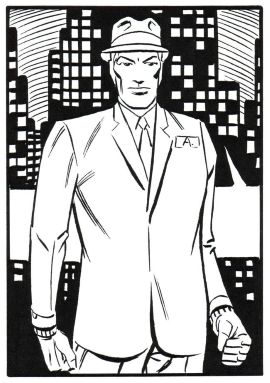 Ditko was very blunt about how Mr. A was intended to embody the Ayn Rand Objectivist philosophy that the artist and writer embraced. Countless cheap shots yet just as many legitimate criticisms get leveled at Ditko and Mr. A because of their devotion to Rand’s principles, some of which Ditko is accused of misrepresenting.
I’ll avoid the easy pile-on, but I will mention the blatantly propagandistic nature of Mr. A’s adventures and the often tiresomely didactic presentation of Objectivism in Steve’s Mr. A works. Ironically, the Mr. A stories have all the “message over entertainment” weaknesses that many comic book fans decry about Woke messaging in present day superhero writing.
Here in 2026, I’m sure most people are aware that Ditko’s Mr. A and the Question served as inspirations for the Rorschach character in The Watchmen.
SOME STANDOUT MR. A APPEARANCES (In no particular order):
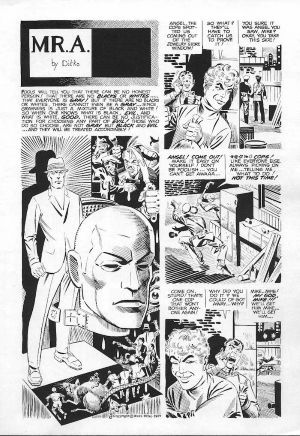 WITZEND #3 (1967) – This is Mr. A’s first appearance but he’s been active for a while since the criminals recognize his black & white calling card and are frightened to learn he is after them. Angel, one of a pair of Juvenile Delinquents who have just robbed a jewelry store, kills a cop who tries arresting him and his accomplice.
Angel’s parents and his teacher Miss Kinder refuse to believe anything bad about the young criminal and blame his actions on his environment. They bash the cops who are on Angel’s trail, too. Mr. A fights and takes down Morg, Angel’s fence who deals in stolen goods from thieves, and his pair of thugs.
As Mr. A closes in on Angel himself, the conscienceless punk frantically kills his own accomplice and severely injures Miss Kinder for standing in the way of his escape. Mr. A’s rooftop battle with Angel leaves the J.D. clinging for life to a flagpole and he lets him fall to his death while tending to Miss Kinder’s wounds.
The white-clad vigilante gives Miss Kinder one of his Joe Friday lectures about misplaced compassion going to criminals instead of their victims as he carries her to a hospital.
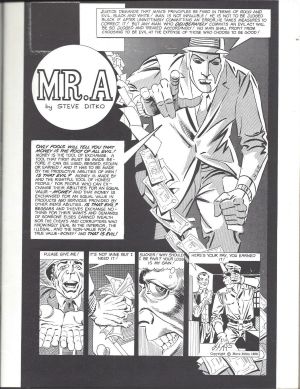 WITZEND #4 (1968) – This second Mr. A story is much longer. Our main character’s reporter secret identity Rex Graine is infuriating organized crime boss Lew Baggot with his series of investigative pieces exposing Baggot’s illegal activities.
When the D.A. starts an investigation into Baggot’s gang based on Graine’s reports, the crime-lord sends his sleazy lawyer Roden to try bribing Rex to stop investigating Lew. Rex refuses, of course, so Baggot has two of his thugs – Icer and Krebs – accompany the next bribe attempt with physical threats but Rex still says no.
Icer and Krebs beat up Rex Graine and warn him to stop covering their boss or they’ll kill him next time. Rex had to let himself be roughed up to avoid exposing his secret identity as Mr. A if he outfought the thugs.
In his costumed identity he takes action, repeatedly clashing with Baggot’s goons while exposing a crooked Assistant D.A., revealing Roden’s illegal actions for his crime boss client and getting the corrupt Asst D.A. to testify against Lew Baggot and his operatives in court.
The publisher of the Daily Crusader wants Rex Graine to report on less controversial topics now that Baggot has been toppled, but we readers are left wondering if he’s doing it because he’s on the take himself.
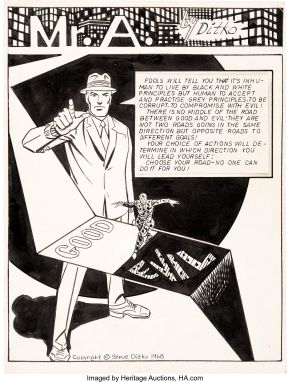 EON (fanzine) #3 (1968)
ONE-PAGE ITEM
Steve Ditko wrote and drew this one-page item which featured his character Mr. A.
No actual story is involved, just a typical statement of the vigilante’s personal philosophy/ justifications for his actions.
*
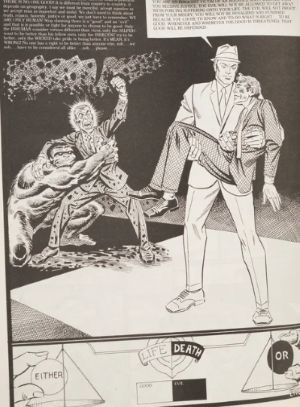 THE DEFENDERS (1969)
This surreal 6-page “story” pitted Mr. A against an apelike villain called the Aggressor.
Largely it was a morality play about how moral relativists tend to defend aggressors by claiming nobody is fit to judge anyone else – except for the hypocritical way they judge everyone who doesn’t meet their definition of “non-judgmental.”
The humanoid/ primate hybrid the Aggressor wears a necklace from which dangles a crucifix with a fist on the lower extremity of the cross. Mr. A condemns religious leaders who defend violent criminals by invoking moral relativism to avoid making any distinctions between good and evil.
This is largely an uninteresting item that’s more like an educational visual aid than any kind of entertaining story.
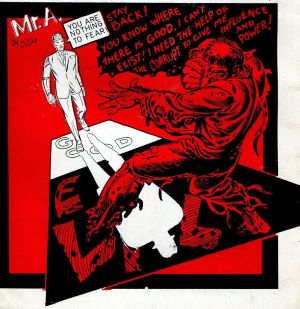 GRAPHIC ILLUSIONS #1 (Summer 1971)
ANOTHER ONE-PAGE ITEM
This visual presentation of Steve Ditko’s Mr. A in a symbolic tableau about his beliefs was the entire back cover of Graphic Illusions #1.
*
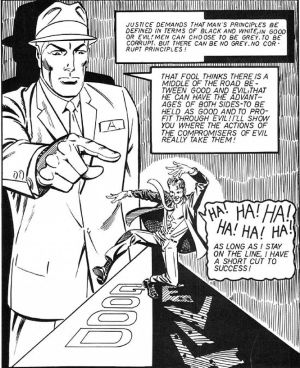 MIDDLE OF THE ROAD (1971) – Inside Graphic Illusions #1 was this Mr. A “story.”
Like The Defenders above, this is really just one long symbolic dissertation of Mr. A’s attitudes, this time toward people who try to walk a fine line between good and evil.
As we’ve seen, Ditko and his character Mr. A believe in black and white morally. Any shades of grey they simple-mindedly dismiss as participating in evil. The white-clad fanatic hounds a man who starts out making small ethical compromises, promising himself that one day he’ll be established enough that he will never have to compromise again.
The opposite happens, of course, as further compromises become necessary to cover up his previous misdeeds. The pattern repeats itself 0ver and over again.
In the end, the Middle of the Road Man finds himself face to face with Mr. A, who holds him accountable for his “evil” life. The sanctimonious vigilante condemns the man to a surrealistic plunge from a cliff down into the gaping maw of a huge skull. Again, no entertainment – just lecturing and messaging.
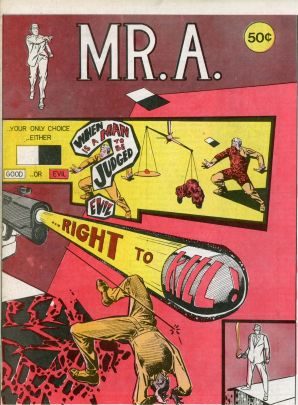 MR. A #1 (1972)
Title: When is a Man to be Judged Evil? – Kolb, a gangster whom Rex Graine’s reporting exposed to prosecution before he became Mr. A, gets out of prison on parole.
At first, Kolb’s as obsessed with killing Rex as he was during the years he spent in the penitentiary. Soon, one of Kolb’s old criminal associates tries to kill Mr. A but fails.
Pursued by Mr. A, the thug flees to Kolb’s tenement apartment and tries to drag him in as an ally in killing the vigilante. Kolb realizes this would just be continuing the life that led to his imprisonment and refuses.
Mr. A overhears Kolb’s decision to stay straight and, when the would-be killer winds up dead in his continuing fight with Mr. A, he lets Kolb stay in the clear so he can resume his new life.
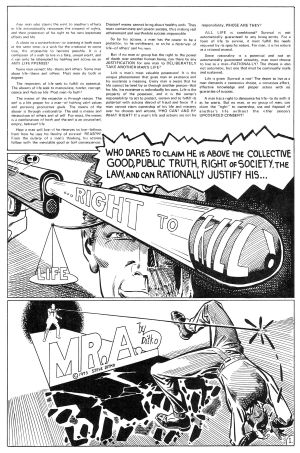 Title: Right to Kill – This full-length tale really resonates because of all the True Crime shows and streaming series with episodes about innocent children being abducted, raped and killed. An elementary school girl named Lilly is kidnapped by three masked criminals – two men and a woman.
They hold the terrified child captive in a tenement building and demand ransom from Lilly’s father and mother. The criminal trio feel that since the child’s parents are wealthy they must have gotten that way through unfair means so there is nothing wrong with victimizing them.
The leader of the group cruelly plans to sexually assault Lilly and kill her after the ransom is paid. (This was an independent comic book, so such topics could be dealt with.) Naturally, Mr. A arrives in time to save the poor kid and he’s wielding a handgun for the first time.
The head criminal has a gun, too, and a battle breaks out. Mr. A exchanges gunfire and also fights hand to hand with the villains in a chaotic brouhaha. At one point the woman reaches the bound and gagged Lilly and threatens to slit her throat unless Mr. A drops his gun and lets her get away.
The white-clad vigilante shoots the woman to death with a well-placed bullet, then resumes fighting her male accomplices. In the final battle, the two crooks are left mortally wounded and are in so much pain they beg Mr. A to put them out of their misery. Instead, he frees Lilly and takes her home to her parents, letting the two men die slowly and agonizingly.
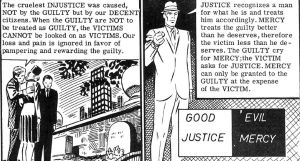 JUSTICE/ MERCY (1972) – First part of a multi-part story which is almost like an anthology series with Mr. A or his secret identity Rex Graine having varying degrees of involvement in the story. Every part has Ditko’s interpretation of Objectivism in it.
Justice/ Mercy features the young driver behind a hit and run slaying being shown more mercy because of his unfortunate life circumstances than the victim’s loved ones are shown by the system. The driver is set free and gloats that “they don’t give a care for the victim, it’s the guilty they’re anxious to protect.”
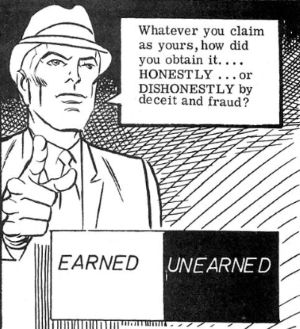 EARNED/ UNEARNED – The unrepentant driver in the hit and run death now gravitates to a political leftist Mr. Slung.
Under Slung’s influence he learns to expand on his courtroom lessons. “Make others feel guilty for what they’ve earned and they’ll be ashamed not to provide for the non-earners who demand it by right.”
Slung elaborates with “The doers are always forced to provide for the non-doers. Yet it is the non-producers who set the terms” and he calls it “legalized banditry.”
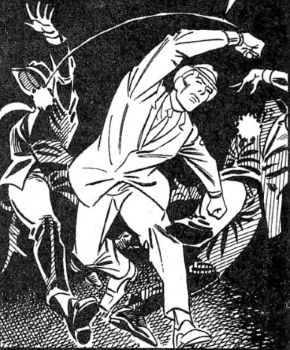 INITIATION OF FORCE/ RETALIATION TO FORCE – Ditko and Mr. A deal with authoritarian leftist movements using the philosophy “Confiscate private property and wealth. They stole it from those who never owned anything. Whatever belonged to someone in particular now belongs to everybody.”
The resulting dictatorship gets recognized by the Free World and becomes a U.N. member. “Humanitarians” claim the internal affairs of dictatorships are a private matter and opponents of the dictatorship are called warmongers.
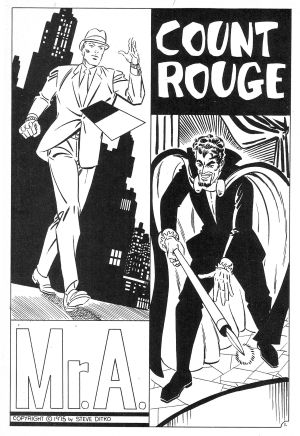 COUNT ROUGE (1975) – NOTE: In a hilarious foretelling of future internet misspellings, this story uses “Rouge” instead of the obviously intended “Rogue.”
Mr. A clashes with a costumed villain called Count Rogue, who uses a cane full of gimmicks and weaponry to rob parties full of wealthy people. He accuses them all of not deserving their fortunes and calls his thefts “social justice.” (Seriously.)
It becomes fashionable to pretend that the Count is dashing and his robberies should be imitated by as many people as possible. Women in particular claim he is attractive and defend all his crimes. The publisher of the Daily Crusader shills for Count Rogue in his newspaper, too.
Rex Graine is furious and the publisher’s hyping of the Count fuels our main character’s ongoing war with the villain. When all is said and done Mr. A exposes Count Rogue’s real identity and defeats him in battle, then turns him over to the authorities.
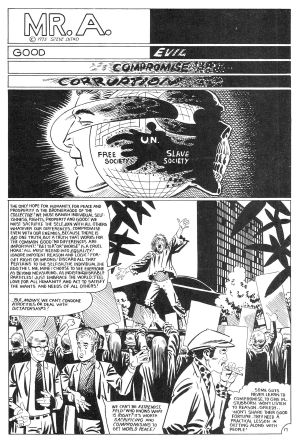 BROTHERHOOD OF THE COLLECTIVE (1975) – It’s no secret that subtlety was practically unknown in Ditko’s Mr. A writing. In this story he draws an awkward and sometimes unfocused analogy comparing the tinpot dictatorship nations who are treated as good faith members of the international community at the U.N. to political alliances between criminals and pillars of the community.
Ditko seems to be very clumsily making the argument that in such alliances the more positive elements don’t elevate the corrupt elements to honesty. Instead, the corrupt elements drag the positive elements down into their morass of unethical behavior.
Things start with Mr. A – wielding a handgun again – trying to shut down the gangs of two warring crime bosses named Bez and Rak. Eventually the two form a temporary truce to try killing their mutual enemy in white. Enter Senator Kud, who pulls Bez and Rak plus other sleazy types into a “committee” that formerly included exclusively honest businessmen, politicians and media moguls. Ditko means for us to compare the resulting corrupt entity to the U.N. but fails to sell it.
More successful are his reminders – via Rex Graine’s reporting – about the importance of individual rights vs collectivism. The bad guys ultimately use Mr. A imposters to commit evil deeds incriminating the vigilante but Mr. A and his alter ego Rex Graine withstand all the dangers and defeat all the villains. It’s all kind of murky and poorly written.
 COMIC CRUSADER #6 (Summer-Fall 1969)
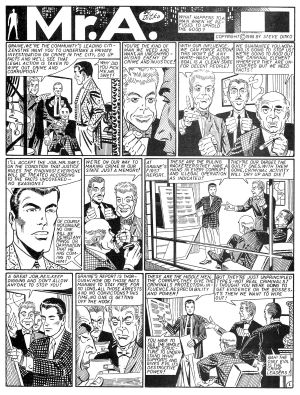
Story: What Happens to a Man When He Refuses to Uphold the Good? – I put this early Mr. A story toward the end because of how dull and excruciatingly didactic it is. It’s virtually one long lecture – mostly from Rex Graine – about punishing not just crime bosses but also the supposedly “honest” rich and powerful community leaders who end up complicit in crimes by turning a blind eye to them.
Alex Swet, a wealthy civic leader and some of his friends are delighted when Rex Graine’s reporting exposes the organizational chart of the city’s racketeers. They grow less delighted as Rex keeps digging and learns the way Swet and his fellows have entered the murky area where corporate corruption and outright criminal behavior mingle.
All of them are glad when organized crime tries to kill Mr. A and business interests try ruining Rex Graine with lawsuits. Mr. A plays a virtual “Ghost of Objectivism Present” by guiding Alex Swet through a lecture against moral relativism since he and his friends now look for excuses for wrongdoers up and down the chain. We end up with no closure.
If Mr. A was kept out of it until the end this could have made a good origin story for why Rex Graine realized that he needed to take things into his own hands anonymously by assuming his Mr. A identity.
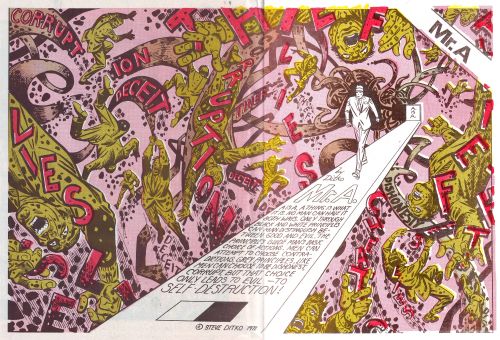
… And finally, below is some wrap-around cover art for The Collector #26 (Summer 1972) with Mr. A delving into the “A is A” root of his worldview.
…
 Balladeer's Blog
Wonderful posts as always. It brought to mind great superhero movies which I have seen and loved.
Thank you very much for saying so.