
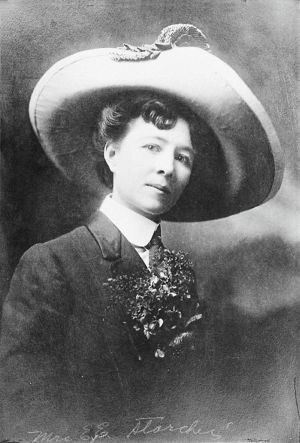
 THE PETTICOAT REVOLUTION – On December 5th, 1916 the “Petticoat Revolution” occurred in Oregon. Women had been allowed to vote in the state since 1912 and in the town of Umatilla several women ran stealth candidacies for municipal offices.
Quirks in the Umatilla laws at the time enabled the ladies to keep their bids for office a secret even from their spouses. Driven by a desire to reverse the town’s decline and slack law enforcement at the time, Robert and Lola Merrick plotted this odd operation with six other women during a card game at their home.
The residents of Umatilla found out on the afternoon of election day that the ladies were running for mayor and other elected positions. Voting participation was so low in the town at that time that the current mayor’s wife Laura Stockton Starcher (above left) was elected as the new mayor by a vote of just TWENTY-SIX to EIGHT!
In addition to the mayoralty, the seven women of the Petticoat Revolution also won the offices of Treasurer (Lola Merrick), Auditor (Betha Cherry) and four of six City Council seats (Stella Paulu, Florence Brownell, Gladys Spinning and H.C. Means.
Newspapers across the country began reporting on the unusual election in the days after December 5th, and by the 11th the term Petticoat Revolution had been coined and “the Card Party Caucus” was the name for the card game which launched the campaigns.
Not only did Laura Stockton Starcher unseat her husband for Mayor, but sister candidate Florence Brownell joined her spouse on the six-seat council.
Mayor-Elect Starcher stated “We believe the woman can do many things and effect many reforms in this town that the men did not dare do. We propose to replace the electric street lights which the present administration removed, clean up and improve the streets, lay sewers and do everything we can to improve the physical and moral health of Umatilla.
“We shall enforce the laws strictly. We have not decided upon our marshal (an appointive office) but that official will be a woman, also. We will not leave the enforcement of our laws to any man, because past experience has proven the laws will not be strictly enforced. If there is occasion for work that our woman marshal cannot perform, we will appoint a deputy for the occasion.”
Umatilla’s new administration took power in January of 1917, and Mayor Starcher’s inauguration speech was strident and sarcastic as she denounced men’s “shortcomings, vices, general uselessness and worthlessness.”
She may well have regretted such showboating because she lasted only eight months as Mayor before having a nervous breakdown and leaving office.
The City Council replaced Laura Stockton Starcher with another woman – H.T. Duncan – but she resigned after a month. Councilwoman Stella Paulu was elevated to the mayor’s seat and not only finished out Starcher’s term but was reelected as Mayor in 1918.
Too few people seem to remember these fascinating events from so long ago.
 Balladeer's Blog
Here in Harris County, Texas, the figurehead Lina Hidalgo seems to regularly disappear from her rantings and ravings in the Commissioners’ Court (the real power is Rodney Ellis). Rumor has it that these disappearances are to therapy.
That would fit Democrat instability!
Pingback: THE PETTICOAT REVOLUTION OF DECEMBER FIFTH – El Noticiero de Alvarez Galloso
Logged, thank you sir!
That was pretty interesting.
Thanks! I certainly agree!
Wow, such a cool post! Thanks for spotlighting the Petticoat Revolution, it’s fascinating reading!
Thank you! You know how I love covering these forgotten items.
I love these little-known stories from history! Thanks for sharing!
Glad to do it!
Fascinating and informative; thanks!
Glad to do it! Thank YOU!
Great post. I have never heard about the Petticoat Revolution before.
Thanks! I appreciate it!