
As Halloween Month swiftly draws to a close here is one of my final seasonal posts. I will examine silent film adaptations of Edgar Allan Poe’s works.
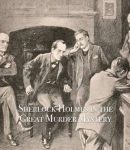 SHERLOCK HOLMES IN THE GREAT MURDER MYSTERY (1908) – Shamelessly, the Crescent Film Company of New York adapted Poe’s Murders in the Rue Morgue but replaced his master detective Auguste Dupin with Sherlock Holmes and the orangutan of the original story with a gorilla.
Actor William Kolle was in the starring role and an unknown actor portrayed Dr. Watson, supposedly the first time the sidekick was depicted on film. No copies of this short movie have survived but promotional materials have.
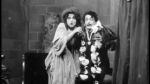 THE SEALED ROOM (1909) – Poe’s The Cask of Amontillado was adapted by film pioneer D.W. Griffith in this movie. Besides changing the title, Griffith altered the story to feature a philandering man and woman being walled up to die. Showing up in small parts during this 11-minute short were America’s future sweetheart Mary Pickford, and Mack Sennett, future comedy icon.
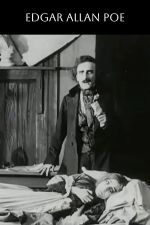 EDGAR ALLEN (sic) POE (1909) – D.W. Griffith wrote and directed this incredibly inaccurate biopic that set the tradition of the film industry’s inability to stick to facts – or in this case, spell the subject’s middle name correctly. Herbert Yost starred as Poe and Griffith’s wife Linda Arvidson played Edgar’s wife Virginia. Running time 6 minutes, 43 seconds.
Moving Picture World’s review called it: “A picture story founded on incidents in his career, which, while not pretended to be biographical, is intended to show him as a man of heart, in contradiction to the calumnies of his enemies. It portrays his devotion to his dying wife, and the writing of that wonderful masterpiece, ‘The Raven,’ for which he receives the paltry sum of ten dollars.”
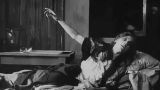 The publication’s take continued with “The picture itself does not represent a connected series of actual occurrences. All the events shown in the picture actually occurred in Poe’s life, but not all together. Nevertheless, it is a pathetic (meant complimentary) series which is offered and the audience, or that part of it which has taken some interest in Poe, was held quiet while the picture was running.”
“The technical quality of the film is good and the action is excellent. The makeup of the character representing Poe is to be heartily commended. The film should serve to draw attention to a character too little known and understood in the history of American literature.”
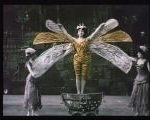 LE SCARABEE D’OR (1910) – Forty-minute French adaptation of The Gold Bug, directed by Henri Desfontaines. The stars were Denis d’Ines, Claude Benedict and Gabrielle Collona-Romano. This film dramatized Poe’s story of archeological clues fueling a man’s obsession with finding an entire treasure of lost gold. No copies of the movie are known to have survived.
IL POZZO E IL PENDOLO (1910) – Almost nothing but the title is known regarding this Italian adaptation of The Pit and the Pendulum. There was also an elusive French film version from 1909 titled Le puits et le Pendule, directed by Henri Desfontaines from Le Scarabee d’Or.
 THE PIT AND THE PENDULUM (1913) – Iconic director Alice Guy-Blache expanded on Edgar Allan Poe’s story in her screenplay for this adaptation which she also directed. The film ran three reels but, typical of so many silent movies, nitrate decomposition destroyed two of the three reels, leaving just one still watchable.
Critics, as they so often are, were upset with the violence, and with the scenes of rats crawling all over the bound protagonist of the story. In Guy-Blache’s memoirs she recounted how difficult it was to try managing the rats, since those were the days before Animal Wranglers in the film industry.
Medieval torture remains at the core of this suspenseful story but this time the reasons are fleshed out by Guy-Blache’s screenplay.
 LE SYSTEME DU DOCTEUR GOUDRON ET DU PROFESSEUR PLUME (1913) – French adaptation of Poe’s The System of Doctor Tarr and Professor Fether, directed by the one and only Maurice Tourneur. Edgar Allan Poe’s story presented the ultimate “inmates have taken over the asylum” horror set pieces. Amping things up was the fact that this 15-minute film was also based on the 1903 Grand Guignol Theater’s one-act play adapting the tale.
The “system” for curing lunatics devised by the madmen posing as Dr. Goudron and Prof. Plume involved gouging out an eye then slitting their throats. Tourneur knocked audiences for a loop with his depiction of the insane inmates surrounding the journalist hero and closing in for the kill.
This is yet another silent film that has not survived but extensive promotional materials do. In the U.S. the movie was released as The Lunatics.
MURDERS IN THE RUE MORGUE (1914) – Virtually nothing but the title and year of release have survived regarding this silent movie.
DIE BRAUNE BESTIE (1914) – A 20-minute German adaptation of Murders in the Rue Morgue directed by Harry Piel and starring Ludwig Trautmann & Hedda Vernon. German sources state the adaptation involves a detective clearing a man of a murder committed by a gorilla, but it’s not clear if they used Auguste Dupin as the detective’s name.
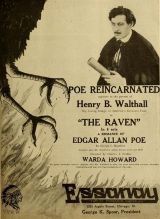 THE RAVEN (1915) – Charles Brabin directed and cowrote this second Poe biopic that isn’t really a biopic but just a punched-up depiction of events from the writer’s life. Henry B. Walthall starred as the adult Edgar Allan Poe after a look at his childhood. Warda Howard played his wife Virginia.
Viewers are shown Poe washing out at West Point, competing for Virginia’s hand in marriage and then failing to support her with his writing income. She dies and the film then has a drinking and drugging Edgar hallucinate a visit from a raven, inspiring the title poem.
A grief-crazed Poe is depicted obsessing over his late wife and being haunted by her ghost, inspiring some of his other writings. One day he encounters the real-life Sarah Helen Whitman, a woman he believes to be Virginia reincarnated. Poe also hallucinates being barred from Heaven before dying. 57 minutes of barely recognizable fragments of Edgar’s real life.
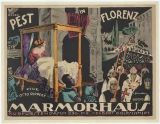 THE PLAGUE OF FLORENCE (1919) – Otto Rippert directed this film based on a script that THE Fritz Lang adapted from Edgar Allan Poe’s Masque of the Red Death. Lang placed the action in 1348 Florence, Italy.
The story was stretched out to one hour and forty-two minutes, with Lang and Rippert producing a memorable silent drama which gets more and more macabre as the Black Death claims more and more victims. The climactic scenes of the female embodiment of the Plague playing a fiddle, Nero-style, while people are dying by the hundreds are very striking.
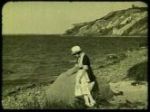 ANNABELLE (sic) LEE (1921) – A very, very, VERY loose adaptation of Poe’s piece. Elements of The Gold Bug are shoved into this tale of a romantic triangle, poetry and death by tuberculosis. Unrelated to Poe’s writings, the 55-minute flick just uses a few references to his work as its springboard.
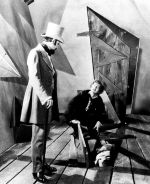 THE TELL-TALE HEART (1928) – This 24-minute short did justice to the Edgar Allan Poe story by not stretching it out to an unnecessary length. Viewers got the treat of a faithful Poe adaptation presented at a time when silent filmmaking was at its peak. There’s even a Dr. Caligari homage. For newbies to Poe, the story involves a murderer whose guilt makes him think he hears the beating heart of his dead victim.
 THE FALL OF THE HOUSE OF USHER (1928) – Director James Sibley Watson packed all the imitations of artsy German cinematic techniques as he could into this 13-minute adaptation of the Poe story. That’s not an insult, just me pointing it out.
Obviously, for an Edgar Allan Poe story those stylish techniques work wonderfully to depict the familial madness of the title Ushers and its supernatural effect on their crumbling mansion.
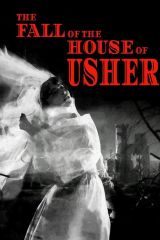 LA CHUTE DE LA MAISON USHER (1928) – France produced this 65-minute film based on Poe’s 1839 story. Jean Epstein directed from a screenplay by the iconic Luis Buñuel.
Sadly, Luis quit after feuding with Epstein over the changes the director was making to that screenplay. Jean changed Roderick and Madeline Usher from brother and sister to husband and wife. He also incorporated elements of Poe’s The Oval Portrait into the storyline.
In the end, what should have been a cinematic team-up for the ages was just a so-so film with some un-Poe-like brightness and happiness. Weird. Abel Napoleon Gance costarred.
 THE OVAL PORTRAIT (1934) – Though the studios had all switched over to sound productions instead of silent films by this point, USC’s Richard Bare chose to direct this adaptation of the Poe story as a silent. You can watch 13-minute and 18-minute versions of this short online.
Ray K. Immel and Margaret Reynolds starred in the tale of an artist so obsessed with completing a portrait of his beautiful wife that he neglects the real-life woman, failing to realize she is dying until it’s too late. Good, but marred by another misspelling of Poe’s middle name.
FOR ALL MY HALLOWEEN SEASON BLOG POSTS OF THE PAST CLICK HERE.
 Balladeer's Blog
What a genius he was
I certainly agree!
Pingback: EDGAR ALLAN POE: SILENT FILM ADAPTATIONS – El Noticiero de Alvarez Galloso
Logged, thank you sir!
Excellent! I must look forward to catching them. 🙏🤙
Thanks! I hope you enjoy then if you do!
I read some of the stories of Edger Alan Poe. Well shared
Thank you very much!
Welcome 🙏
😀
Fascinating post. I’d no idea there wee so many silent films of his work. Thank you for this.
Thanks! I’m always glad to share the info!
Your blog is always very interesting.
Thanks! That’s very nice of you!
Great posts as always. I have never heard of these silent films before.
Thank you very much!