
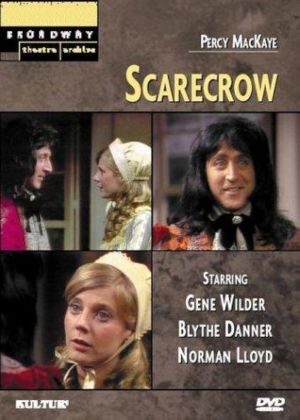
 THE SCARECROW (1972) – Gene Wilder, Blythe Danner, Nina Foch, Pete Duel and Will Geer starred in this Hollywood Television Theatre production that first aired January 10th, 1972. Long time readers of Balladeer’s Blog may recall my remarks on previous Halloweens about how underused I feel scarecrows still are in Halloween movies.
The Scarecrow, from the 1908 play by Percy MacKaye, was based on Feathertop aka Lord Feathertop, the 1852 short story by Nathaniel Hawthorne. The tale deals with a witch who brings a scarecrow to life to do her bidding. In the past I’ve reviewed silent film versions of Feathertop and pointed to it as an overlooked scarecrow tale.
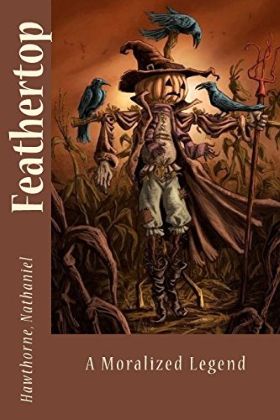 Percy MacKaye stretched the story out and altered some of the themes, so The Scarecrow is an adaptation of Feathertop, not a faithful dramatization of it. Gene Wilder portrays the scarecrow.
Nina Foch plays the witch Goody Rickby (Mother Rigby in the short story). She despises Will Geer’s character, the supposedly “respectable” Justice Gilead Merton (Hawthorne’s Judge Gookin).
Twenty years earlier, Goody Rickby had a fling with Justice Merton and even bore his son, who died as an infant. (In Feathertop the affair and child outside of marriage are hinted at rather than stated outright.)
Blythe Danner portrays Rachel Merton (Polly Gookin in Feathertop), the niece of Justice Merton, who lives with him along with her mother Cynthia (Joan Tompkins). Pete Duel – in his last role before taking his own life – plays Rachel’s betrothed Richard Talbot, who is as preening and sanctimonious as the other “decent” citizens of Boston.
The time period is the 1690s, established by Richard Talbot’s threat to Goody Rickby’s shaky status as a suspected witch, “We’re not as enterprising as they are in Salem, but we may yet come to it.”
The Scarecrow presents Rickby vengefully trying to lure the daring Rachel Merton into witchcraft to shame herself and her uncle. Rachel buys a mystical mirror from Rickby despite Richard forbidding her from doing so.
Meanwhile, Goody Rickby and her “errand boy” Dickon (Norman Lloyd) have been putting together a scarecrow. In this play, Dickon is very openly the Devil himself in human form and Lloyd plays him a bit campy but is fun to watch.
 The Devil and the Witch finish concocting the scarecrow intent on disguising him as a handsome dandy from England named Lord Ravensbane (instead of Hawthorne’s Lord Feathertop). The goal is to ruin Rachel and Richard’s romance by having the scarecrow steal Rachel’s heart and then bring disgrace and destruction on Rachel Merton and her uncle by revealing she is consorting with a living scarecrow, making her a witch.
Nathaniel Hawthorne presented Feathertop in the light of a Noble Automaton, ultimately too kindhearted to break Polly/ Rachel’s heart so he sacrifices his “life” to end their romance and let her marry a human male.
This made the animated scarecrow a better “man” than the high society fops who pursued the young lady partly because of the good her father/ uncle’s prestige could do for them.
MacKaye’s play The Scarecrow draws the story out to – in my opinion – unnecessary length. It goes on for at least 20-25 minutes longer than it has to and the padding is pretty dull. And though MacKaye kept Hawthorne’s gimmick of the scarecrow needing to frequently puff on the infernal tobacco in its pipe to remain animated, he alters the story’s theme a bit.
Gene Wilder’s Lord Ravensbane falls so thoroughly in love with Rachel (while encouraging her studies in witchcraft, unlike Feathertop) that eventually his love for her becomes his animating force, not the smoking of his pipe.
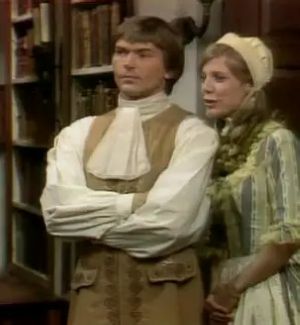 Also unlike Feathertop, Lord Ravensbane comes to forget his artificial nature and believes himself to be a real human being. That illusion is dispelled when he sees his true scarecrow self while he and Rachel Merton look in the witch’s mirror that the young lady bought earlier in the play. Lord Ravensbane is devastated by the revelation and does not long outlive his exposure.
Gene Wilder’s performance is impressive as he grows in sophistication from his first, awkward hours of “life” to his passionate and imperious nature the longer he is in the company of Rachel.
The one hour and forty-five-minute runtime of this commercial-free telefilm made this too long for most children’s attention spans, but the overall production is a bit too silly for adults. Puritan Passions, a 1923 silent movie version of MacKaye’s play, had a running time around 70 minutes, which would have helped The Scarecrow find a larger audience.
FOR ALL MY HALLOWEEN SEASON BLOG POSTS OF THE PAST CLICK HERE.
 Balladeer's Blog
Pingback: THE SCARECROW (1972) FORGOTTEN TELEVISION HALLOWEEN TALE – El Noticiero de Alvarez Galloso
Logged, thank you sir!
Good story 👏🏼 how do you get this old story?
It’s been published in various short story collections over the years and can also be found for free online.
Oh 😱
😀 😀
Nice read
Thanks very much!
Ooh, I’m definitely going to seek out a copy of Feathertop. Thanks – you’ve found a real gem with this spooky dandy scarecrow story!
Thank you very much! I hope you enjoy it!
Great posts as always. I have never heard about the forgotten television show “Scarecrow” before.
Thanks! I’m always glad to spread the word!
If you ever want to see some really frightening scarecrows, play the video game Divinity: Original Sin 2 some time. Man did those scarecrows kick the crap out of my party.
Wow! Thanks for the suggestion! I wasn’t aware of that.
Oh you’re welcome! I think I might have oversold it a little as it’s just one fight, in Act 2, but daaaamn is it a memorably tough one lol
No problem! I’ll adjust my expectations!