
 For this installment of my examinations of Greek comedies I will focus on one of the ancient Greek comedians whose entire corpus is very, very, VERY fragmentary, touching briefly on all of their known works. For background info on ancient Greek comedy plus my previous reviews click here: https://glitternight.com/ancient-greek-comedies/
ALCAEUS – This comic playwright came along for the tail end of Attic Old Comedy. Alcaeus’ career ranged from approximately 405 BC to the 380s BC and we have fragmentary remains of eight comedies from an unknown total body of work.
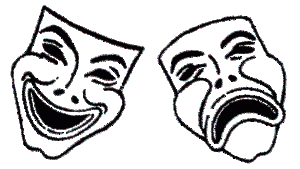 1. TRAGI-COMEDY – This play gave comedic treatment to the traditional rivalry between comedy and tragedy on the ancient Athenian stage. The comedy had fun with the inherent tensions between the two dramatic forms, including the fact that tragedy took pains to preserve the audience’s suspension of disbelief while comedy reveled in bursting the dramatic illusion via constant meta-theatrical breaking of the fourth wall.
Tragedy was the long-standing, prestigious and revered art form while comedy was the comparative newcomer and was still perceived as an upstart medium by the established writers of tragedy. One might also think of the Strauss opera Capriccio with its light-hearted rivalry between the music and the libretto in operas, with a writer of each claiming greater importance.
Academic interpretation of what little remains regarding this comedy includes highbrow elements addressing why tragedians never wrote comedy and comedians never wrote tragedy, and addressing the still-debated question if tragedians DID write both given the outright comedy of the Satyr Plays that the tragic poets wrote as fourth pieces after each of their tragic trilogies.
(My own opinion has always been that yes, Satyr Plays do mean tragedians could write both and that fact might have added to their faint disdain for the comic playwrights, whom they may have viewed as one-trick ponies.)
Academic debate continues over whether or not Alcaeus’ Tragi-Comedy was the source for a comedy of the same name from the period of Middle Comedy, which itself served as an inspiration for Plautus’ later play Amphitruo.
Debate also continues over what may be scenes from Alcaeus’ Tragi-Comedy depicted on some of the surviving Choregos Vases. These vases preserve our only images of the extraordinary and fantastic costumes worn in Attic Old Comedy.
Remember the comedies competed against each other (as the tragedies did) at festivals to Dionysus, most prominently the Dionysia and the Lenaea. Part of the festival atmosphere included vases decorated with images from the competing plays, with the play’s Choregoi (or “producers” to simplify the term for brevity’s sake) also paying craftsmen to make these vases which attendees could buy as mementoes of the occasion.
Every summer when you can buy 7-11 Big Gulps or Happy Meals with images from the latest blockbuster movies on them I always smilingly think of them as modern Choregos Vases. But I’m kind of weird. There were other wares being sold in keeping with the festival theme and for all I know people may have sported T-shirts saying “My parents went to the Dionysia of 426 BC and all I got was this stupid T-shirt”. Probably not.
2. SACRED MARRIAGE – A mythological burlesque of the most sacred wedding in Greek mythology: between the chief deity Zeus and his bride Hera, called Juno by the Romans and the reason why her namesake month of June is STILL the traditional month for weddings.
Insert my usual reminder that NOTHING was sacred in the “anything goes” arena of the Athenian stage comedies. Even the gods were fair game and were depicted in the most disrespectful manner imaginable. Today most religions are fair game, especially Christianity, and there’s even a faux-daring Broadway comedy ridiculing Mormon beliefs called The Book of Mormon. The last frontier in terms of actual irreverence today would come from lampooning Islam.
Picture a stage comedy presenting Muhammad’s marriage to Khadija, with Muhammad depicted as a male gold-digger pursuing the wealthy older woman. That’s the kind of respect for satirical comedy the ancient Athenians had! We all know that in reality a stage comedy about Muhammad would result in a bloodbath caused by many practitioners of the sole religion that perpetuates superstitious savagery like killing people just for drawing pictures of their central figure. Now that’s a religion BEGGING to be satirized. That is, by anyone with a backbone.
3. PASIPHAE – Another mythological burlesque, this one centering around the title woman. Hera cursed Pasiphae, the wife of King Minos of Crete, causing her to fall madly in love with a bull. Pasiphae’s attempts at seducing the bull met with no success, so she turned to her husband’s inventor, Daedalus, to construct an artificial cow body for her to wear so that she could, uh, consummate her passion for the bull. It takes no stretch of the imagination to picture how hilarious this bawdy story would be on stage.
The inter-species affair continued until Pasiphae became pregnant and gave birth to the man-bull creature called the Minotaur. More of the comedy came from Pasiphae and Daedalus’ attempts to civilize, educate and refine the creature so she could try to pass it off as another child from her husband Minos. In the end the savage brute resisted all attempts at acclimating it to life among a royal family and so Daedalus constructed the massive Labyrinth to contain the Minotaur.
This is the only comedy of Alcaeus with a definite date, since we know it was one of the five comedies competing in 388 BC. The other four were Wealth by Aristophanes, The Laconians by Nicochares, Admetus by Aristomenes and Adonis by Nicophon.
4. ENDYMION – A sendup of the myth of Endymion, a hunky shepherd who became the object of a romantic rivalry between Zeus and Hera. In the end the two stubborn deities would only be happy if NEITHER of them wound up with him and so Zeus put him into permanent slumber.
The moon goddess Selene (this comedy dates before her later conflation with Artemis) fell in love with the sleeping shepherd as she rode across the sky each night and began an illicit affair of her own with the young man. She would surreptitiously rouse him (as it were) from his enchanted slumber, then after coupling for a while would put him back to sleep and resume her journey in the moon-chariot.
5. PALAESTRA – The title refers to the wrestling gymnasiums of ancient Athens where men looking for male lovers would often hang out to try to pick up some of the well-bodied wrestlers. It was very, VERY common in Attic Old Comedy for the satirists to accuse various politicians and even each other of participating in this activity.
It was not against the law or even that outrageous a proclivity by their standards back then, it was just something to kid public figures with, like people today might make fun of a man’s weakness for large-breasted women or such. Anyway, for this comedy insert your own joke about the Village People song YMCA here.
6. GANYMEDE – Back to mythological burlesque with this comedy. The play lampooned the story of Ganymede, the beautiful young man who caught the eye (and other organs) of Zeus. The fragments tell us that Zeus took the lame fire and forge god Hephaestus with him to Earth to get Ganymede (though in most myths he sent a giant eagle to fetch the man for him), with slapstick humor resulting from Hephaestus’ limp. (Lighten up. It’s a comedy.) Zeus arranged for Ganymede to be ever at hand by making him immortal and assigning him to be the cupbearer for the gods.
7. SISTERS IN ADULTERY – Very little is known about this bawdy comedy involving clever women cheating on their dimwitted husbands.
8. CALLISTO – Only the title and one fragment remain of this comedy. It may have been about: 1. Callisto the young woman who had an affair with Zeus and was later transformed into Ursa Major OR 2. The Callisto who was a famous high-class prostitute in Athens and who had a famous risque encounter with the philosopher Socrates.
© Edward Wozniak and Balladeer’s Blog 2012. Unauthorized use and/or duplication of this material without express and written permission from this blog’s author and/or owner is strictly prohibited. Excerpts and links may be used, provided that full and clear credit is given to Edward Wozniak and Balladeer’s Blog with appropriate and specific direction to the original content.
 Balladeer's Blog
Pingback: ALCAEUS: ANCIENT GREEK COMEDIES – El Noticiero de Alvarez Galloso
Logged, thank you sir!
Interesting posts as always. I have never heard about this ancient Greek comedy before. But as always I found your posts engaging to read.
Thanks very much!
Dear Edward
It is a wonderful feeling to read your blogs.
🙏❤️💗💖
I appreciate it, thanks!
Good one 🤣 well shared
Thank you!
Welcome 🤗
😀 😀
Love it! Another play I’m not familiar with but will be shortly.
Thank you, Capn! I appreciate it!