
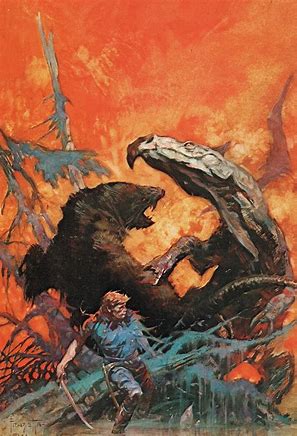
 GULLIVAR JONES ON MARS aka Lt. Gullivar Jones – His Vacation and various other titles and spellings, was published in 1905 and is one VERY odd piece of work. The author was Edwin L. Arnold, whose ineptitude made this novel very unfulfilling as he defeated his storyline at every turn. Before I get into this third and final part of my review of Gullivar Jones on Mars the links to the first two parts are below:
PART ONE – I examined the low-profile feud between fans of Edwin L. Arnold, who maintain that many elements of this novel “influenced” (to say the least) Edgar Rice Burroughs’ later stories about John Carter of Mars, and Burroughs fans. The parallels are many, and I laid them out while also pulling in Arnold’s novel Phra the Phoenician. Click HERE.
PART TWO – I reviewed the first half of Gullivar Jones on Mars, complete with what revisions I would make to correct the way Edwin L. Arnold never failed to sabotage his own work, letting intriguing concepts die on the vine or letting rising tension peter out into lame anticlimax. It’s almost comical how he did that. Click HERE.
GULLIVAR JONES ON MARS: PART THREE OF THREE
 MORNING ON THE ISLE OF BEASTS – We pick up the morning after our hero, U.S. Navy Lieutenant Gullivar Jones, survived the night on the Isle of Beasts – my name for the place, since Edwin couldn’t be bothered to provide names for places or characters much of the time.
As another odd diversion in this odd novel, Gullivar’s first person narration describes the bloody aftermath of the evening’s battles between assorted Martian creatures the size of dinosaurs. There had been nothing gory prior to this point in the book, but for a few paragraphs the author rivals the future Robert E. Howard in describing the dismembered limbs, torn-open torsos and blood-soaked fragments of organs that litter the ground.
My revision: None regarding the aftermath, but I would have had our hero be a participant in the previous night’s fighting, given his greater than human strength on Mars. Edwin Arnold just had him as a spectator.
Gullivar sets out to explore the rest of the island to find a way of resuming his quest to recover his abducted love interest Princess Heru, the yellow-skinned, green-haired beauty. He encounters a fisherwoman who superstitiously views him as a spirit due to his odd (to the Martians) skin color and his super strength.
The athletic fisherwoman provides our hero with breakfast, since the narrative is never consistent on how the Martians view spirits. He asks about the Thither People, brutish, hairy humanoid savages who abducted Princess Heru for their ruler, King Ar-Hap.
The woman (as usual unnamed by Arnold) tells him about the savages’ homeland to the northwest of the Isle of Beasts. She directs him to her home village since she has more fishing to do, and he sets out through the jungle to procure a seagoing vessel from the villagers.
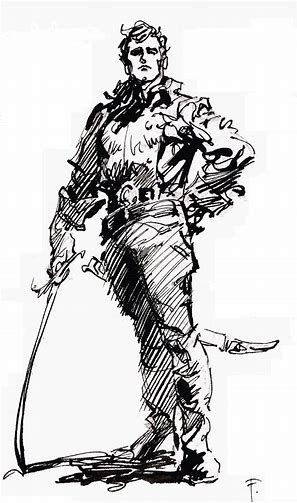 THE JUNGLE OF MENACE – Again, my name for it since Arnold provides none. The author manages to shine once again as he has the sword-wielding Gullivar describe the menacing life-forms who inhabit the jungle.
This northern jungle lacks the dinosaur-sized creatures from the south but is filled with chimeric combinations of predatory life-forms. Their bodies resemble Earth animals but in weird hybrid ways. There are also large carnivorous plants which crawl around on crablike legs or slither like snakes or climb like insects. Arnold’s grotesque description of a bird-like beast feeding on some of the living plants stays with you.
My revision: I would again depict Gullivar having to do some actual fighting to get through this jungle. Once again, Arnold himself simply had our main character make his way through without any of the deadly creatures paying him any mind. Not exactly exciting.
Gullivar reaches the fisherwoman’s home village. She had just been there and then went out on another fishing expedition, so the villagers know of him. They provide him with one of their “boats” which are formed out of enormous gourd-like vegetation which they hollow out.
NOTE: Jones can’t help but notice how much more energetic and enterprising the islanders are compared to Princess Heru’s subjects the Hither People back at the city of Seth. Unlike the pampered, drunk and high Hither People, who live listless Lotus Eaters type lives, the islanders still live with purpose given the perils they face on their creature-infested island.
 THE RIVER OF DEATH – Okay, for once Edwin Arnold did provide a place name. As Gullivar prepares to set forth with his gourd-boat full of supplies, the islanders tell him he must paddle northward for six hours, then turn westward into the mouth of a river which will lead him to the Thither People’s capital city. The city’s name is apparently none of our damn business.
They also tell him he must at all cost avoid the darker-watered mouth to the River of Death, down which the Hither People float their dead in richly appointed ships. In another concept that Burroughs later reused as the River Issus, Arnold’s Martians believe the river leads to the actual realm of the dead, from which no one returns.
Gullivar does as directed, but as the six-hour mark approaches, realizes that the islanders failed to take into account his superior strength compared to theirs. His rowing took him further, faster than they could go. He is too far north and growing cold.
Our hero turns around and rows southward, looking out for a continent to the west so he can try to find the river that will take him to Ar-Hap’s city, where Heru is being held. Unfortunately, the whirling waters at the mouth of the River of Death are too strong even for his paddling to resist and since he passes that river mouth first, he and his boat get carried downstream.
Along the winding river he encounters previous death-barges which got stuck on rocks or in shallow pools. Ultimately, Gullivar is lucky to escape getting carried over a waterfall that plunges so far down that even with his strength it would likely have killed him.
Our title character finds he is now in a snowy, icy land. He finds the ruins of a massive Mortuary City which was obviously another victim of the mysterious Cataclysm which hit Mars in the distant past and which other characters have made enigmatic references to.
At one time it was populated by a priestly caste who would receive the dead sent down the river and preserve them in icy “shelves” in the enormous amphitheater that made up the bulk of their city. Gullivar lights a fire for himself and the warmth melts a little bit of the ice and the frozen corpse of a king falls out.
Jones puts the dead man’s crown and gold-plated jaw in his packet (as one does) and moves on. Days later, our famished hero encounters a member of the Thither People’s hairy, savage race. He (unnamed) is very old so rather than participate in the warfare and plundering of the younger Thither People he makes his fortune by scavenging precious metals and jewelry from the long-dead figures in the sprawling necropolis.
The Old Hairy Savage is unable to kill Gullivar, so he accepts him as a travel mate. Jones learns a lot about Martian history from the Old Hairy Savage, history that Princess Heru’s decadent people were not at all interested in.
Old Hairy Savage informs our main character that the long-ago Cataclysm not only wiped out the nearby City of the Dead (my name for it) via earthquakes and the like, but it thoroughly damaged the Hither People’s major cities all across the planet. In the aftermath, the Thither People, who had been oppressed and preyed upon by the ancestors of the Hither People, rose up.
Under their long line of kings, with Ar-Hap being the latest, the Thither People conquered city after city to become the dominant people on Mars. Scattered Hither People cities still exist, like Heru’s city called Seth, but Ar-Hap refrains from slaughtering them in order to use them as periodic sites for raiding and plundering.
Old Hairy Savage also tells Gullivar that he assumes he is either a spirit or a man who fell from the stars, like another figure who lives far to the south. (Don’t bother wondering about that Man from the Stars. He’s never brought up again, as Edwin Arnold lets another promising idea die on the vine.)
My revisions: None really necessary for the past several pages, but I would omit referring to the Man from the Stars since that reference goes nowhere, even though Gullivar expresses interest in finding the man to see if he, too, is from Earth.
The people at Old Hairy Savage’s village of Thither People casually accept Jones as a spirit, just in case you thought something interesting was about to happen, like them trying to kill Jones the way Old Hairy Savage did upon meeting him.
The inhabitants of this village of Thither People are indifferent toward Gullivar’s plans to barge into Ar-Hap’s capital and retake Princess Heru. In the hands of a better writer, this could have been a springboard to pointing out that the bulk of the hairy savages are indifferent toward King Ar-Hap because they, as commoners, never get to share in the proceeds of Ar-Hap’s wars of conquest and are just content not to be oppressed by Hither People like their pre-cataclysm ancestors.
Instead, Edwin Arnold has every Thither Person he meets not be the least bit concerned that Gullivar intends violence against their king. Thither People even feed Jones and help him on his way from here, robbing his quest of nearly all trace of danger. Only Ar-Hap’s soldiers ultimately take action against Gullivar.
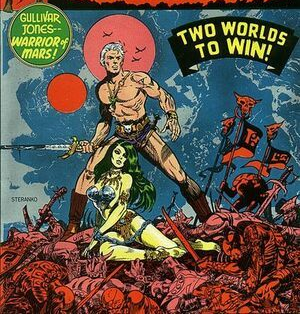 THE CITY OF QUEEN YANG – As Jones bobs along from one band of accommodating Thither People to another accommodating band of Thither People, he learns about the legend of Queen Yang and her City. Queen Yang’s City (unnamed, of course) was the Hither People city that held out the longest against the Thither People’s armies after the Cataclysm.
The men and women of that city all laid down their lives fighting to hold off the hairy savages until all that was left in the place was Queen Yang herself and roughly one thousand children of the city who were too young to fight.
Queen Yang proceeded to kill all of those children to keep them out of the hands of the Thither People, then took her own life. Finding nothing but a dead woman surrounded by dead children spooked the superstitious Thither People. Their army fled the city and never returned.
Over the centuries the city became overgrown with vegetation and trees grew so plentifully in the area that that entire section of forest was avoided because of the tales of Queen Yang and the dead children haunting it.
Believe it or not, Edwin Arnold actually follows through on some foreshadowing! As Gullivar Jones approaches Ar-Hap’s capital city, he gets lost due to a heavy fog that often clings to the “haunted” forest. He ends up coming across the City of Queen Yang.
Though nothing supernatural has happened up until now in this novel, Gullivar encounters the actual ghosts of the dead children inside the city. He foolishly follows them until falling asleep, exhausted.
Overnight, Queen Yang in skeletal form visits Jones in a dream but does him no harm. And another chance for something dramatic to happen slips away! The next day, while searching for a way out of the labyrinthine city, Gullivar comes across the bones of Queen Yang, surrounded by the skeletons of the thousand children she killed.
Based on nothing, Jones assumes that Queen Yang must have been the last full-blooded queen of the Hither People, so he takes her crown off her corpse just like he did to the frozen king in the north. Such a hero!
Our title character believes that having Princess Heru wear the crown of that woman he is convinced was her direct ancestor will … well, I don’t know what he thinks it will do. Don’t worry, though, because Heru’s possible descent from Queen Yang has no impact on the rest of the story. At all.
Gullivar makes his way out of the city’s ruins without further incident, but I’m sure you guessed that already in this book. He approaches Ar-Hap’s capital and holes up for the night in a nearby port city. If Arnold told us what the city is called he’d have to kill us, I guess. Anyway, a married pair of Thither People shelter him for the night and raise no objection to his plans to take Heru and flee back to Seth.
If this had been an actual adventure novel, our hero would probably have woken up surrounded by enemy soldiers to whom the married Thither People would have betrayed him. Instead, he just wakes up and makes his leisurely way by ship a few miles up the coast to the capital.
NOTE: If you’re wondering, every Thither Person Jones meets still just accepts him as a spirit or something similar and never interferes with him. Wow! I was on the edge of my seat reading this!
My revisions: I’d have had something, ANYTHING happen to our hero in Queen Yang’s City. Have him fight a creature or do something more with the oddly introduced and abruptly dropped ghosts. Or at least have Gullivar needing to be surreptitious as he makes his fugitive way through the Thither People villages on his way to confront Ar-Hap and free Heru.
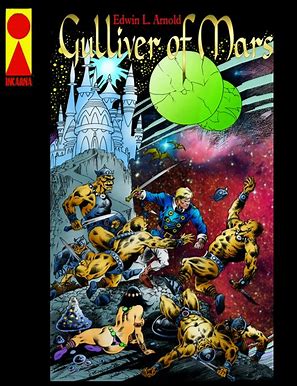 KING AR-HAP’S CAPITAL CITY – Having learned that Ar-Hap is momentarily out of the capital leading a punitive expedition against a rebellious village of Thither People, Gullivar at last gets the lead out and tries to get the princess and escape before the king gets back in town.
Conveniently, he encounters a previously abducted Hither People woman – AND SHE ACTUALLY HAS A NAME! She is named Si and she was King Ar-Hap’s captive plaything until he grew bored with her, then she was given to one of the king’s underlings as a reward. She agrees to help Jones get into the palace.
NOTE: Periodically over the past few chapters the temperature has grown hotter and our hero was just assuming it was typical for this part of Mars. Now that foreshadowing is followed up by the appearance of a light brighter than the moons Phobos and Deimos in the sky.
Before Gullivar can find Princess Heru and escape back to Seth with her and Si, King Ar-Hap returns with his army. All the villages are growing frantic at the atypical heat and the light in the sky. As it draws ever nearer, Jones realizes it is a comet.
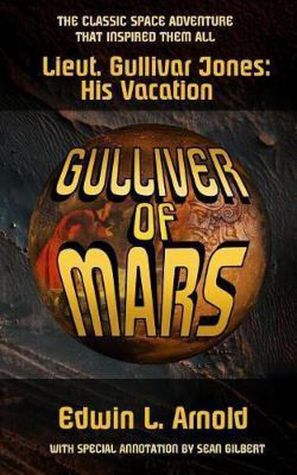 THE CATACLYSM – Okay, credit where it’s due, Edwin Arnold handled this bit of business well. Gullivar learns that the long-ago Cataclysm must have been caused by this same comet passing by Mars hundreds if not thousands of years ago.
This time the comet is passing even nearer to the Red Planet, causing intense heat and scalding hot rain. No earthquakes this time for some reason, but the heat is causing animal life to panic and enter the cities where they … gently hang around with the inhabitants. You didn’t think something exciting like an animal apocalypse was going to break out, did you?
At any rate, Arnold is back to making his case for being called one of the worst storytellers in history. Despite the chaos, Gullivar is reunited with Princess Heru as King Ar-Hap and he … TALK about him letting Heru go.
Jones tries to bluff Ar-Hap into cooperating by playing into the notion that he is a spirit. The king isn’t easily swayed and wants some proof. (Uh, guys, there’s a comet approaching. Mobs are at large and fires are starting.)
As proof, Ar-Hap demands that Gullivar accomplish two tasks. Edwin Arnold now CEMENTS his case for being called one of the worst storytellers in history. The two tasks he wants Jones to perform are to recover the crown of the late Queen Yang and recover the crown and gold-plated jaw of a long-dead king from northern Mars.
Yes, you read that right. Against astronomical odds, King Ar-Hap challenges Gullivar Jones to recover artifacts HE ALREADY HAS WITH HIM! And on top of that, not only is Queen Yang’s crown one of the prizes he must secure but the frozen, unnamed king whose crown and gold-plated jaw that Jones took at random JUST HAPPENS TO BE THE LONG DEAD KING THAT AR-HAP IS REFERRING TO!
My revisions: Instead of this beyond serendipitous turn of events, I would have had Gullivar reach Ar-Hap’s capital much earlier in the novel. He could try negotiating for Heru’s release by impressing the king with the superhuman strength he possesses in Mars’ weaker gravity.
Ar-Hap could then set him the two tasks. Our hero could go forth and deliberately obtain the specific items demanded by Ar-Hap. After Jones returns with them, the king could villainously refuse to keep his word and order Gullivar killed.
Amid a thrilling battle between Jones and Ar-Hap’s soldiers the heat could increase and the comet be sighted in the sky. Amid the chaos Gullivar could get himself, Princess Heru and Si out of the city.
Back to the novel. Gullivar, Princess Heru and Si agree to wait in the capital city while Ar-Hap and some of his soldiers travel to a nearby sacred mountaintop to pray for the comet to spare Mars. To make that agreement even more pointless, after a few days go by with no word from Ar-Hap and the comet still approaching, our hero FINALLY decides to grab the ladies and flee.
Frustratingly, Ar-Hap and his soldiers NOW arrive back in town. The heat increases and everyone grows weak from thirst and heat prostration. How will Edwin Arnold screw up THIS dramatic moment, you may ask.
Simple. He just has the comet continue passing by without causing any more damage. At all. Our heroes, who idiotically stayed in the city, HANG AROUND FOR A FEW MORE DAYS (during which Si dies) before finally deciding to revisit their plan to escape. This time they go through with it but Ar-Hap and his ships set out after them, knowing they’re headed back to Heru’s home city of Seth.
Arnold drags out the little bit of story that’s left over the course of a few more exasperating chapters. I’ll leave out all the false starts and culs de sac and simply summarize what happens.
Gullivar and Heru’s ship arrives back in Seth first, of course, and Arnold depicts several pointless delays and hinted at complications that don’t materialize. Then, at another ceremony, Ar-Hap and his navy arrive to kill Jones, completely destroy Seth this time and retake Princess Heru.
Just like the initial raid when Heru was abducted, the Hither People are far too passive and frightened to fight back. They die by the thousands – including the city’s ruler Prince Hath – as Gullivar tries to keep himself and Heru alive.
Eventually, some of Princess Heru’s ladies in waiting tell Jones they can secretly take her up one of the rivers to a Hither People city much further inland. Arnold never makes it clear if that will put her beyond the reach of Ar-Hap and his troops or if it’s just a delaying measure.
As Ar-Hap’s men prevent Gullivar from being able to join the fleeing retinue of Princess Heru, he barricades himself in a supply room and holds the Thither People off. In another astronomical coincidence, among the objects in the supply room is the magic carpet which transported Jones to Mars in the first place.
With no closure regarding Princess Heru’s safety, the carpet returns our hero to New York City. Yes, just like in Edgar Rice Burroughs’ very first John Carter story, the Earthman on Mars is returned to his home planet via the same idiotically contrived manner in which he arrived on Mars in the first place. And he has no idea about the ultimate fate of his princess.
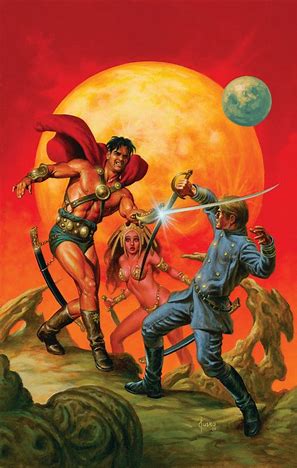 REMINDER: In part one I laid out all of the similarities between this 1905 novel and Burroughs’ first John Carter story years later. I also mentioned how both Arnold AND Burroughs may have imitated Gustavus Pope’s 1894 novel Journey to Mars.
In that 1894 work U.S. Naval Lieutenant Frederick Hamilton gets abducted by a spaceship from Mars and taken to the Red Planet. Like Gullivar Jones and John Carter, Hamilton winds up meeting different-colored races of Martians and romances a beautiful princess amid a series of adventures.
Pope even wrote a sequel novel in 1895 titled Journey to Venus, which saw Frederick Hamilton and his beloved Princess Suhlamia having sword and science adventures on that planet.
At any rate, back to the Arnold novel. Once Jones is back in New York City, Gullivar’s fiancee Polly is thrilled to see that he has finally shown up after a few weeks of being missing. Also, Jones gets his long-awaited promotion in the U.S. Navy and that means her parents will regard him as a prominent enough young man for their daughter.
Gullivar and Polly agree that nobody else will believe what really happened to him during the weeks he was missing, so he writes his account of the events and publishes it as science fiction. What did Jones do with the magic carpet? None of our damn business!
And that wraps up my look at Gullivar Jones on Mars. That is one weird, frustrating, yet oddly intriguing science fiction novel. +++
FOR MY ORIGINAL LIST OF TEN DIFFERENT WORKS OF “ANCIENT” SCIENCE FICTION CLICK HERE
 Balladeer's Blog
Great write-up! I’m a John Carter fan. Certainly seems this influenced Burroughs.
Thanks! You know it!
Pingback: ANCIENT SCIENCE FICTION: GULLIVAR JONES ON MARS (1905) CONCLUSION – El Noticiero de Alvarez Galloso
Logged, thank you sir!
Wonderful posts as always. I have never heard of this ancient science fiction story before but as always found your post extremely engaging. The setting of the story on the planet Mars reminded me of great science-fiction films set on Mars that I have seen. For instance, it brought to mind the great film “The Martian”. Ridley Scott’s blockbuster captured the life of an astronaut seeking to survive on Mars. One of my favourite science-fiction films of all-time. It shares similar themes to the ancient science-fiction story you discuss here.
Here’s why I recommend it strongly:
Thanks! I have not yet seen that movie.
Pingback: Sensor Sweep: Edgar Rice Burroughs, Dragon Magazine, Red Sonja, Tanith Lee – castaliahouse.com
Logged, thanks!