
The Frontierado Holiday falls on Friday, August 1st this year. As always, this holiday celebrates the myth of the Old West, not the grinding reality.
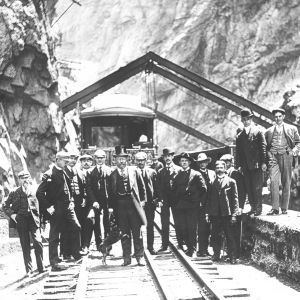 ROYAL GORGE RAILROAD WAR – To this day I’m astonished that comparatively few people are familiar with the 1878-1880 war between William Jackson Palmer’s Denver & Rio Grande Railroad and William B. Strong’s Atchison, Topeka and Santa Fe Railway. Fighting started near Trinidad, CO in February 1878. The initial goal was to lay the first railroad lines through Raton Pass on the border between Colorado and New Mexico.
The competition grew violent and involved famous gunfighters like Doc Holliday, Texas Ben Thompson (also called Texas Thompson), Bat Masterson, Mysterious Dave Mather, John Joshua Webb, David “Prairie Dog” Morrow and Dirty Dave Rudabaugh (he was called Arkansas Dave in Young Guns II because they had used Dirty Steve Stephens in the first movie and apparently didn’t want to have another “Dirty” nickname in the sequel).
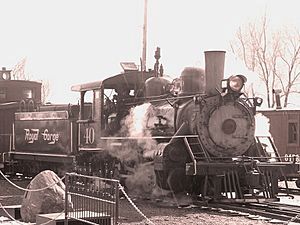 That’s more name appeal than many Range Wars of the Old West had, so you’d think there’d be at least as many movies about this situation as there’ve been about the Earps and Doc Holliday vs the Clantons and McLaurys. It’s not like Westerns have ever cared about historical accuracy so they could easily spice up the slow periods of the war involving the outcome of assorted court cases.
At any rate, gangs from each side raided the other side, stealing or destroying equipment. The mercenary gunslingers used crude stone forts (DeRemer Forts) to fire from to try driving off the other side’s saboteurs or gunmen. Both sides even killed rival construction crews via rockslides.
Sabotage parties struck at both companies’ equipment and facilities, leading to the Atchison, Topeka and Santa Fe hiring gunmen to accompany their sabotage parties. This gave them an edge.
The Denver & Rio Grande was suffering a cash flow problem, so they yielded to their rivals in this early stage of the war. Early the following year, a Silver Rush in Leadville, CO made the Royal Gorge the next crucial pass for the competing railroads.
Determined not to be intimidated again, the D&RG hired gunslingers of their own by March 1879. This prompted the AT&SF to add to their own lineup of gunfighters leading to both sides having dozens of mercenaries in action. Bullets flew everywhere, including depots and engine houses.
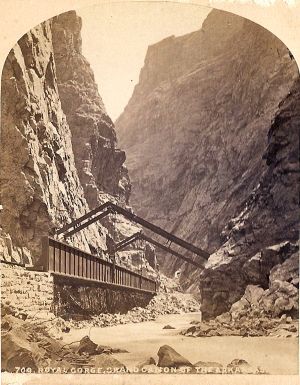 For a time, this Royal Gorge phase of the war was more like a modern-day gangster war than a cinematic western war of shoot outs. Only the active participants knew who really killed who and when during that period of the violence, making exact attribution impossible outside of a few incidents.
Meanwhile, the court cases between the feuding railroads continued winding their way through the legal system. On June 10th of 1879, the Fourth Judicial Circuit Court ruled in favor of the D&RG.
That railroad wasted no time taking advantage of that ruling. (Eventually the U.S. Supreme Court would also rule in favor of the D&RG) With the law now clearly on their side, the D&RG enlisted the help of actual lawmen in the region and struck down several AT&SF strongholds.
Soon, the Denver & Rio Grande’s “offensive” brought the heavy fighting to the Atchison, Topeka & Santa Fe garrison in Denver. When that fell, the Colorado Springs garrison was taken down next.
By now, Bat Masterson and his men holed up in their Pueblo, CO stronghold. The D&RG men tried to commandeer a cannon at the State Armory but Bat’s side beat them to it and used the cannon to help defend their Pueblo roundhouse.
Before long, the besieging D&RG forces defeated Masterson and his big names, who surrendered. Periodic eruptions of further violence continued, but on March 27th, 1880 the rival railroads signed what has been called “the Treaty of Boston,” ending the war. The total number of those killed in the conflict is unknown.
Accounts vary about Masterson & company’s surrender being legit or if Bat was bribed to give up just to finally bring the violence to an end. I’m sure the fact that the side with all the famous gunfighters lost has been a factor in the lack of attention paid to this Railroad War.
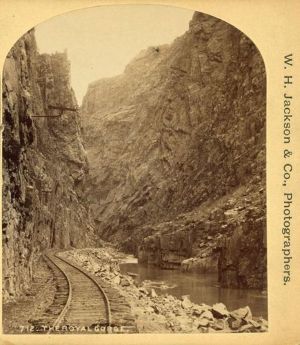 Still, though, I’m surprised facts were any obstacle. Movies persist in pretending the Earps and Doc Holliday won their war with the Clantons and McLaurys even though it was the former who were forced out of Arizona Territory.
Since both sides in this railroad war were basically in the pay of tycoons a movie script could make it look like Bat Masterson, Doc Holliday, Texas Ben and the others grew “disillusioned” with the Robber Baron they were fighting on behalf of and roguishly accepted bribes to just surrender.
At any rate, this 1878-1880 conflict deserves to have as big a name as the Lincoln County War, the Pleasant Valley War, the Johnson County War, the Mason County War and other “wars” of the Old West.
 Balladeer's Blog
Building transcontinental RR was not easy, clean, and often bloody from what I’ve read. This article is interesting.
Thank you. I’m always surprised it hasn’t gotten as much fame as other Old West conflicts. Hell, Doc Holliday, Bat Masterson, Texas Ben & Mysterious Dave alone are such a draw!
Impressive
Thank you.
Very interesting indeed! I love your very atmospheric original photographs — I’ll need to show my husband these; he’ll be super impressed!
Thank you very much! I hope he is!
Very interesting post. I am not familiar with the history of railroads in the Old West so I found this to be incredibly informative. It did bring to mind great western movies I have seen that capture the railroad. For instance, it brought to mind the amazing movie “3:10 to Yuma”. Released in 2007, James Mangold’s movie captured a railroad in the Old West. One of my favourite films of all-time. If you are interested in railroad wars of the Old West, I highly recommend it.
Here’s my thoughts on the movie:
https://huilahimovie.reviews/?p=277551
Thank you very much!
I am pretty sure all this was the inspiration for “The Line” (demonic corporate railroad trains) and “The Gun” (demonic revolvers and the gunslingers who wielded them) which did battle in The Half-Made World, a steampunk weird Western fantasy novel by Felix Gilman. Both of them were bad, but it was pretty clear by the end of it which one was worse. I won’t spoil it for the reader though.
Wow, I’ve never heard of either of those. Thanks for the warning about the low quality. If I buy them it will be with my eyes wide open.
Oh, no, sorry, The Half-Made World book itself was fantastic! I meant that both the Line and the Gun were bad, but that in the end, it was pretty obvious that one of them was worse. 😁
Oh, okay, I understand.