
 HAPPY MEMORIAL DAY! Balladeer’s Blog takes a look at the Union Army’s Michigan Brigade of Volunteers – nicknamed the Wolverines – from the U.S. Civil War. I’m focusing on them because, though not unknown, increasing numbers of people have taken to ignoring their contributions to the Union victory just because of the post-Civil War career of the Brigade’s commander – General George Armstrong Custer.
I’m no Custer fan myself, but the men who served under him in the Civil War don’t deserve to be thrown a figurative cold shoulder because of the ugliness later associated with the man leading them. The soldiers of the 1st, 5th, 6th and 7th Michigan Cavalry plus Artillery Battery M, the units in the Michigan Brigade, were crucial to victory.
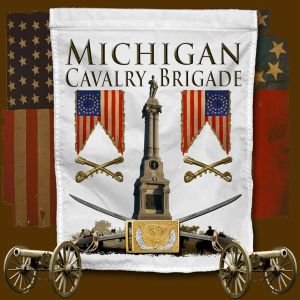 The brigade was first being formed in December, 1862 and on June 29th, 1863 newly promoted General Custer assumed command.
BATTLE OF HANOVER – On June 30th the Michigan Brigade took part in this battle set in Hanover, PA. It was part of the leadup to the Battle of Gettysburg. The Union thwarted Confederate Cavalry General J.E.B. Stuart’s attempt to link up with the main Confederate Army under Robert E. Lee.
HUNTERSTOWN – With the Battle of Gettysburg having started the previous day, the Brigade fought in this July 2nd, 1863 clash along Beaverdam Creek near Hunterstown, PA. They forced Confederate General Wade Hampton’s cavalry to withdraw.
BATTLE OF GETTYSBURG, DAY THREE (July 3rd, 1863) – The Michigan Brigade saw vicious action at multiple locations throughout this climactic day of the Union victory. Online sources detailing Gettysburg fighting do far more justice to the brigade’s heroics than I can do here. This day saw Custer make with the memorable cry “Come on, you Wolverines!” as he led his men into battle.
BATTLE OF FALLING WATERS aka the BATTLE OF WILLIAMSPORT (July 12th and 13th) – Lee’s Confederate forces fled south after their loss at Gettysburg but when they arrived at the Potomac River near Williamsport, MD they found that flooding had made the river impassable. Lee’s men settled in, backs to the water, prepared for battle.
At this point in the war, the Union Army still suffered from lethargic leadership at the top. (The far more energetic General Ulysses S. Grant would not take command of the entire army for several months.) That lethargy meant that it was not until July TWELFTH that Union forces – the Michigan Brigade among them – entirely caught up with Lee.
Skirmishes late in the day on the 12th became large-scale actions on July 13th. Unfortunately, by now the flooded Potomac’s waters had sunk low enough that the Confederate Army was able to escape.
JULY 14th, 1863 – Union cavalry units – among them the Michigan Brigade – defeated and captured roughly 700 Confederate soldiers in the rearguard of the forces which had just crossed the Potomac.
AMISSVILLE, VA (July 24th, 1863) – By July 24th, Lee had concentrated his remaining forces around Jeffersonton, VA. Cavalry and Artillery units of the Michigan Brigade, probing and reconnoitering, fought it out at nearby Amissville, VA with the troops of Confederate Generals James Longstreet and A.P. Hill.
Overpoweringly outnumbered, the brigade was at last able to fight its way free and retreat without losing any artillery. Two members of the Michigan Brigade – Captain Smith Hastings and Lieutenant Carle Woodruff, received Medals of Honor for their actions at Amissvillle.
BRISTOE CAMPAIGN (October 13th – November 7th, 1863)
FIRST BATTLE OF AUBURN (October 13th) – At Auburn in Fauquier County, VA the brigade was among Union forces that clashed with J.E.B. Stuart’s cavalry. Stuart withdrew but remained nearby.
SECOND BATTLE OF AUBURN (October 14th) – The Michigan Brigade and other units under Union General Gouverneur K. Warren found and fought the Confederates. Stuart’s cavalry was able to escape but the brigade prevented the South from capturing their supply wagons.
BATTLE OF BRISTOE STATION (October 14th) – Later in the afternoon of the same day many of the same units on both sides battled again in this Union victory.
BATTLE OF BUCKLAND MILLS (October 19th) – This Confederate victory saw Union Generals Custer, Davies and Kilpatrick defeated by Confederate Generals Fitzhugh Lee and Stuart.
BATTLE OF MINE RUN (November 27th, 1863 – December 2nd, 1863) – Five days of inconclusive fighting, with the Michigan Brigade among the combatants, ended the campaigns in this region for 1863.
KILPATRICK’S RAID TOWARD RICHMOND (February 28th, 1864 – March 1st, 1864) – The brigade was part of the 5,000 cavalrymen fighting in General Judson Kilpatrick’s Raid Toward Richmond which caused massive destruction and clashed with various Confederate units.
OVERLAND CAMPAIGN (May 4th – June 24th, 1864)
The Michigan Brigade fought in the battles of this campaign throughout Virginia, including Trevilian Station, the largest pure cavalry-on-cavalry battle of the war. (June 11th – 12th).
The other battle of the campaign which featured the Wolverines was Haw’s Shop aka Enon Church (May 28th).
DEFENSE OF WASHINGTON DC – July of 1864 saw the brigade among the units summoned northward to protect Washington DC from Confederate General Jubal Early’s campaign. The Michigan Brigade ultimately did so by forcing Jubal to retreat south through the Shenandoah Valley after their encounter at Winchester, VA on August 11th.
BATTLE OF OPEQUAN (September 19th, 1984) – This battle is also called the Third Battle of Winchester. The Michigan Brigade, one of the brigades under Union General Phil Sheridan, attacked and defeated Confederate forces under Generals Breckenridge, Early and Gordon.
BATTLE OF FISHER’S HILL (September 21st – 22nd, 1864) – Union General Phil Sheridan again led the Michigan Brigade and thousands of other troops in an attack on Confederate General Jubal Early’s heavily defended position near Strasburg, VA. Despite Early’s advantages the Union forces won.
*** On September 26th, 1864 General Custer was promoted to Divisional Command and James H. Kidd assumed command of the Michigan Brigade, making it “safe” for people who hate Custer to start crediting the accomplishments of the Wolverines.
 Balladeer's Blog
One of my great-great-*-grand 48er-immigrant uncles, father- and grandfather-sides, fought with the Michigan Brigade, 6th Cavalry (judging from letters written much later). He was wounded at Enon Church.
Wow! That’s so cool! Thanks for sharing that!
Well done.
Thank you!
I appreciate it!