
For Balladeer’s Blog’s overview of the entire Kapitan Mors der Luftpirat series click HERE. For my look at the first five stories in the weekly text series click HERE.
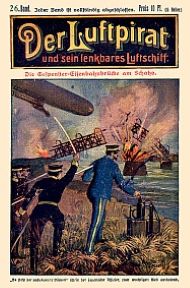 THE GHOST RAILWAY BRIDGE ON THE SHAHO – Our masked hero and his crew on their Luftschiff are in the sky above the River Shaho. They observe the Russian and Japanese armies preparing for another monumental battle. NOTE: The Kapitan Mors tales are like the Sherlock Holmes stories in that they often jump around in time. This one is set during the Russo-Japanese War, so much earlier than most of the Mors stories.
To avoid the mass casualties of the previous battle at Shaho, Kapitan Mors and his men do a psy-op against his hated Russians. They stage seemingly supernatural events surrounding a “ghost railway” and push the Russian commander to the brink.
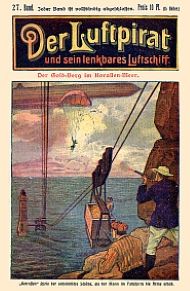 GOLD MOUNTAIN OF THE CORAL SEA – At the secret island headquarters of Kapitan Mors near New Zealand, his spaceship the Meteor is well advanced in its construction. For vital technology regarding anti-gravity he and his crew fly to the Scottish Highlands, where hides LeComte, a mad French scientist known for his advances in anti-gravity.
LeComte uses his lair’s energy beams in a battle with Mors and his Luftschiff. Reaching a stalemate, the Frenchman offers to sell his secrets to the Air Pirate, but the price he demands is so high our hero can only obtain it in one spot – the rumored Mountain of Gold somewhere between the Coral Sea and Australia’s Gulf of Carpentaria.
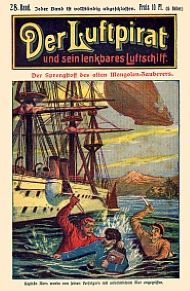 THE ANCIENT MONGOLIAN EXPLOSIVE – While flying over Mongolia, one of the Luftschiff’s huge propellers suffers damage and falls off. Kapitan Mors and his men land down below to find the propeller and effect repairs. Mors leads an expedition in search of the propeller.
At one point, off in the distance, our heroes see an entire Mongol village destroyed. An enormous column of flames shoots high into the air, accompanied by potent blast waves. Mors investigates and tries to obtain the power source which ancient Mongolian wizards believed was magic but which our Air Pirate believes is an element that can power his planned voyages into space.
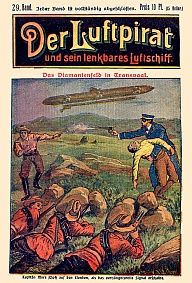 THE DIAMOND FIELD IN TRANSVAAL – The Kapitan has at present exhausted his stores of industrial diamonds that help keep his Luftschiff running. Word of a fresh strike of diamonds in the Transvaal prompts him to lead his crew on a flight there.
The Air Pirate’s notoriety is such that he and his crew face jeopardy every minute they spend there, especially in Pretoria. When the new diamond field is located, our masked pirate tries a raid but the local government is prepared for the Luftschiff and attack it with what we would today call massive anti-aircraft artillery.
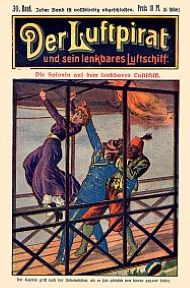 THE SPY ON THE AIR SHIP – In Chicago, Kapitan Mors’ old foes in the Trust and Standard Company have upped the reward on Mors’ head to five million U.S. dollars. Instead of our hero’s usual nemesis Ned Gully, the figure who comes forward with a plan this time is a beautiful woman – Anita Long.
Her father – a brilliant engineer – has died and left her a fortune of a million or so dollars. She used the money to construct a solar-powered rocket-ship that can fly faster than the Luftschiff and supposedly overpower it with high-tech weaponry. Soon, she and her crew are facing Mors and his men far above Australia.
*** I’ll examine the next several tales in the near future. FOR THE NYCTALOPE, A NEGLECTED FRENCH HERO SIMILAR TO CAPTAIN MORS, CLICK HERE.
 Balladeer's Blog
Stories like these in the early 1900s, though popular across Germany, met particularly stiff resistance in Southern regions—especially in Swabia. There, comic series were often viewed as “time-gobblers” that endangered the moral and intellectual development of children and adolescents. In many Swabian schools and respectable households, there was something akin to a hunt: teachers confiscated them, and parents dismissed them as frivolous distractions.
In true Swabian fashion—disciplined, practical, and focused on long-term usefulness—reading time was expected to be spent on scripture, history, or improving one’s grasp of mathematics. These stories were seen not just as a waste of time, but as a threat to Ernsthaftigkeit—seriousness—which was considered a moral virtue.
Additionally, they were often associated with the lower and working classes, particularly due to their use of colloquial or simplified German. Among the middle classes and upward, there was an expectation that children read proper literature—preferably in French, which remained the language of culture, refinement, and social mobility. Being monolingual was, much like today, seen as a serious impediment to one’s future career and societal standing.
Terrific summary of all that for us! Thanks!
Talking about how Sherlock Holmes stories jump around in time, I was listening to an audio of “A Study in Scarlet” and all of a sudden the reader starts talking about a wagon train in the old American west. I thought the audio files were mixed up but no, that’s how Doyle wrote it.
Ha! Yeah, his odd anti-Mormon segment goes on and on and on!
Captain Mors sure has a lot of challenges with his Luftschiff . . . one time it’s the propellers are falling off, the next time something else! Poor guy.
Yep, it’s always something it seems!