
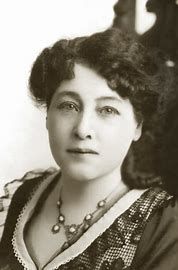
 Alice Guy-Blache (1873-1968) was a French film pioneer and was also the first woman to direct movies. Alice worked for the Gaumont Film Company and from 1896 to 1906 was Gaumont’s Head of Production.
Some sources say she was the only woman in the world directing movies during that period.
Among her films:
THE FAIRY OF THE CABBAGES (1896) – A light-hearted short that ran less than 2 minutes, this movie depicted a costumed woman as the title fairy. The premise was the old folk notion that children were found under cabbages in a cabbage patch. It was a lesser-known variation of the stork tale. The short was remade in 1900 and 1902.
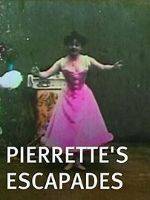 PIERRETTE’S ESCAPADES (1900) – A woman changes from a pink dress to a green dancing outfit. She proceeds to dance alone and soon finds the stock clown character Pierrot dancing with her. The clown tries kissing her but is rebuffed. Next, the stock character Harlequin dances with her, impresses her and the two share a kiss as the 2-minute production comes to a close. Some frames were hand-tinted.
 ESMERALDA (1905) – The oldest known movie version of The Hunchback of Notre Dame. Alice had been shepherding Gaumont’s movies away from mere visual spectacle and on to narrative filmmaking.
This 10-minute production is, like so many silent films, lost to us. Denise Becker starred as the title character and Henry Vorins played Quasimodo.
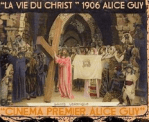 THE BIRTH, THE LIFE AND THE DEATH OF CHRIST (1906) – This movie directed by Guy-Blache has a running time of 33 minutes and presents twenty-five tableaux from the Gospels. Unlike the 1902, 1903 and 1907 Jesus films produced by the French studio Pathe Freres, each of which began with the Virgin Mary being informed by an Angel that she was bearing Jesus, Guy-Blache begins with Mary and Joseph’s arrival in Bethlehem.
She does, however, add an episode not depicted in the earlier film, the Good Samaritan. Oddly, Alice’s movie omits scenes like the Wedding Feast at which Jesus turned water into wine and young Jesus schooling His instructors.
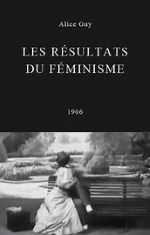 THE RESULTS OF FEMINISM (1906) – Alice directed this 7-minute and 31 second comedy about a future in which butch women run the world and exaggeratedly effeminate men sew, cook and are ogled & fondled by the women. A lot of the humor comes from women being the sexual aggressors and men being coy and demure.
Women ban men from entering the taverns where they drink and carouse, too. In the end a bunch of husbands pushing their babies in strollers reach their breaking point. They lead a male uprising and take back the taverns and the dominant roles in society. Too silly to be offensive. It’s on the level of a Mad Magazine Looks at the Lighter Side of Feminism bit.
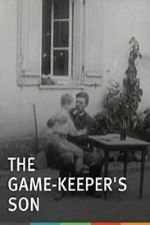 THE GAME-KEEPER’S SON (1906) – The versatile Guy-Blache directs a violent tale of revenge. Two poachers murder a gamekeeper who interferes with their crimes. His son sets out for revenge and has the police corral one of the poachers, then pursues the other, who tries fleeing. The gamekeeper’s son stabs that second poacher in a fight and the criminal falls to his death in a ravine. The police hail the son as a hero. 5 minutes long.
MADAME’S CRAVINGS (1906) – Alice’s next offering was this comedy about a pregnant woman yielding to her cravings and devouring all the food she comes across as well as – taboo in our eyes – smoking and guzzling wine. 4 minutes and 36 seconds.
 GREATER LOVE HATH NO MAN (1911) – By now Guy-Blache was living in the United States and working for Solax Studios. Her husband Herbert Blache was a co-owner and Alice was the Artistic Director. She directed most of the studio’s movies and ran their Fort Lee, New Jersey operations.
This 16-minute western is set in a New Mexico mining town in the 1800s. A man is dumped by the woman he loves, who prefers the new manager of the mine. The man gives his life to save the man and the young lady from a violent labor revolt.
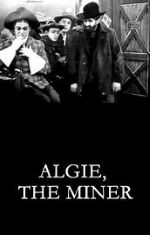 ALGIE THE MINER (1912) – Running at just under 10 minutes, this western comedy finds Billy Quirk starring as Algie, a wimpy greenhorn who is refused the hand of Clarice by her father. The father insists Algie become “a real man” before he may marry Clarice.
Algie heads west and is mentored by a brawling, gunslinging, hard-drinking man called Big Jim. Algie and Big Jim strike gold and the trick shooting our hero learned from Jim enables him to drive off claim-jumpers. With wealth and newfound machismo, Algie gets to marry Clarice.
FALLING LEAVES (1912) – A quasi-adaptation of O. Henry’s 1907 story The Last Leaf. A young girl works to keep her tuberculosis-stricken older sister alive. 12 minutes long.
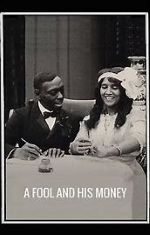 A FOOL AND HIS MONEY (1912) – One of the very first films with an African American cast, this comedy runs just under 11 minutes. A black man gains instant wealth and becomes engaged to a woman who rejected him when he was penniless.
Unfortunately, his riches go to his head, and he becomes a swaggering jerk. He winds up losing all his money in a card game and his fiancee leaves him for the victorious card shark.
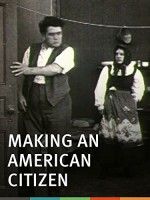 MAKING AN AMERICAN CITIZEN (1912) – This roughly 14-minute film directed by Alice Guy-Blache depicted a chauvinistic Russian emigre learning to stop beating and treating his wife like a pack mule the way he was used to back in the Old Country.
The story is told in broad comedic style as the man’s bullying and physical abuse of his wife gets called out again and again, ultimately leading to him getting sentenced to 6 months of hard labor. After serving his time, he and his wife settle into a happier existence with no more domestic violence.
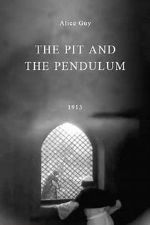 THE PIT AND THE PENDULUM (1913) – Alice expanded on Edgar Allan Poe’s story in her screenplay for this adaptation which she also directed. The film ran three reels but, typical of so many silent movies, nitrate decomposition destroyed two of the three reels, leaving just one still watchable.
Critics, as they so often are, were upset with the violence and the scenes of rats crawling all over the bound protagonist of the story. In Guy-Blache’s memoirs she recounted how difficult it was to try managing the rats, since those were the days before Animal Wranglers in the film industry.
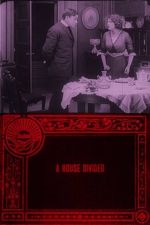 A HOUSE DIVIDED (1913) – A 12-minute comedy. A married couple each mistakenly think the other is cheating on them. They literally stop talking to each other but in the end everything is made clear and they reconcile.
SHADOWS OF THE MOULIN ROUGE (1913) – This hour-long thriller is among the many, many lost silent movies. From promotional materials and reviews we know that it was about a physician in Paris who falls in love with a wealthy man’s wife. The doctor drugs and abducts the bride, then tries to convince the man that she must be dead while he keeps her imprisoned.
THE LURE (1914) – Alice directed this 50-minute adaptation of George Scarborough’s stage play. The Lure is also a lost film, but reviews and promotional materials tell us it scandalized stage and screen audiences and critics by depicting the poverty and the sexist culture that can drive women to prostitution.
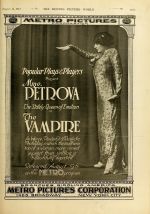 THE VAMPIRE (1915) – Actress Olga Petrova starred in this film about a mysterious female motorist who suffers injuries. She is brought into an Adirondacks resort and looked after. She recovers and proves to have an unearthly way of controlling and preying upon the men in the resort.
More of a suspense film than outright horror as viewers are left guessing about the woman’s humanity or lack of it. 50 minutes.
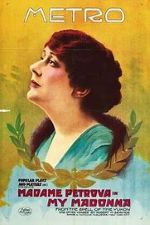 MY MADONNA (1915) – Another collaboration between Alice Guy-Blache and Olga Petrova. A hungry artist uses a high-class kept woman as his model for a painting of the Virgin Mary. Olga, as that woman, convinces one of her male customers to buy the painting for a fortune, which he does.
Olga and the artist marry but drift apart when he falls for the wife of a Baron, one of her previous clients. That client, meanwhile, wants to win back our starlet. The artist winds up wrongly accused of murdering the Baron but Olga proves his innocence. They are reunited at the church where hangs his painting of her as the Madonna. 50 minutes.
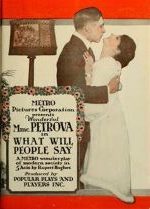 WHAT WILL PEOPLE SAY? (1916) – Alice and Olga together again in this 50-minute film. Olga portrays Persis, the daughter of a millionaire. She falls in love with American military officer Harvey Forbes (Fritz de Lint) but cannot marry him because her father has lost his fortune and marries her off to a wealthy family in a business arrangement.
Persis’s rich husband cheats on her and she seeks out Harvey. Persis’ husband gets violent, leading to a divorce, following which she and Harvey marry. My parents met this exact same way! (I’m kidding!)
THE EMPRESS (1917) – A womanizing artist takes the model (Doris Kenyon) for his latest masterpiece, The Empress, to a plush hotel. The cad forces his way into her room, but she rejects him. However, the hotel owner snapped a photo of them and after the model goes on to marry a prominent man he tries blackmailing her via the photo of her with the other man in a bedroom. 66 minutes.
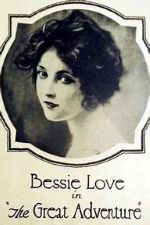 THE GREAT ADVENTURE (1918) – Bessie Love was the actress directed by Alice Guy-Blache this time around. Bessie stars as Ragna “Rags” Jansen, an actress who wows them in her Middletown home but longs for Broadway success.
She gets a job as a chorus girl and is romanced by Billy Blake, understudy to the play’s star. That star tries to seduce Rags, prompting his wife to leave him so he quits the show. Billy becomes the new male lead and Rags, who learned to despise the oily star, becomes the female lead and they live happily ever after. 50 minutes.
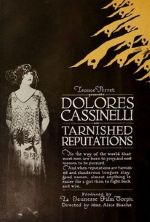 TARNISHED REPUTATIONS (1920) – Alice’s final film. She retired after completing this. Dolores Cassinelli starred as Helen, who is romanced by an artist when he comes to her small village to paint. He uses her as his model for The Saint Among the Lillies and beds her, then abandons her with just a letter.
His painting earns him wealth and acclaim, so the lovesick Helen moves to New York to try renewing their relationship. The artist is at the Vatican, where the Pope has commissioned him to paint his portrait. Helen winds up working in a sweatshop and is later mistaken for a prostitute. A good man helps her but she still wants the artist. 50 minutes.
*** Alice Guy-Blache’s simple advice to her actors was “Be natural.” Those words were featured in the title of the 2018 documentary about Alice – Be Natural: The Untold Story of Alice Guy-Blache.
FOR MY LOOK AT THE SILENT FILMS OF THE GREAT ACTRESS SARAH BERNHARDT CLICK HERE.
 Balladeer's Blog
What a collection of movies. Some, I wouldn’t mind watching.
You know it! And she wrote many of them, too,
Pingback: SILENT FILMS DIRECTED BY ALICE GUY-BLACHE – El Noticiero de Alvarez Galloso
Logged, thank you sir!
Your voice is so unique and uplifting—I always feel better after reading your work. You capture emotions in such an authentic and relatable way. Thank you for sharing your talent so generously. You make me want to write more, think more, and be more present in my creative journey.
Thank you very much for such kind words! They mean a lot to me coming from someone of your own impressive output!
You’re an amazing writer!
Thank you very much!
All are good 👍 you promoted all these forgotten things. Well shared 💐
Thank you very much!
All is good! You always bring those which are forgotten. Well shared 💐
Thanks! 😀
😯😯😜😜
Ha!
Ooh, what an excellent collection of silent films! I’m definitely going to watch some of these. MADAME’S CRAVINGS sounds like one I could relate to: I’m known to eat everything in sight and guzzle it all down in an afternoon. I’m inspired! Perhaps I’ll go and do that now (hopefully the cupboards aren’t bare, lol). . . 😊🍔
Too funny! Enjoy yourself!