
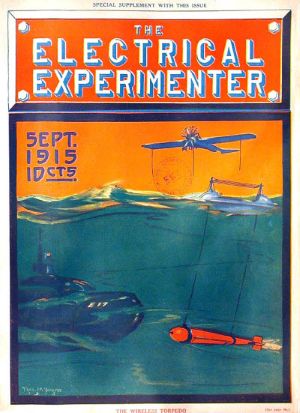
 OMEGON (1915-1916) – Written by George Frederick Stratton, this serialized story dealt with a fictional war of super-scientific weaponry between the United States on one side and China, Japan and Mexico on the other.
Omegon (Electrical Experimenter Sep 1915) is the title of the opening installment of five total, all of which I will review in this blog post. The main character of the entire work is Fred Cawthorne, a millionaire inventor and manufacturer in the electronics field.
With World War One raging, Cawthorne is exasperated at America’s failure to modernize its armed forces in case our nation gets caught up in the war, as of course, we did in 1917. Fred has proposed futuristic weapons himself and been rejected by the War Department.
Cawthorne seeks out other geniuses whose projects have been turned down by the short-sighted government and finances them himself. When America’s West Coast panics at the sight of a combined Japo-Chinese fleet approaching San Francisco, President Wilson is unprepared.
Not so Fred Cawthorne, who has financed a private fleet of Wheaton Miniature Submarines, named for their inventor, one of Cawthorne’s allies. The mini-subs are sent into action against the approaching fleet.
These Wheaton Subs attach themselves to the enemy ships below the water line, drill holes into the vessels and then flood them with ether to knock out the crew. Because this is fiction, this works on all the enemy ships, buying enough time for the U.S. government to start mobilizing our military, since Japan and China make it clear that all-out war is now on.
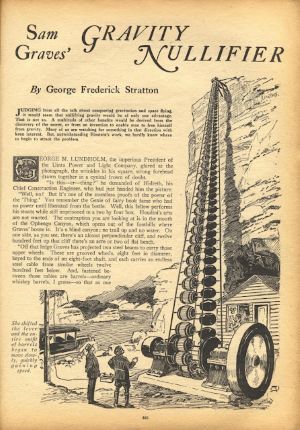 The Gravitation Nullifier aka Sam Graves’ Gravity Nullifier (Electrical Experimenter Oct 1915) – Part Two features Mexico entering the war on the side of America’s enemies. Our southern neighbor lets Japan and China use their ports as well as launch a land assault from Mexico into the United States.
Land battles are fought and America is steadily being driven back until Fred Cawthorne and the Private Sector once again come to the rescue. Cawthorne’s affiliated inventor Sam Graves (later to star in his own separate series of stories by George. F. Stratton) outfits American airplanes with his Gravitation Nullifier.
With the Japan-China-Mexico Alliance getting its land forces routed by United States gravitational superiority, the government asks Cawthorne and Graves to ready the Gravitation Nullifier for use on the high seas.
Soon, the vicious campaigns at sea are presumably about to be won by the U.S. but the Nullifier proves inconsistent to the point of uselessness over water. The war will continue, but at least America is faring better in the land battles now.

BALLADEER’S BLOG
The Poniatowski Ray (Electrical Experimenter Jan 1916) – This third installment continues in a similar vein. Cawthorne comes up with an answer for America’s ongoing difficulties in the war at sea. (Compartmentalization to contain the ether sprays neutralized the Wheaton Mini-Subs earlier in the war.)
Radium powered ray-guns fire concentrated beams that instantly detonate explosives on the enemy ships, basically defeating them with their own stockpiles. The U.S. is still outnumbered three-to-one, however, so the war continues.
The Shirikari Tentacle (Electrical Experimenter Feb 1916) – America’s enemies have begun using super-scientific weaponry themselves. Submarine vessels with electronic tentacles wrap themselves around U.S. Navy ships and expend a sufficient charge to electrocute the crew to death and knock out onboard tech.
It turns out an American inventor, Forsythe, tried to sell the electro-tentacle technology to the War Department before the war but was among the scientific geniuses whose innovations were rejected. Fred Cawthorne had not yet started his syndicate so Forsythe sold his invention to the Japanese instead.
They have finally gotten the weaponry up and launched, but ripped off Forsythe money-wise AND credit-wise, claiming a Japanese scientist named Shirikari invented the tentacle devices. The American traitor escapes and defects back to the U.S. to let Cawthorne know how to neutralize the threat of the tentacles.
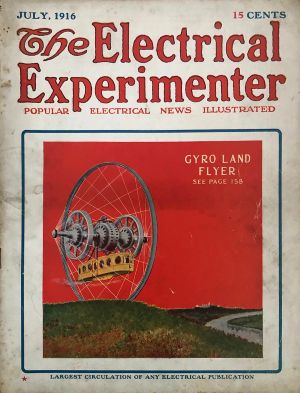 Trailing Aravilia (Electrical Experimenter Jul 1916) – The fifth and final installment. By now the Pacific Ocean is controlled by the U.S. Navy and on land America’s armed forces have driven most of the invading troops back below the border.
A Mexican military commander named Aravilia proves to be a genius at guerilla warfare. He and his troops are preventing American victory to such a degree that the U.S. fears the enemy will rally around Aravilia’s successes and renew their efforts.
Our hero Fred Cawthorne comes up with an Electromatograph. This device, the most comically unlikely of the entire series, can locate a person’s thought-waves by analyzing samples of their handwriting.
Using the Electromatograph on Aravilia’s handwriting on documents, the U.S. Army is able to locate the enemy commander no matter where he is. Using conventional weapons plus the Gravity Nullifier America mops up Aravilia’s forces and he himself is killed, ending the war.
In a really cheap example of sequel bait, Stratton ends the story with Cawthorne and company learning that the corpse is really that of an Aravilia double and the man himself remains at large to potentially trouble the U.S. in the future. Luckily no such sequel materialized.
These Fred Cawthorne stories are choppy, and they reflect the spreading jingoism of that era of global conflict but still manage to be entertaining in places. George F. Stratton was a talented engineer who answered Hugo Gernsback’s (editor of Electrical Experimenter) call for stories from actual scientists. It definitely shows that Stratton’s true talent was in electronics, not writing.
In the late 1920s Gernsback reprinted the Fred Cawthorne series in his more widely known publication Amazing Stories.
FOR MORE “ANCIENT” SCIENCE FICTION CLICK HERE.
 Balladeer's Blog
Pingback: ANCIENT SCIENCE FICTION: OMEGON (1915-1916) – El Noticiero de Alvarez Galloso
Logged, thank you!
Interesting posts as always. I have never heard about this ancient science fiction story before but found it fascinating. It brought to mind great movies about naval warfare that I have seen. The plot of the story Omegon reminded me a lot of the war movie “Greyhound”. Released in 2020, Aaron Schneider’s movie told the true story of a submarine that was used in WWII. Tom Hanks is excellent as usual in it. The movie shared quite a lot of similarities with the ancient science fiction story you discussed here. It’s one of the most underrated war movies that I have seen.
Here’s why I recommend it strongly:
Thanks! I haven’t seen Greyhound yet.
You are so brilliant, Edward, to know about all of these historic publications, movies, TV shows, events, etc. Do you spend a lot of time on research?
Thanks! You’ll make me blush! Some might call it research but I really do enjoy reading these old, old works.