
St. Patrick’s Day continues with this tale from Ireland’s ancient Book of the Dun Cow (Lebor na hUidre) in which the demigod Cuchulainn helps the saint convert Ireland to Christianity. Interesting blend of Christian and pagan elements. For more from the Book of the Dun Cow click HERE.
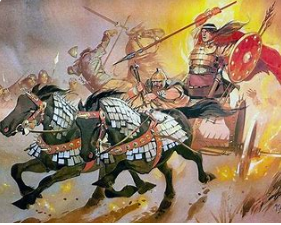 THE PHANTOM CHARIOT OF CUCHULAINN (Siaburchapat Con Culaind) – This tale is dated to around the mid-400s A.D. because of the presence of St. Patrick.
The story goes that St. Patrick pays a visit to the stubborn Loegaire mac Neill, a High King of Ireland, again entreating him to convert to Christianity. Loegaire tells Patrick that he will not believe in the God of Christianity unless that God can raise Cuchulainn from the dead and have him pay a visit to and converse with him (the king).
God immediately sends an angel to tell King Loegaire and St. Patrick that God will raise Cuchulainn and send him to converse with Loegaire near the ramparts of the fortress at Tam.
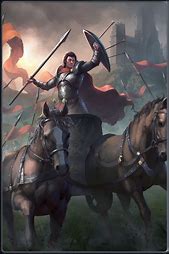 The next day, St. Patrick and King Loegaire are both on hand at the appointed place when Cuchulainn appears, riding in his chariot driven by his usual charioteer Laege. The demigod’s two horses – the Dub Sainglend (black horse of Saingliu) and the Liath Macha (gray horse of Macha) – are pulling the chariot.
Cuchulainn stops to interact with the two living men. To help kill King Loegaire’s skepticism, the demigod performs assorted feats that only a being who was more than human could perform.
Cuchulainn tells St. Patrick that he knows why God called him back to life from where he has been suffering with other pagans in Hell. He expresses his faith in the Christian deity based on his own awful experiences after death and begs the saint to plead with his God to let him enter Heaven.
Turning to address King Loegaire, Cuchulainn regales him with tales of his great deeds with women and in battle wielding his legendary spear the Gae Bulg. This lengthy section presents dozens of the demigods’ legendary accomplishments in flowery, poetic style. At one point he states “I was gentle to the gentle/ But against dishonor I wrought vengeance.”
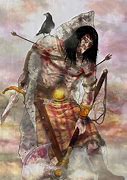 After Cuchulainn at last relates the tale of his death by one of the three magical spears of Lugaid mac Con Roi, he adds an account of what happened to his soul. The account is in the worldly terms so common to many myths, and with his soul looking just like his human form and even bearing a ghostly counterpart of the Gae Bulg.
This section goes like this:
“Demons carried off my soul/ Into the red charcoal
“I played the swordlet on them/ I plied on them the gae bulga;
I was in my complete victory/ With the demons in pain
“Great as was my heroism/ Hard as was my sword
The devil crushed me with one finger/ Into the red charcoal!”
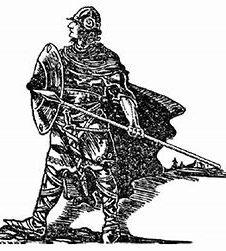 After thus acknowledging that Satan himself defeated him easily even though his subordinate demons fell to him, Cuchulainn goes on to speak of the agonies of Hell, where all of the other pagan Ulster heroes have been suffering with him since they died.
He closes by advising King Loegaire in the strongest terms that he should convert to Christianity if he hopes to avoid the tortures of Hell. Cuchulainn also praises the Christian God and acknowledges Jesus as the son of that living God.
As the story comes to a close, Cuchulainn is allowed into Heaven (no mention is made if his charioteer Laege is allowed in with him) and readers are told it has been 450 years (“9 times 50 years”) since Cuchulainn was killed.
 Balladeer's Blog
Pingback: SAINT PATRICK MEETS CUCHULAINN – El Noticiero de Alvarez Galloso
Logged, thank you sir!
Good feel for the holiday, don’t you think?
Yes, I certainly do!
💚💛
Thank you!