
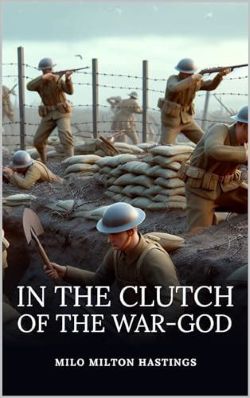
 IN THE CLUTCH OF THE WAR-GOD (1911) – Written by Milo Milton Hastings and serialized in the July, August and September 1911 issues of Physical Culture magazine.
The tale is set in the “far future” year 1958. Ethel Calvert, a young American woman, lives in Japan with her father, a grain magnate. The United States and Japan are on the verge of war and the author describes both nations as being “in the clutch of the war-god.”
In the fictional world of this story Japan has become so overpopulated that it has long since given over nearly all its land to housing rather than farming. That has made Japan dependent on other nations – mostly the United States – for food staples.
A very tense Cold War has been waged between America and Japan for years. Japan wants additional “living space” and feels that its culture is so superior that they should be free to settle wherever they please, recognizing no borders.
For America’s part, the national attitude similarly reflects the belief that its culture is superior and that the world is its oyster. Strikingly, Hastings depicts Japanese national chauvinism in a positive light while condemning America’s.
Ethel Calvert’s father is among the Americans killed in anti-foreigner riots that sweep Japan. She is unable to reach any United States consulate in time to be evacuated with the rest of the Americans as war breaks out.
Our heroine is taken in by her late father’s friend Professor Oshima and his family. Oshima’s wife was originally French and she helps Ethel adjust her clothing and hair style to blend in with Japanese society to avoid being slain as an American.

BALLADEER’S BLOG
As the war rages, Milo Hastings fills in more of the details of life in 1958. The United States consists of the very rich and the very poor since technological advancements led to widespread unemployment. Even farming is done almost exclusively by machines.
The working class live in crowded slums in the cities, with the wealthy living in the spacious countryside. “Aeroplanes” are as commonly used by the affluent in 1958 as cars were by everyone in the “real” 1958.
The wealthy are depicted as obese alcoholics and drug users, obsessed with pursuing leisure time and pleasure.
Japan, in contrast, is depicted as a culture of physically fit vegetarians. Bizarrely, Hastings presents it as a positive development that his fictional Japan is so fitness obsessed that people who are NOT in excellent shape do not qualify for jobs, healthcare and much more.
NOTE: This largely reflects Milo Hastings’ own peculiar notions regarding physical fitness and eugenics. More on that below.
The war between the U.S. and Japan is largely a naval conflict waged on the Pacific Ocean and its islands. The author nicely anticipated aircraft carriers of the future in this 1911 work, and city-sized versions of such carriers are used by both nations.
Japan has air superiority thanks to their bamboo planes (hey, it’s fiction) with incredibly light engines. Those engines can be retrieved from planes that get shot down because they float on the surface of the ocean. America’s metal planes, on the other hand, sink and are complete write-offs.
Troop transports have “turtle shell” tops, with the emphasis on invulnerability to the shells and missiles fired by 1958’s warplanes. Semi-submersible “toadstool” craft are like floating arsenals which can deal out a lot of damage then hide beneath the waves with just their flat, armored tops remaining above the sea level.
 After nineteen months, Japan finally takes the Philippines from the U.S. and America falls back on a purely defensive strategy, fearing Japanese attacks on the west coast or elsewhere. Ethel Calvert is taught to copilot a fighter plane with Professor Oshima’s male secretary Komoru.
Eventually, Japan’s forces – including Ethel and Komoru – overrun parts of the United States after a crucial victory near Beaumont, TX. While fighting continues elsewhere, Ethel takes a job working on a corn plantation.
An American pacifist named Stanley Winslow (who seems to be a Milo Hastings self-insert right down to pushing a fitness publication) recognizes the superiority of Japan and its fitness-oriented, no-booze-or-recreational-drugs culture. He and Ethel fall in love and marry.
The United States surrenders to Japan in the early 1960s and is subjected to a mostly benevolent occupation, provided Americans completely embrace Japanese fitness philosophy. Stanley Winslow becomes the Secretary of Public Health under the occupation government. He and Ethel live happily ever after.
NOTE: Milo Hastings’ colleague Bernarr (not Bernard) Macfadden was currently in prison over a supposedly nude beauty contest held by his Physical Culture movement. Hastings’ bias against his own country in this story is a surprising twist on the usual fare of the early 20th Century but the hypocrisy really stands out.
Milo and Bernarr felt increasingly hostile toward the U.S. for what they perceived as our society’s rejection of their healthy lifestyle and proto-nudist philosophy. That hostility definitely shows throughout In the Clutch of the War-God as future Japan is depicted far more positively due to that nation’s fictional embrace of Hastings and Bernarr’s values.
In the Clutch of the War-God is a fascinating read, but not always in the way Milo Hastings may have intended. Even though he pushes the Japanese as the good guys and Americans as villains an objective reader can’t help but find both nations to be full of faults.
Ironically, that successfully makes the story riveting as a work of “What If?” science fiction. The casual depiction of interracial marriages is another intriguing element of this flawed but fascinating work from 1911. Hastings also wrote The City of Endless Night (1919).
FOR MORE “ANCIENT” SCIENCE FICTION CLICK HERE.
 Balladeer's Blog
Great review. Sounds like an intriguing book! 😊
Thanks! Yes, it’s full of unexpected developments.
Pingback: ANCIENT SCIENCE FICTION: IN THE CLUTCH OF THE WAR-GOD (1911) – El Noticiero de Alvarez Galloso
Logged, thank you sir!
This is worth the read just to see how 1911 man envisioned the 1958 future.
You’re certainly right!
Old science fiction but beautiful well shared
Thank you for saying so!
I feel happy to appreciate others 😊
That’s part of what a kind-hearted person you are!
👏👏
😀 😀