
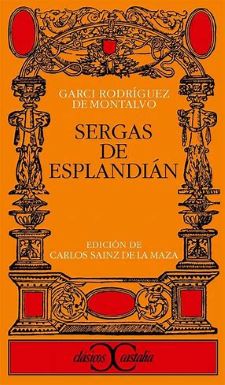
 LAS SERGAS DE ESPLANDIAN AKA The Adventures of Esplandian (1510) – There were many subsequent editions of this Spanish novel by Garci Rodriguez de Montalvo but 1510 is the year of the oldest known version. Part fantasy, part proto-science fiction and part chivalric romance saga, The Adventures of Esplandian is best remembered today for its supposed role in naming California.
To begin with, Montalvo wrote this book as his own personal addition to the legends surrounding Amadis of Gaul. Esplandian, the son of Amadis, was also known as the Black Knight because of the color of his armor. After a series of adventures Esplandian and his forces conquered Constantinople, taking it from the Muslim armies.
As the various Islamic city-states gather to besiege Constantinople many battles are fought, with Esplandian and his Christian forces managing to hold the city. The conflict widens, with Christians and Muslims alike sending word all around the world for allies to help defend or seize Constantinople.
Many chapters go by devoted to tales of the cosmopolitan rulers and warriors who journey to join their faith’s side in the ongoing war. Chapter FIFTY finally deals with a Muslim explorer named Radiaro who reaches California, but it’s a California that’s far from what you would expect.
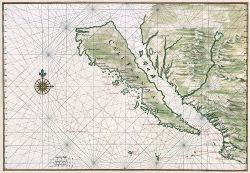 The Adventures of Esplandian depicts California as an island ruled by dark-skinned amazon warrior women led by Queen Calafia.
To provide context on that, the 1500s were a period of Conquistadors being at large in the Americas. And as a reminder why Queen Isabella and King Ferdinand had okayed Christopher Columbus’ 1492 expedition in the first place – Spain was trying to establish their own colonies to compete with other European powers.
Spain had only recently succeeded in driving out the Muslim conquerors who had held the land for hundreds of years. Spanish heroic tales were still steeped in struggles against Islam, its leaders and political units. “Caliph”, “Caliphate”, etc combined with the name Queen Calafia to provide the Calif part of the word California.
Next, we address the way that Montalvo was forcing all of this into a knightly saga that was set hundreds of years earlier than 1510 when the first edition of The Adventures of Esplandian came out. It was far from the only time that such fictional retconning of world history would take place.
In England, for instance, writers crafted the romantic tradition that Jesus – before undertaking his three-year mission that ended in his Crucifixion – had visited the ancient land that became Britain. Remember the lines that go “And did those feet (as in Christ’s feet)/ In ancient times/ Walk upon England’s mountains green?”
Or for a much later example look at how Mormon beliefs made Native Americans the Lost Tribes of Israel and had the resurrected Jesus visiting what would eventually become the U.S. Hell, Mormon beliefs even held that Missouri was where Adam and Eve had been exiled after being cast out of the Garden of Eden.
So, in Montalvo’s case he altered the order of events to revise the new discoveries of the Conquistadors to fit into Age of Chivalry tales from centuries before the 1500s.
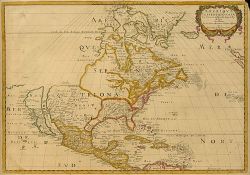 Regarding why California was at first mistaken for an island (until the 1700s on some maps), that happened because what we now know as the Baja Peninsula had been “discovered” by the forces of the Spanish Conquest. We all know how long that peninsula is, and for a lengthy period it seemed that it was just one big island.
At any rate, Montalvo’s novel had fused elements of early 1500s fables about the New World with Spain’s ingrained sagas of resistance to Islam. Thus, we get the fictional “Queen Calafia” and Radiaro’s hope for a new Caliphate ally sharing the etymological origin of California in a strange “which came first, the chicken or the egg” fashion.
The “ancient” California that Montalvo presented to the world also incorporated Conquistador legends about a Lost City of Gold and/or an Earthly Paradise in the New World. Queen Calafia’s realm was so rich in gold that the armor and weapons of her and her amazon warriors were all made of that precious metal.
The queen also had hundreds of trained griffins (indigenous to California in this story) who had helped her conquer assorted territories near her “island.” Calafia was in the mood to see more of the world and add it to her holdings, so she agreed to accompany Radiaro to help the Muslims take Constantinople.
With thousands of her female warriors and with hundreds of her trained griffins Queen Calafia was guided to Constantinople by the Muslim Radiaro. The queen met the other Muslim commanders at a feast in her honor.
The next day Calafia unleashed her flying griffins on the Christian forces holding Constantinople, led by Esplandian (Remember him?). After centuries of being trained to spare only women when sent into battle by the queen, the griffins could not be restrained from killing Christians AND Muslims alike, resulting in many dead on both sides.
After that debacle, Queen Calafia and her women warriors make the griffins remain roosting on their ships while they fight side by side with the Muslim armies. More battles are fought with Constantinople still in Christian hands.
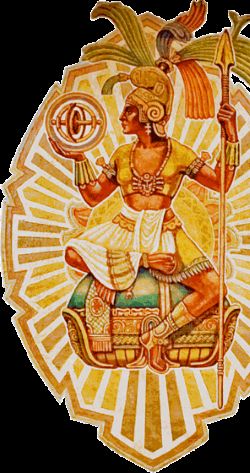 When more Christian armies arrive to join the fighting, the Muslims and Calafia face disaster, but strive to at least spare their subordinates by having her and Radiaro challenging Esplandian and his father Amadis to single combat to decide the issue.
Esplandian and Amadis win and spare the lives of the defeated Queen Calafia and Radiaro. Typical of these types of stories, Calafia “sees the light” and becomes a Christian. She is married to Esplandian’s cousin Talanque and her sister Liota marries the Christian warrior Maneli.
Our main character Esplandian marries Leonorina, daughter of the King of Constantinople. Calafia, her sister and their husbands sail back to California with the amazon fleet, bringing this tale to an end.
To me the odd alternate history and alternate geography elements plus griffins being depicted as real animals that lived in California put this portion of the Esplandian saga in the ancient science fiction category.
It’s similar to the way that the part of Orlando’s tale that takes place on the moon qualified it for one of my earlier Ancient Science Fiction installments.
FOR MORE “ANCIENT” SCIENCE FICTION CLICK HERE.
 Balladeer's Blog
Greetings! 🖐
Hello there!
That means the Author Garci Rodriguez wrote mixing with fact and fiction about California because we got a fictional queen Calafia ! Beautiful story well shared 💐
Thank you, I agree!
😍
😀
an article that opens up insight into how a long time creates a story. I like your article
Thank you very much for saying so!
Very good morning and happiness Edward is good luck and a happy day, dear 🙋🏼♀️
Good morning and a happy day to you as well!
Fascinating stuff! I had no idea that California was first mistaken for an island. Respect to Queen Calafia’s women warriors (kinda want to be one, actually. I’d be truly fierce, one of the best!).
Thanks! You’d probably kick butt as one of her warriors!
Wonderful posts as always. I have never heard of this ancient science fiction tale before but found this post fascinating. I thought this story would definitely make for a good movie. There are elements in this story that reminded me of films that I love. For instance, the Amazon warriors in the story brought to mind the comic book movie “Wonder Woman”. Diana is raised on the land of Theymiscira which is ruled by strong Amazon women. Just like in this ancient story, these women are strong warriors with strength. The similarities between the two are striking to me. As a huge fan of Wonder Woman, I would like to some day see this ancient science fiction story be made into a film in the future. Thanks for sharing it.
Here’s why I loved Wonder Woman:
Thank you! I agree, Wonder Woman was a terrific movie!
Java Bean: “Ayyy, I’m glad California isn’t an island now! Our Dada hates boats!”
Yeah, that would be a nuisance, Java Bean!