
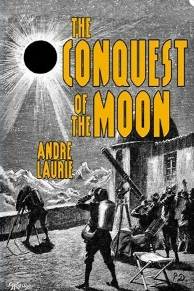
 THE CONQUEST OF THE MOON (1887) – Written by French author Paschal Grousset under the alias Andre Laurie. This work ranges from absurd to fascinating, with – for people looking for science fiction – WAY too much time devoted to the fighting in the Sudan during 1884 and 1885.
In Australia, two German conmen – Ignaz Vogel and Costerus Wagner – team up with an American conman named Peter Gryphis. The trio launch a scheme to bilk scientifically ignorant tycoons by getting them to invest in their company which will supposedly conduct mining operations on the moon.
Hundreds of thousands of pounds are raised from the trio’s victims, who are thoroughly bamboozled until a stockholders’ meeting in Melbourne, Australia. Gryphis, Vogel and Wagner are successfully maintaining their ruse until, from the audience, French astronomer Norbert Mauny speaks up, demanding a detailed explanation of how the conmen plan to reach the moon.
In the best “Howard Johnson is RIGHT!” spirit, the assembled marks are galvanized into a skepticism they should have shown much earlier. To try to keep their victims snowed, the three confidence artists improvise a plan to use a transportation tube linking Earth with its satellite.
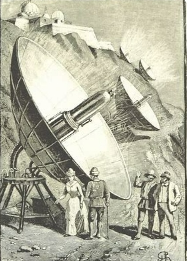 Mauny dismantles that plan and proposes a genuinely idiotic alternative. He plans to create a mammoth magnet in the Sudanese desert and use it to pull the moon down to physical contact with the Earth, thus making the company’s mining project possible.
At this point I was convinced that Mauny must be a conman himself, but no, an alleged scientist like him has proposed a cosmically stupid and potentially apocalyptic plan that makes the conmen’s transportation tube idea look reasonable.
Norbert prevails, with the stockholders voting heavily in favor of his plan, but remember, the members of this Brain Trust were already foolish enough to invest in this cockamamie lunar mining venture in the first place.
Next, the investors’ money is used to finance an expedition to the Sudan. Mauny, Gryphis, Vogel and Wagner are among the company men taking part in the project, which suffers many setbacks amid the violent uprising of the Mahdi.
Other members of the expedition are Sir Bucephalus Coghill, a true Lord Haw-Haw type of British buffoon; Coghill’s personal Wayland Smithers named Tyrell; Kersain the French consul and Kersain’s daughter Gertrude.
Kaddour, a Sudanese dwarf, works to sabotage the project and to convince Gertrude to run away with him. She is a very snobbish young beauty and has already started a romance with Norbert Mauny, whose brain-dead “pull the moon down to the Earth” plan has apparently impressed the vacuous idiot.
At Mount Tehbali, Mauny oversees workers who construct an enormous glass base atop the mountain and use pyrites plus a string of broadcast stations to turn the base into an enormous electromagnet. No, I’m not joking.
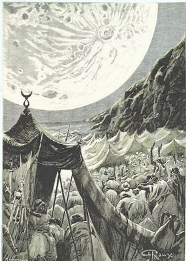 Just as construction is complete, the Mahdi’s army charges the mountaintop base to destroy the hubristic project. Norbert activates the gigantic electromagnet and with astonishing swiftness pulls the moon down to his base atop Mount Tehbali.
There are no gravitational side-effects from this (I warned you this story was largely absurd) and the Mahdi’s forces are driven off by the sudden arrival of the moon just overhead. Coghill’s toady Tyrell panics and throws Mauny’s magnet into reverse, sending the moon back into orbit but causing the destruction of the complex atop Mount Tehbali.
When our main characters regain consciousness after that incident, they realize that the nearness of the moon took them AND Mount Tehbali itself along with it. Norbert Mauny’s scientific genius (?) keeps them all alive by chemically manufacturing oxygen for them to breathe.
The massive supply of food and water that the expedition brought with it will let them survive for a time. Mauny has calculated that Tyrell’s panic sent the moon into an orbit far different than normal. That means the moon will come incredibly close to the Sudanese desert again before their supplies run out, enabling a desperate attempt to return to Earth.
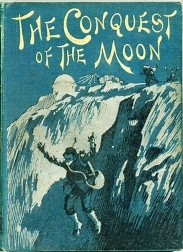 Now comes the fascinating portion of The Conquest of the Moon. To pass the time while awaiting their chance to try escaping the moon, Norbert Mauny leads the others in lunar exploration. They breathe through oxygen masks and equipment devised by the “genius” (if you ignore his crackpot scheme to risk an Earth-moon collision just to do lunar mining).
The narration draws some acceptable (for the era) comparisons between the Sudanese desert and the lunar terrain. Eventually, after playfully clowning around in the moon’s lower gravity, our heroes discover relics of an ancient civilization amid the shifting sands. Personally, I wished most of the earlier part of the story had been edited down in order to get to this section much sooner.
Our explorers uncover monuments and ruins, as well as a manuscript that will need translating. Skulls and skeletons of the long-dead moon people are found, showing that the humanoid beings were roughly fifty feet tall.
Bringing the best part of The Conquest of the Moon to a close, the three conmen Gryphis, Vogel and Wagner take advantage of the situation to seize control of the group’s weapons, food and water. The villains announce themselves as lunar raiders, which is the closest this tale ever gets to anybody conquering the moon.
The dwarf Kaddour outmaneuvers the conmen and reveals that he has wanted revenge on them for years. When he was a child the trio abducted him, stunted his growth by keeping him in a small cage for years, then sold him to a circus.
Kaddour recognized the grifters when they arrived in the Sudan and that is why he made attempts to sabotage their project. Mauny and the other “good guys” are moved to pity over what Gryphis, Vogel and Wagner did to Kaddour and agree he deserves to enact revenge against them.
When the moon soon passes very close to the Sudanese desert once again, Kaddour keeps himself and the three conmen on the moon so he can do as he pleases with them. The others use parachute “technology” devised by Norbert to jump from the moon to the Earth and land safely. (Yes, we’re back to absurd territory again!)
 The expedition is saved from the harsh desert conditions AND from the Mahdi’s troops by the arrival of units from General Gordon’s Khartoum Campaign. Mauny and Gertrude plan to wed. The End, with none of the other dangling plot threads addressed.
As I made clear above, my personal recommendation would be to skip right to our main characters arriving on the moon. Although if you share my weirdass sense of humor you may want to read the details of Mauny’s hilariously irrational plan to draw the moon to Mount Tehbali. Guaranteed laughs!
I was disappointed that we never got a sequel novel in which Norbert Mauny has backers finance a plan to harness solar energy by launching the entire Earth like a cannonball toward the sun. But I’m kind of weird.
FOR MORE “ANCIENT” SCIENCE FICTION CLICK HERE.
 Balladeer's Blog
Another fascinating article- thank you!
Thank you very much for saying so!
Pingback: ANCIENT SCIENCE FICTION: THE CONQUEST OF THE MOON (1887) – El Noticiero de Alvarez Galloso
Logged, thank you sir!
Clever that. It doesn’t matter that it would never work. It matters that a curious brain tried to make it so. Love this sort of thing.
I know how you feel!
Great ancient science fiction stories. I’ve never heard of the story “The Conquest for the Moon” but it definitely sounds interesting. The story reminded me a lot about classic science fiction movies that capture moons that I have seen. For instance, the story brought to mind the movie “Gravity”. Alfonso Cauron’s Oscar-winning movie told the story of a woman struggling to survive in space. She embarks on a mission to the moon which ends up leading to dangerous consequences. One of the best space travel movies I have ever seen. Sandra Bullock is amazing in the lead role. It shares several common themes with the science fiction story you discussed here.
Here’s why I recommend the movie:
Thanks! Your Gravity review is great!
Good science fiction ! Very old but interesting well shared 💐
Thank you very much!
😴😴🫡🫡
You’re always so creative with these!
Ha ha 😂 I am creative with my imagination 🤣🤣😂😂 also. Ha ha
Yes you are.
I liked the story of Qaddour, the Sudanese dwarf, a fantasy film with the use of imaginative realism
Yes, he seemed like a bad guy at first until his true past was revealed!