
Here are the silent films of the iconic and world-famous actress Sarah Bernhardt. This revered stage thespian was born in 1844 and died in 1923. She was practically royalty when she deigned to appear in a few silent films.
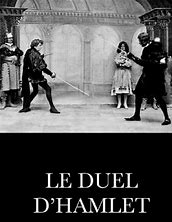 LE DUEL D’HAMLET (1900) – In this roughly 2-minute short, the 56-year-old Bernhardt gave cinema a gender-flipped Hamlet as she fenced with Pierre Magnier as Laertes in the climactic duel.
“The Divine Sarah” as she came to be called, was spryer and more athletic than women half her age. This brief moment of history was the first time ANY scene from Hamlet had been presented on film.
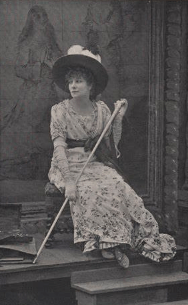 TOSCA (1908, 1912) – Bernhardt portrayed Floria Tosca in this adaptation of the Puccini opera. (Yes, it’s a silent movie version of an opera.) The entire story was condensed into just 40 minutes and Sarah was so appalled with the production that she insisted that it not be released and, in fact, wanted it destroyed!
Luckily for cinema history, it was merely shelved for 4 years and wound up getting released to cash in on the success that Sarah’s silent movie about Queen Elizabeth the First was enjoying in 1912.
Obviously, this 1908 work has most of the weaknesses that many point out in early silent cinema, but to me the historical importance of having more footage of Sarah Bernhardt emoting on screen outweighs other considerations. As it is, it’s still a cosmic injustice that there’s less film footage of the Divine Sarah than there is of Mamie Van Doren.
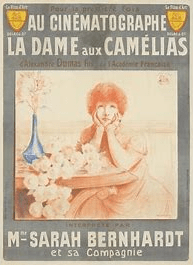 LA DAME AUX CAMELIAS (1912) – Bernhardt took on the role of Marguerite Gauthier in this adaptation of the Alexandre Dumas fils tale of a floral-themed prostitute. More popularly known as Camille, this production costarred Lou Tellegen as Armand Duval and Paul Capellani as Sadoul.
La dame aux camelias ran roughly 30 minutes and earned Sarah the fee of $30,000.00 – equal to $966,000 here in 2024.
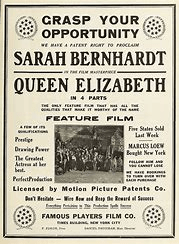 LES AMOURS DE LA REINE ELISABETH (1912) – Bernhardt had a huge hit with this version of The Loves of Queen Elizabeth. The story centered around Queen Elizabeth the First’s romance with Robert Devereux, the Earl of Essex (Lou Tellegen).
At 44 minutes in length, this film took an episodic approach, which in my opinion works better if you’re not going to have the time needed to fully explore such a story. There are no dialogue boards, but a synopsis of each scene appears on screen before it is then acted out.
Stagey and lacking in close-ups, but c’mon! And the fact that the film forever preserves THE Sarah Bernhardt gracefully bowing to the camera at her figurative curtain call can blow you away when you let it all sink in.
ADRIENNE LECOUVREUR (1913) – This adaptation of the 1849 play Adriana Lecouvreur was crammed into a mere 20 minutes! Sarah Bernhardt herself helped pen the screenplay which can’t help but make me think of The Reduced Shakespeare Company. Sadly, no copies of this movie have survived.
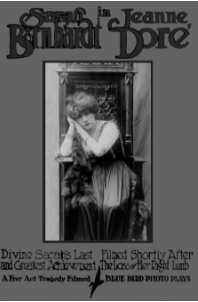 JEANNE DORE (1915) – Forget “break a leg”, Bernhardt had just had a leg amputated before filming began on this 50-minute venture. Shots were tastefully arranged to conceal the loss of Sarah’s limb, but the supremely DIS-tasteful tagline for Jeanne Dore was “The Divine Sarah’s greatest achievement filmed shortly after the loss of her right limb!” Kinda makes “You’ll believe a man can fly” look wimpy as hell, doesn’t it?
As the title character, Bernhardt acts out the dramatic staple of the noble wife and mother who perseveres against all the heartache caused by her profligate gambler of a husband and her errant son’s affair with a married woman. When that affair leads to murder, Jeanne Dore carries out a thespian coup of her own to let her condemned son go to the guillotine thinking his unfaithful paramour still loves him.
DIE TANZERIN (1915) – This 63-minute film debuted in December of 1915, as World War One was still raging. This is one of the many, many silent films which have not survived. The title means “the dancer” and the director was the prolific Georg Jacoby but I have not been able to learn what the storyline was.
 MERES FRANCAISES (1917) – The title means Mothers of France and it’s a morale-building wartime film. Sarah Bernhardt was in her 70s but nobly did her best as Madame Jeanne D’Urbex, the matriarch of a French family which suffers more than its fair share of loss and heartache as World War One rages on.
Sarah as Jeanne loses her husband and a son to the grave, plus members of her extended family endure blindness and the loss of beloved friends. Madame D’Urbex puts aside her own pain and becomes the rock on which the women of her family and the young nurses serving under her can rely.
It’s a rare cinematic look at the global conflict from the point of view of women. Bernhardt is still limited by her missing leg and her advanced age, but that only emphasizes what she and others were enduring as the war refused to end.
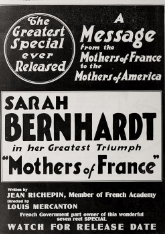 Madame D’Urbex is unconquerable and is like a fictional Joan of Arc of the military hospitals. Her closing words in Meres Francaises may seem like wartime schmaltz, but this was filmed during a less cynical time. Those closing words? “So that the mothers shall no longer suffer, it is necessary that France carry on the war, war upon war, and that the glow of the future paradise shall illuminate itself from the bayonets of France.”
I can picture many modern-day actresses longing to portray such a strong, indefatigable character on the big screen. 73 minutes long.
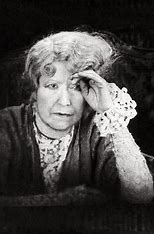 LA VOYANTE (1924) – The Divine Sarah Bernhardt went out the way she probably always wanted – while acting. In late March 1923 our lady died during production of this 60-minute movie.
Bernhardt played the title character – a fortune teller who serves as a figurative Mary Worth shepherding her clients to the happiness she foretells in their sessions together. A copy of the film survives in French archives but I’ve never been able to see it.
FOR MY LOOK AT THE FILMS OF SILENT MOVIE ACTRESS THEDA BARA CLICK HERE.
 Balladeer's Blog
That is an amazing name from the past. What an actress.
I agree. Plus it’s such an odd feeling actually seeing her on film.
Impressive recap.
Thank you very much Espy!
Great posts as always. I am a huge film buff but I’ve never been so fond when it comes to silent films. I have seen a few but rarely ever enjoyed them. That being said, Sarah Bernhardt definitely appears to be a fascinating actress. Her career brought to mind the movie “The Artist”. Released in 2011, this Oscar-winner film depicted the life of a silent movie star struggling to adjust to the transitions to talkies movies in the 1920s. It’s a strong Best Picture winner, and was my personal favourite film of 2011. A tribute to silent movies and that golden era of Hollywood in which Sarah Bernhardt made her silent movies. If you’re a fan of silent films, this movie is definitely worth seeing.
Here’s a list of my favourite films of 2011 (“The Artist” is number 1 on the list):
Thank you so much! I’m on my way to read your list of favorites from 2011.