
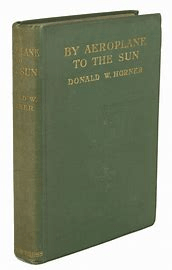
 BY AEROPLANE TO THE SUN (1910) – Written by Donald W. Horner. This British novel features ideas that wouldn’t have been out of place decades earlier but in 1910 it’s astounding to encounter concepts like an alleged scientist believing that the sun is inhabited.
The story is set in the far-off year 2000 A.D. Automobiles run on electricity, wireless video telephones are available and fluorescent lighting is commonplace. The British Parliament is now majority female and women have passed legislation stating that in a Leap Year women may propose to men and the men must accept or be subjected to ruinous fines.
Wealthy astronomer (?) Dick Stevenson fears that his neighbor Cynthia Meadows will propose to him, and in the semi-comical setting of this novel goes so far as to design and construct a spaceship – which he calls an aeroplane. He plans to be off exploring space long enough for Leap Year to be over.
Stevenson decides to mount an expedition to the sun because in the year 2000 we are told that the moon and Mars have been thoroughly explored. The brick-shaped spaceship/ aeroplane is built from the newly discovered metal called zioomium, which is as light as silk but stronger than steel.

BALLADEER’S BLOG
Dick and his team outfit the vessel with its own atmosphere and ionic propulsion motors. Despite Stevenson’s plan to have an all-male crew the uneven tone strikes again with unlikely and silly complications placing two women in his crew of six – and one of them is Cynthia Meadows herself!
The vessel fails to achieve escape velocity on its first attempt and the crew wind up at the North Pole but succeed in escaping Earth’s gravity on their second attempt.
Stevenson decides to check out Venus while he and his crew are passing by. It turns out Venus is mostly wilderness and is inhabited by gigantic humanoids. Our heroes are captured but manage to escape.
Next comes Mercury and as the ship gets closer to the sun, Stevenson and company come across a formerly unknown planet that the crew names Vulcan. The brightness of the sun has prevented its discovery until now.
The explorers finally arrive at the sun. In keeping with a fringe theory that I thought had died in the 1800s until encountering it in this novel, the sun is not hot but simply gives off light. The theory held that it was the Earth’s atmosphere that converted that light into heat.
The ship lands on the surface of the sun and discovers that the place is similar to Earth, surprisingly enough. As Stevenson speculated, the sun’s size makes its gravity stronger but by breathing the solar atmosphere one becomes strong enough to function in that greater gravity.
Regular readers of Balladeer’s Blog may remember that many science fiction works written long before this one had more realistic notions than By Aeroplane to the Sun. That theme continues as the crew discover that the sun is inhabited by huge intelligent spider creatures who communicate via noises that are close to musical.
The spiders abduct the ladies for who knows what purpose and take them to their underground home. Stevenson and the rest of the men rescue them and take off, leaving the sun behind.
On their way back to Earth our adventurers encounter a Martian spaceship which at first seems friendly but then turns hostile. Dick Stevenson manages to destroy the Martian vessel. (By the way, Martians in this tale are humanoid but have very high foreheads.)
The explorers arrive back on Earth and in a rare bit of accurate forward-thinking the story presents them landing in a splashdown in the Pacific Ocean off the coast of South America. As for Dick Stevenson and Cynthia Meadows, the Dickster has fallen in love with her during the course of their adventures and they plan to get married.
By Aeroplane to the Sun is light and fluffy and despite the opening bit about the women in Parliament passing their virtual Sadie Hawkins legislation this novel actually treats its female characters more positively than many 1950s sci-fi stories and movies. Especially movies.
I know the women wound up needing rescued from the sun-spiders, but this is a 1910 novel. Not every sci-fi work from back then can produce heroines as intelligent and courageous as the one in A Honeymoon In Space from 1900.
This novel is more light adventure than hard science fiction and is passable on that level. By all means don’t bother with it if the outdated science and social attitudes annoy you.
FOR MORE “ANCIENT” SCIENCE FICTION CLICK HERE.
 Balladeer's Blog
For the solidity of your review, Imma give this one a pass. I’ll have more time for college sports recaps.
There ya go!
Great review of ancient science fiction stories. I don’t find much time to read these days, but this story appears to be fascinating. It brings to mind memorable science fiction movies that I have seen in the past. For instance, the science fiction book reminded me of the film “Arrival”. Denis Villeneuve’s masterful film offered a glimpse at a gruesome alien invasion. Amy Adams gave one of her best performances in this movie. It’s truly an underrated thought-provoking movie that stands out in a genre which has grown stale over time. If you enjoy reading “By Aeroplane to the Sun”, you will also love this movie.
Here’s why it’s worth watching:
I appreciate it! I am on my way to your review of Arrival.
Great ancient science fiction story. I know I already commented on this one before, but once again this one really resonated with me. It reminded me of great science fiction movies I have seen. For instance, the story brought to mind the beloved “Star Trek” film series. I recently had a chance to see “Star Trek: Beyond” and really enjoyed it. A spectacular sequel honoring a classic series. Here’s why it’s worth watching:
“Star Trek: Beyond” (2016) – Movie Review – The Film Buff (huilahimovie.reviews)
Thanks! Your review of Star Trek: Beyond is great!