
 A JOURNEY TO THE WORLD UNDERGROUND BY NICHOLAS KLIMIUS (1741) – This novel was written by Danish author Ludvig Holberg and became a European sensation. Like Swift’s Gulliver’s Travels, Holberg’s work in this book had satirical political meaning and though the issues and social criticism no longer apply to the modern-day world, the fundamental story structure still holds up on its own.
The tale begins in 1665 as Nicholas Klimius, freshly graduated from the University of Copenhagen, is doing natural science research in the mountains of Norway. At one point, his colleagues on the expedition lower him by rope into a cavernous hole in the ground so he can explore it.
 The rope breaks, and Nicholas falls so far that his colleagues assume he was killed. Actually, Klimius fell down into the often-theorized Hollow Earth. In this case with an interior sun and small worlds in orbit around it.
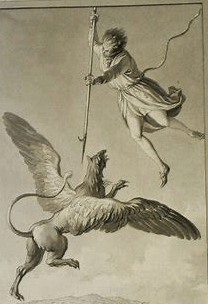
The atmosphere in this subterranean realm provides nourishment and moisture, eliminating the need to eat and drink. After days of being trapped in an orbit of his own around the interior sun, Nicholas gets attacked by a griffin. The resulting battle pushes our main character out of orbit and he lands softly on a small planetoid he learns is called Nazar.
This first world that Klimius explores is inhabited by a race of intelligent trees that have humanoid heads, multiple branches which serve as arms and two root-shaped feet on which they can walk, albeit very, very slowly.
The tree-beings are part plant and part animal. Like human beings, they are divided into males and females. Nicholas is kept in custody as the tree-beings teach him their language. Once he is able to explain to them how he came to Nazar, they subject him to aptitude tests to see where he might fit into the society of their nation, called Potu.
 Because Klimius’ learning is considered useless to the Potuans, he is relegated to the job of King’s Messenger, since he can move much more rapidly than the tree-people. Nicholas considers this job to be lacking in challenges for a man of his intellect, so he entertains himself by writing detailed descriptions of every Potuan location to which his job takes him.
Eventually, the king becomes aware of our hero’s writings. He is impressed and reassigns Nicholas to explore the rest of the planet Nazar and report back regarding what he finds.
Klimius is a little happier in this new job. Luckily, war is unknown among the different nations of tree-people on Nazar, so Nicholas faces no hostility as he records his observations of the other countries he visits. He is considered a novelty to tree-people and goes unmolested.
There are some physical differences among the tree-people of other lands. Some live for only a year, some lack the humanoid heads, and so on. Equality of the sexes is practiced in each country.
Because of the small size of the individual planetoid Nazar, it is not very long at all before Klimius has chronicled his worldwide findings. Put back in his role as royal messenger, Nicholas grows discontented again.
Becoming more and more resentful, he begins agitating for policies to undermine the existing political order. He winds up banished from Nazar. Klimius is placed in a coffin, and a flock of gigantic birds pull him up and away from the surface of the planetoid.
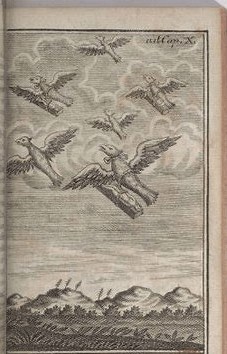 Eventually the birds let go, and Nicholas floats down to another planetoid, the much larger Martinius. The nation he lands in is inhabited by intelligent, civilized monkey-people. (Insert your own “It’s a madhouse, A MADHOUSE!” joke here.)
Luckily for our hero, the Martinians are as welcoming as the tree-people were. After learning their language he is tested to determine what job he is qualified for. In the case of the monkey-people, they move more quickly than even Nicholas can, so he is not even fit to be a messenger.
Instead, he is assigned to help carry palanquins, a role he finds even more degrading than being a messenger. Again, since he has nothing new to offer Martinian science, Klimius takes to diverting himself with another hobby.
This time, Nicholas takes to making elaborate wigs for himself. These wigs deeply impress the monkey-people, and everyone wants one. Before too long, Klimius has become a success, with his wigs in high demand.
Our main character is named Chief Wigmaker by the king and becomes part of the nobility. Nobles are the same everywhere, it seems, and even the Martinian royal class engage in sexual intrigues. The king’s wife tries to seduce Nicholas, who rejects her. She then accuses him of making advances toward her.
 Klimius is stripped of wealth and position, then condemned to be a rower on one of the kingdom’s trade galleys. Once the journey is well and truly underway, the ship’s captain agrees to free Nicholas from oar duty in exchange for him making the captain one of his wigs.
Klimius settles in to recording his observations of the various nations with whom Martinius does business. The Mezendorians are the major empire of the planetoid and are at the top of the mercantile “food chain.”
Other realms are Picardania, inhabited by intelligent jackdaws; Pyglossia, world of mouthless pig-people who speak via their anuses; and Crotchet Island (Guaita), inhabited by one-legged humanoid-mechanoid beings who are like robotic musical instruments.
The vessel carrying Klimius and his shipmates wrecks, with our narrator as the sole survivor. He is washed ashore in the land of Quama, inhabited by dark-skinned human beings.
In Quama, Nicholas’ learning sets him apart for once (I know, I know) and his mastery of science causes him to be hailed as a divine messenger. With the ugly ambition that Klimius has already demonstrated in his adventures, he indulges his darker tendencies.
In the years ahead, he revolutionizes Quamian technology, industry and weaponry. Acting as ruler and commander-in-chief, Nicholas conquers all the villages of Quama and names himself Emperor.
 Overseeing the manufacturing of guns and cannons, Emperor Nicholas launches military campaigns to expand his empire to the rest of the planetoid. He and his armies conquer the instrument-oids of Crotchet Island, Picardania, Pyglossia, the Tanachites (intelligent humanoid tigers) and even the powerful Mezendorians themselves.
Next, Klimius invades Martinius, taking over the nation of monkey-people and becoming the monarch of the entire planetoid. Once again, Nicholas’ darker tendencies get the better of him and eventually cause him to become a blood-soaked tyrant.
The subjugated peoples across the world rise up against him and manage to overthrow his regime. Klimius escapes with his life, and while on the run from his former subjects, he falls “up” a cavernous hole which returns him to the mountains in Norway.
Years have passed, but Nicholas’ former friends and family recognize him, although they reject his accounts of inner planetoids, chalking all of that up to hallucinations caused by malnutrition and injuries from his fall into the hole years ago.
Chastened by his many experiences, Klimius learns to be humble. He stops trying to convince others about what he went through and settles down to an academic career and a marriage. He spends the rest of his life secretly writing memoirs of his time in the Hollow Earth.
We readers are told that Nicholas Klimius passed away in 1695. His heirs eventually published his writings in 1741 in the form of this book. Some of Nicholas’ reworked memoirs included a portion in which he described the European countries the way they might seem to the inhabitants of the Inner Earth.
 A Journey to the World Underground by Nicholas Klimius is an enjoyable read, but it can be difficult to get a feel for the work as a whole because most versions that have been published in the past hundred years or so are severely abridged, omitting different sections of the original.
Obviously, the science is very outdated but the story itself has appeal. For readers who are not familiar with all the other “ancient” sci-fi books I’ve reviewed regarding subterranean realms, this novel may serve as a revelation that Inner Earth tales did not begin with Jules Verne.
FOR MORE REVIEWS OF “ANCIENT” SCIENCE FICTION CLICK HERE.
 Balladeer's Blog
A beautiful story of Nicholas Klimius by Ludvig Halberg. Very interesting ☺️
Thank you very much!
🥰
You’re the best!
Who told ?🤭🤭🤭😺😺😺balladeer?
Yep! I spread the word!
Like Joe Biden😁😁😁
Ha!
🫣🫣🫣
UUU
😳😳😳🤭🤭🤭
VVVVVVVVVVVVVV
🤬🤬🤬🤬
Another beautiful story. I have never heard of Nicholas Klimius before but he’s definitely a fascinating character. The intellect, love of science and bravery of the character makes him an interesting figure. He reminds me a lot of Robert Oppenheimer from Nolan’s “Oppenheimer”. Both characters are very similar in their fascination with exploring worlds that are far removed from reality. Like Oppenheimer, Nicholas Klimius seems like a fascinating character that would be great to explore in a movie.
Here’s why I loved Christopher Nolan’s Oscar-winning biopic:
Thank you! I liked Oppenheimer, too!