
Back in 2014, Balladeer’s Blog examined the top deities in Hittite Mythology. Here is my breakdown of the two separate surviving versions of the myth regarding the storm god Tarhun fighting the supreme serpent Illuyanka. Both versions tie in with the Purulli Festival.

Tarhun and his vizier Suwaliyut confronting Illuyanka
VERSION ONE – Illuyanka, a miles-long serpent, emerges from his lair in the Netherworld (making him another ally and possible son of the god Kumarbi) and unleashes havoc and disorder.
Tarhun the storm god clashes with Illuyanka in Kiskilussa and, unexpectedly, the serpent is triumphant. Illuyanka plucks out Tarhun’s eyes and his heart and leaves him to live blind and helpless (yes, even though he has no heart now).
In this first version of the myth Tarhun’s daughter Inara, the goddess of the wild animals of the steppes, plots with her father to get revenge on Illuyanka and restore her father’s supremacy over the gods. Inara invites Illuyanka and all the other gods in the Hittite pantheon to a huge feast she is throwing for herself and a mortal man from Zigarratta named Hupasiya.

Balladeer’s Blog
The tablets recounting the myth are incomplete and there is speculation that the feast was to celebrate Inara and Hupasiya marrying. It IS certain from the fragments that Hupasiya has Inara sleep with him first to pay him for playing along with her and her father’s plot against Illuyanka.
The serpent attends the feast, matrimonial or otherwise, and when he is sufficiently drunk Hupasiya binds Illuyanka. The blind Tarhun then slays the serpent and retrieves his eyes and heart. The storm god is hailed as the restored King of the Heavenly Deities even though his victory over the serpent came through treachery.
Inara then built a house for herself and Hupasiya on a rock cliff near the city of Tarukka while his children were gestating inside her. After twenty days she was ready to give birth (you know how mythology makes its own rules as it goes along) and as she went out to deliver her babies she warned Hupasiya NOT to look out the window at her or the children.
Needless to say Hupasiya ignored the warning and looked out the window. He was so traumatized by what he saw that when Inara went back inside the house she found him weeping and begging to be permitted to return to his home city of Zigarratta. We are never told what he saw and the remaining tablets are so fragmentary that the conclusion to this part of the story cannot be determined.
Given how much I love comparative mythology I find it interesting how parts of this tale parallel a pair of Shinto myths. In one the Shinto storm god Susanowo, having been stripped of much of his godly power by having his beard and his fingernails torn off, is exiled to the Earth.
He tries to save the region of Izumo from the depradations of a giant eight- tailed dragon. Since he is without much of his divine power while in exile he first gets all eight of the dragon’s heads drunk on saki, then cuts all the heads off, killing the creature.
In the other Shinto myth, when the god Ninigi’s son Hoori marries Toyota, the daughter of the sea god Watatsumi, and she is about to give birth to their child she builds a hut to shelter her while she endures her labor.
She warns her husband NOT to look into the hut while she is giving birth but, naturally Hoori DOES look and sees Toyota in her sea-serpent form delivering their child. He cries out in horror and Toyota, hurt and angered by her husband’s indiscretion, leaves him forever and returns to the sea.
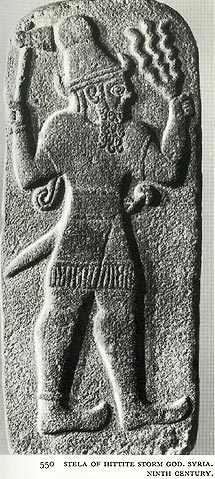 VERSION TWO – Illuyanka, a miles- long serpent, emerged from his lair in the depths of the sea (NOT the Netherworld like in the first version) and unleashed havoc and disorder. Tarhun the storm god clashed with Illuyanka in Kiskilussa and, unexpectedly, the serpent was triumphant. Illuyanka plucked out Tarhun’s eyes and his heart and left him to live blind and helpless (yes, even though he had no heart).
The main difference in the two versions centers around the way in which Tarhun eventually gets revenge on Illuyanka. In this version the defeated, blind and “heartless” storm god, seemingly living in exile from his heavenly kingdom following his defeat, marries “the daughter of a poor man”. Neither the name of the daughter or the father is mentioned in the surviving fragments of the myth.
Tarhun has a son (also unnamed in the tablets) by this woman and eventually this son courts and marries the humanoid daughter of Illuyanka. This is all part of the storm god’s plan for revenge which involves exploiting a loophole in the Hittite marriage laws. Those laws stated a poverty- stricken groom – as Tarhun’s son is, since his father is helpless and penniless since he was overthrown by Illuyanka – may go to live with a wealthy bride’s family as a servant in exchange for a “bride price” after they are wed.
The storm god’s son makes his “bride price” the eyes and heart of Tarhun, which Illuyanka has kept as trophies of his conquest. Apprehensive but bound by the law, the supreme serpent agreed. To nobody’s surprise when Tarhun was again whole he challenged Illuyanka to a rematch and this time was triumphant. No fool, Tarhun decided to kill Illuyanka and all his children to prevent any chance of the serpent deity or his kin ever posing a threat to him again.
The storm god’s son, out of obligation to his new wife’s family, insisted his father slay HIM (the son) as well, since Illuyanka had taken him into his household and complied with the bride price obligation. With regret, Tarhun did so.
The tablet goes on to detail a conflict arising because of all this, but it is not clear how nor is it clear why it ties into the naming of which deity will be the “state” deity of the city of Kastama. The completion of the myth has not survived so barring new archeological finds we will never know what one part of this second version has to do with the other.
In this second version even though Tarhun still employs treachery, at least he wins a fair fight with Illuyanka, rather than kill him while he’s bound and drunk. Also in this version the fact that the serpent emerges from the sea instead of the Netherworld gives the story an even greater resemblance to the Canaanite storm god Baal’s battle with Yam, the sea deity.
FOR MORE HITTITE DEITIES CLICK HERE: https://glitternight.com/2014/04/22/hittite-mythology-the-top-deities/
FOR SIMILAR ARTICLES AND MORE OF THE TOP LISTS FROM BALLADEER’S BLOG CLICK HERE: https://glitternight.com/top-lists/
© Edward Wozniak and Balladeer’s Blog 2014. Unauthorized use and/or duplication of this material without express and written permission from this blog’s author and/or owner is strictly prohibited. Excerpts and links may be used, provided that full and clear credit is given to Edward Wozniak and Balladeer’s Blog with appropriate and specific direction to the original content.
 Balladeer's Blog
Hmm wait where was Gozer the Gozerian while all this was going on … ? 😁
Ha! Gozer was in Sigourney Weaver’s refrigerator.