
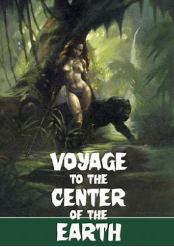
 VOYAGE TO THE CENTER OF THE EARTH aka Planet at the Center of the Earth aka “Journey to the Centre of the Earth, or Various Adventures of Clairancy and His Companions, to Spitsbergen, to the North Pole, and to Unknown Countries, translated from the English of Hormidas Peath by M. Jacques Saint-Albin”.
Jacques Collin de Plancy, who is more noted for his writings on occult subjects, authored this work. Odd, considering how occultism and superstition are ridiculed in parts of the story.
Decades before Jules Verne’s better-known story about subterranean exploration came several other “ancient” science fiction works about strange worlds inside of a hollow planet Earth. Some of them have already been reviewed here at Balladeer’s Blog.
 This particular story centers around the fictional seaman Hormidas Peath and his crew who became shipwrecked in the icy Arctic Sea in 1806. They were shocked to discover that temperatures got warmer the further north they went, so they kept following the warmer air until they reached the Iron Mountains.
That mountain range was perfectly circular and the North Pole at its center was really the opening to the Inner Earth planet called Pluto after the Roman god (The dwarf planet Pluto was not discovered until 1930.) Peath and his companions explored that much smaller planet inside of the Earth, which was kept rotating by magnetic forces.
This novel was, like so many others before and since, presented as the “real-life” journal of an expedition. Hormidas Peath and company spent the next eight years exploring the various nations of Pluto before emerging from the South Pole’s counterpart to the North Pole’s subterranean tunnel.
Antarctica had its own Iron Mountain Range which was perfectly circular. Peath and his colleagues had iron helmets strapped to their heads and the South Pole’s magnetic forces levitated them from the Inner Earth up to the South Pole tunnel “doorway.”
The humanoid inhabitants of the Inner Earth were all merely two feet tall on average. Among the nations/ city-states that Hormidas’ expedition traveled through:

BALLADEER’S BLOG
ALBUR – The largest nation of Pluto. Forty-five million Plutonians lived in Albur, which boasted over 400 cities. Albur’s people had the highest technology in Pluto and used agricultural and metal-working procedures far beyond the other subterranean countries. Their weaponry was also much more advanced.
The main city of Albur was Orasulla and all the lesser cities were laid out exactly like Orasulla. All were surrounded by high walls and all had a ritual pyramid at the city center with all the other streets emanating outward from that religious structure.
Every building besides the pyramids were four stories tall (proportionate to the smaller Plutonians) and were painted yellow with green doors. Albur was a hereditary monarchy with a strict caste system. The current king or queen had a cabinet of twelve ministers who were elected by the free castes of Albur to ensure that the people’s interests were taken into account.
Vegetarianism was enforced by law in Albur, with meals being eaten at six-hour intervals during waking hours. Wine in the country was made with a much lower alcohol content than on the nations of the Earth’s surface.
Elephants the size of calfs were plentiful in Albur and were used to pull the wagons of public transportation and were ridden by the cavalry in battle. The largest animals in the country were the lossines, six feet long lizards who were so domesticated they were used as watch-dogs on Albur’s large estates.
The lossines were also used to patrol the Forbidden Zone around Albur’s only volcanic region. Like Saint Bernards with their containers of alcohol, lossines were trained to find and help humans lost in the Forbidden Zone by permitting the humans to mount them and ride them back to safer regions.
Both of the sexes – males and females – received the same education, with physical fitness a large part of the curriculum.
Peath and his companions were exiled from Albur when they were caught eating meat. As outsiders they were not imprisoned for five years for the crime like a citizen would be.
THE BANOIS EMPIRE – The inhabitants of this place were Pluto’s tallest and could reach a height of two and a half feet. They communicated in song rather than speech.
Banois had a constitutional emperor who was severely limited in their powers. The people of Banois ate fish but otherwise were vegetarians like the Alburians. Banois was more lenient toward outsiders who ate meat as long as they caught and prepared it themselves.
Foreign meat-eaters were even welcomed into the empire during hunting season to keep the population of predatory animal species in check. The forests of Banois were vast and included many dragons, who were seven feet long and had bat-like wings. Dragons were sacred and could not be hunted or killed.
FELINIA – This country was a sort of theocracy, but given its elaborate philosophies of magic and superstition, maybe it should be called a “superstitiocracy” instead. All politics, social activities and academic endeavors centered around mysticism.
The most revered religious leader in Felinian history was Burma, who performed miracles and spread his philosophy during his life. At one point he was carried off to parts unknown by a winged elephant and returned years later with the Sacred Book.
In a parallel to surface world religion, differing interpretations of the Sacred Book – or doubts regarding its authenticity – have resulted in wars over the years. It is later implied that Burma may have compiled the Sacred Book based on an exploration of the surface world.
Burma’s greatest “miracle” was learned to have a scientific basis, which was considered heretical in Felinia. The religious leader once had several followers strap iron hats like his own to their heads and rise to the world beyond (the surface world).
In fact, the ascension when strapped to iron resulted from the intense magnetic forces of the region. That inspired the means by which Hormidas Peath and company escaped Pluto and returned to the surface world.
NOLANDANIA – The geographically largest – but most sparsely populated – nation of Pluto. Its citizens were somewhat hedonistic and therefore never posed any military threat to neighboring countries.
All but a few virtuous and productive people in Nolandania endlessly partied and cheated on their spouses almost daily. Non-stop debauchery ruled and the few sensible citizens knew that it was not sustainable for any nation and were prepping for the inevitable societal collapse.
Journey to the Centre of the Earth is nowhere near as well-known as it should be, probably because the title fools people into thinking it is the much later Jules Verne novel. That’s why I prefer Planet at the Center of the Earth as a title, to at least clarify that it is an original story.
FOR WASHINGTON IRVING’S 1809 depiction of an invasion from the moon click here: https://glitternight.com/2014/05/05/ancient-science-fiction-the-men-of-the-moon-1809-by-washington-irving/
FOR TEN MORE EXAMPLES OF ANCIENT SCIENCE FICTION CLICK HERE: https://glitternight.com/2014/03/03/ten-neglected-examples-of-ancient-science-fiction/
 Balladeer's Blog
Intricately woven and richly detailed, “Journey to the Centre of the Earth” is a hidden gem deserving of more recognition.🤝🎉🏆
I agree! Thank you!
Another great ancient science fiction story. This was an intriguing story that brought to mind amazing science fiction movies which I have seen. For instance, it reminded me of the Avatar franchise. The Avatar movies also take place on a fantastical planet which is running out of resources. Pandora is a fascinating planet serving as the backdrop for the movies. I love all the Avatar movies but I particularly admired the sequel “Avatar: The Way of Water”. Most sequels rarely live up to the standards set by predecessors, but it was an exception. One of the best movies of 2022, and a theater experience I’ll never forget.
Here’s why it’s a must-see:
“Avatar: The Way of Water” (2021) – Movie Review – The Film Buff (huilahimovie.reviews)