
 The Rivals of Sherlock Holmes was a 1971-1973 British television series about London by Gaslight detectives from both the Victorian and Edwardian Ages.
The program featured mystery stories and charismatic detectives written and created by contemporaries of Arthur Conan Doyle. For more click HERE.
 Episode: FIVE HUNDRED CARATS (February 5th, 1973)
Detective: Inspector Leo Lipinzki of Kimberley, South Africa, a figure created by American author George Griffith. The first Inspector Lipinzki story was published in 1893.
Synopsis: We are now in the second and final season of The Rivals of Sherlock Holmes. In addition to his many “ancient” science fiction stories – reviewed previously here at Balladeer’s Blog – George Griffith also wrote the eight Inspector Lipinzki stories, which were later collected in the book Knaves of Diamonds in 1899.
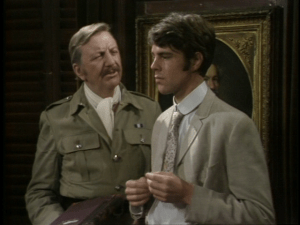 For the first time in this series we have a story set outside Great Britain, which I found to be a welcome change of pace. Leo Lipinzki (Barry Keegan) works as a Detective Inspector for the Cape Police, but technically the already wealthy and powerful De Beers Diamond Corporation is who he really answers to.
Virtually all the murders, thefts and other crimes that Lipinzki investigates stem from IDB – Illicit Diamond Buying – amid the busy diamond mines and other establishments of South Africa. (And if you read the Inspector Lipinzki stories you’ll see that the acronym “IDB” is used ad nauseum.)
The episode Five Hundred Carats opens up with a murder that we eventually learn ties into the brilliant, seemingly impossible theft of the Great De Beers Diamond. Though in the original story George Griffith presented it as if the Inspector himself was relating the case to him, The Rivals of Sherlock Holmes substitutes the fictional “Mr. Cornelius” (Alan Tilvern), an American diamond buyer, for Griffith.
While Lipinzki investigates the murder we viewers get a taste of the expertise the green-uniformed Inspector has acquired during his years in South Africa. The killer used a spear to knock off their victim, trying to make it seem like a native South African committed the deed, but our detective can tell from a minor adjustment to the weapon that a white person was responsible.
The spectacular theft of the Great De Beers Diamond was accomplished by thwarting some absolutely staggering security measures, including barred cells and sturdy safes, which seemed impossible to overcome. The ingenious solution to the manner in which the crime was carried out put me in mind of the best episodes of Banacek, but set in the 1890s.
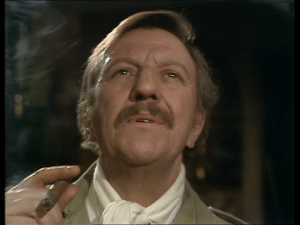 Roughly two-thirds of the way through the tale, Inspector Lipinzki has fixed upon the perpetrators, but must deduce how they did it AND must swim upstream against the De Beers board members who circle the wagons around their own when Leo’s investigation takes him where they don’t want him to go.
Risking career suicide, our detective wages a war of nerves on his quarries while thwarting their desire to smuggle the diamond out of South Africa.
Barry Keegan’s performance as the Inspector won me over. Instead of the stereotypical dapper, polished gentleman that he was in the original stories, Keegan’s Lipinzki is a rougher, more hard-boiled detective. He seems a far more likely type to have survived the hotbed of intrigue and crime that Kimberley was at the time.
Clad in his dashing, quasi-Breaker Morant style uniform, the tough, hard-drinking Leo comes across like a hybrid of Sam Spade and a world-weary ex-pat surviving by his wits and fists in an exotic spot where life is cheap. And in Kimberley, the lure of diamonds can spawn deadly betrayal at any moment.
(To emphasize that point about betrayal, in one of the Inspector Lipinzki stories one of his female officers – who handled “intimate” searches of women suspected of smuggling diamonds in their orifices or cleavage – turns out to be the smuggler, having given in to temptation, thereby throwing away her career.)
 Aideen O’Kelly brilliantly plays Bridie Sullavan, an attractive Irish widow who runs Rick’s Cafe Americain, I mean the local bar/ gambling spot, called The Victoria. Bridie is a terrific supporting character, serving as potential suspect AND sometime love interest for the Inspector while capably handling herself against drunk customers and overly amorous admirers.
The low budget is the only sizable problem with this episode. The mystery and mis en scene are entertaining and the tweaks to Lipinzki’s character work to perfection. But I DO wish they had kept the short story’s scene in which the Inspector shows off the small museum of smuggler’s relics that he keeps in his office. To me those souvenirs from some of his other cases would have cemented Leo in the minds of the audience as a true Sherlock Holmes of the Cape.
The Inspector Lipinzki stories combine so many of the best elements of Film Noir and Colonial-Era tales of intrigue that I would have loved to see at least one or two more of his yarns adapted for the small screen. Unfortunately, this was the only one of George Griffith’s Lipinzki stories in the series.
But hey, anybody up for some fan fiction about Sherlock Holmes and Inspector Lipinzki taking on Sebastian Moran in 1890s South Africa? +++
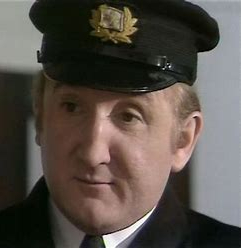 Episode: THE LOOTING OF THE SPECIE ROOM (April 16th, 1973)
Detective: Chief Purser Eli Horrocks, created by C.J. Cutcliffe Hyne. The first Mr Horrocks story was published in the year 1900.
Comment: He’s a Chief Purser who solves mysteries! Instead of doing the thousandth screen adaptation of Agatha Christie’s Murder on the Orient Express or Death on the Nile, how about someone bringing to life Hyne’s seafaring sleuth Mr Horrocks? The Looting of the Specie Room has a lot of the “snooty British upper class prigs caught up in a crime” appeal that Christie’s later mysteries had.
Rounding up an all-star cast and filming this first-rate mystery as it unfolds amid cushy 1900 trans-Atlantic ship travel might make for a surprise hit. Compared to other Chief Purser Horrocks mysteries like The Derelict THIS little honey would probably work best as a movie. The detective work would just be part of the charm, with the period detail providing the rest.
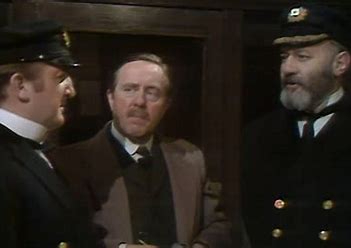 Synopsis: The RMS Oceanic is hoping to pull off a double-coup – hauling a record-setting TWO HUNDRED FIFTY-THOUSAND dollars in gold bullion (or $9,137,670 today) from New York City to Southampton AND setting a new speed record for a trans-Atlantic voyage. Lord Altington, the owner of the shipping line, is aboard to oversee this venture and keep the pressure on the crewmembers.
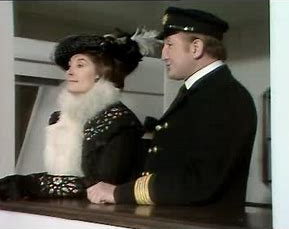
Also aboard for this bit of hoped-for history are assorted sleazy reporters and a mix of Upper Class Twits whose pomposity and snobbery rival Lord Altington’s. When half the gold disappears on the way to Great Britain, the spectacular theft could mean the end for Chief Purser Horrocks (Ronald Fraser), whose position makes him ultimately responsible for all valuables on board.
With Lord Altington looking for a scapegoat, with the crew pointing fingers at each other, with Inspector Trent bungling the investigation and with an entire shipload of suspects ready to scatter to the winds upon arrival in Southampton, Horrocks takes it upon himself to play detective in order to save his own skin.
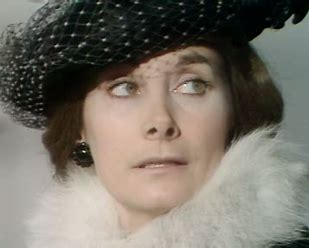 Among the suspects are the sensation-seeking reporters as well as passengers like wealthy widow Mrs Vanrenen, played by Jean “Sara Kingdom” Marsh for this episode’s Doctor Who connection. Snooty Lord Altington has no intention of inconveniencing his fellow blue-bloods by treating them like potential thieves and lets them all leave and return to the ship as they please during a stopover in Liverpool.
Some of Chief Purser Horrocks’ fellow officers had motives and opportunity for the crime as well, like First Officer Clayton (Stephen Yardley), who has a mountain of gambling debts and a hotsy-totsy wife to pamper. It even turns out that Horrocks himself has certain financial enigmas in his past, keeping him firmly in the sights of Inspector Trent. A debut story for a serial detective is the only time their innocence or guilt can really be in question, further cementing the need for The Looting of the Specie Room to be the first Horrocks mystery in any potential series.
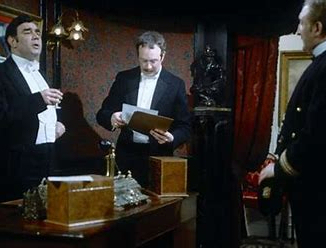 Against overwhelming odds, the plucky Chief Purser must figure out how the theft was committed and unearth evidence strong enough to convict the guilty party or parties. If he fails he’ll be the fall guy for the shipping line and his own closely-guarded secrets will be exposed. And speaking of secrets, just how much was the Oceanic and its cargo insured for?
Like so many other detectives, fictional or not, Horrocks finds himself in harm’s way because of his investigation. With so much at stake a brutally violent attempt is made on the sleuthing seaman’s life.
Ron Fraser is pretty good as Eli Horrocks, who solves this Banacek-style mystery while still attending to his many duties aboard ship. The character’s jaded, world-wise way of schmoozing, dealing and finessing in order to see to the various strange desires of the hopelessly pampered passengers emanates a kind of Saint Jack air.
If the Chief Purser has a Watson it would be Assistant Purser Robbins, played by Michael Cashman of Sandbaggers fame. Robbins is young and handsome enough to appeal to the ladies, while Horrocks does the heavy thinking, sort of like the chemistry with Chief Inspector Barnaby and his sidekicks on Midsomer Murders.
 Author C.J. Cutcliffe Hyne loved the sea, as made clear in his many novels and short stories. That love is shared by his major fictional creations like Captain Kettle and Chief Purser Horrocks. While Kettle was a conventional nautical hero, Horrocks served in seventeen crime stories.
The Looting of the Specie Room is my second-favorite episode from Season Two of The Rivals of Sherlock Holmes, after the 1893 Inspector Lipinzki mystery. In this production viewers not only get the usual “Sherlock Holmes without Sherlock Holmes” fun but also some “Agatha Christie before Agatha Christie” vibes. The great story was almost wasted considering the cheap and cramped style of 1970s BBC dramas and cries out for a big-budget version. +++
FOR MORE FORGOTTEN TELEVISION CLICK HERE: https://glitternight.com/category/forgotten-television/
 Balladeer's Blog
Agatha Christie vibes–that must be good.
Yes, it’s pretty enjoyable!
There’s a reason I so enjoy British television. Well, Brit, Dane, Swede, Irish, Scottish. Were it not for the $$istic grubbing of Acorn, it would rate as the ONLY package I subscribed to. Your review here, Balladmaster, very well done.
Thank you very much! I agree, there’s a lot of quality programming from overseas.
It is a fantastic book and the story is great! Well reviewed 👍
Thank you!
☺️🙏
You’re very kind!
😛😛how
With your nice remarks.
I am happy
Me too!
🙄
Ha!
🤔🤔🤔
They look very contemplative.
They are in worry about my future 😛😛
Oh no!
Oh yes 😝
Too funny!
🥲🥲🥲
$$$
🙄🙄🙄
!!!
🤨🤨
I grew up seeing these actors in many roles on the TV screen. I have the ‘The Rivals…..’ book somewhere. I bought it because I am an avid fan of Conan Doyle. I was interested in others’ stories of similar nature. Many Strand illustrations exist inside. Enjoyed your reviews. Thank you.
Thank you very much! I agree, that book is great. The BBC radio series 2011 continuation of The RIvals of Sherlock Holmes was good, too, but the stories were only a half hour in length. If you’re not familiar with the radio series it introduced some additional female detectives, some new male detectives AND some additional mysteries with detectives from the tv series like Martin Hewitt and Max Carrados.
Thanks for this. I’m not familiar with the radio series. When I made ceramics I used to listen to Radio 4 (UK) afternoon plays. But can’t recall those at all. I’ll look into it. All the best.
Same to you! Glad to do it!