
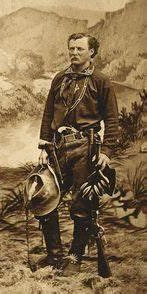
 COMANCHE JACK – Balladeer’s Blog presents another seasonal post for the upcoming Frontierado Holiday, observed Friday August 4th this year. Frontierado celebrates the myth of the old west, not the grinding reality.
Comanche Jack – real name Simpson Everett Stilwell – was born on August 18th, 1850, possibly in Tennessee. At some point in the 1850s his family moved to Kansas, and in 1862 or 1863 his mother and father got one of the time period’s rare divorces.
The mother kept the future Comanche Jack’s sisters, Mary and Elizabeth, while his father left with him and his brothers, Millard and Frank. They settled elsewhere in Kansas but the young man was struck with wanderlust and ran away from home at some point in 1863.
Once he reached Kansas City, Missouri, Stilwell took work on a wagon train headed for Santa Fe, New Mexico. The young man grew up quickly traveling back and forth with wagon trains going to and from locations like New Mexico, Kansas and Missouri.
 During that four-year period, he developed his marksmanship, as well as his scouting, Indian fighting and wilderness survival skills. In the snowy months, Comanche Jack rode with hunting parties along the Beaver, Canadian and Wolf Rivers.
Our hero joined the U.S. Army in 1867 and served at first as a scout and guide for troops out of Fort Dodge, Kansas, then later Fort Hays and Fort Harker. While working as an army scout, Comanche Jack became friends with the famous Buffalo Bill Cody and others.
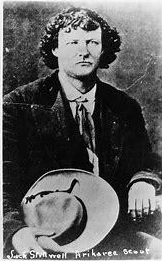
September 19th, 1868 saw Stilwell among the 51 soldiers and scouts along the Arikaree River who were surrounded and attacked by a combined force of 250-300 Cheyenne, Sioux and Arapaho. Former Pony Express Rider Irish Tommy was also one of the scouts in the party.
This bloody 9-day siege in Colorado became known as the Battle of Arikaree Fork and the Battle of Beecher Island. Noted Cheyenne Chief Roman Nose was among the Native Americans killed in the battle, supposedly by Comanche Jack himself.
Around midnight of the first day of fighting, General George Forsyth called for volunteers to try getting word to Fort Wallace, KS that the unit was in dire need of help. Jack was among the volunteers and used the cover of darkness to slip past the besieging forces and ride the 4 days to Fort Wallace, then 4 days back with reinforcements.
 The Native Americans withdrew at the approach of those reinforcements and the besieged men were saved. Stilwell continued his career as an army scout.
On November 4th, 1868, Kansas Governor Samuel Johnson Crawford resigned so he could be appointed commander of the 1,200 men of the Nineteenth Kansas Volunteers. General Phil Sheridan gave orders to Crawford to lead his unit to Fort Supply, where he was to rendezvous with George Armstrong Custer for a campaign against the Cheyenne along the Washita River in Indian Territory (now Oklahoma).
Comanche Jack and Apache Bill Seamons were the two scouts assigned to escort Crawford and his men to Fort Supply. Stilwell and Seamons served in fighting Cheyenne all through that infamously freezing, snowy winter during which many men and horses died, and the Battle of the Washita River took place.
In 1871, Jack was transferred to Fort Sill, Indian Territory. The summer of 1872 found Stilwell guiding General Sheridan and his escorts from Fort Sill to Fort Dodge, and during that journey Sheridan made his notorious report about sighting roughly 90 million buffalo in a 400-mile area.
In the fall of 1872, the Kiowa Chiefs Setanta and Big Tree were released from their prison in Texas and, accompanied by a cavalry detachment under Lieutenant Carter, were being escorted to Fort Sill for return to their reservation.
Major George W. Schofield was in charge at then undermanned Fort Sill, and he dispatched Comanche Jack with an urgent message to Lt. Carter that the fort was not fit at the moment for the 2 chiefs or the potential of a renewed war upon their return to the Kiowa. Jack successfully reached Carter before his unit could reach Fort Sill, and the lieutenant took Setanta and Big Tree to Atoka instead.
Comanche Jack also saw action in the Comanche Uprising from June to September, 1874 against Comanche, Kiowa, Apache and Cheyenne tribes. One of Stilwell’s escapades during that conflict included a desperate 75-mile ride through hostile territory from the Darlington Indian Agency to Fort Sill to deliver a Paul Revere style warning when the uprising broke out.
On August 25th, 1875, a fellow Fort Sill scout named Jack Kilmartin guided Deputy U.S. Marshal James N. Jones to a lumber camp to arrest a fugitive named Thomas Campbell. Tensions rose and gunfire broke out between the lumber men on one side and Jones & Kilmartin on the other.
Campbell was killed and the lumber company accused the deputy marshal and the army scout of waging war on civilian workers. A writ was immediately sworn out for the arrest of Kilmartin, Jones, and, through an unknown error – Comanche Jack as well.
 Some sources claim Stilwell took part in the lumber camp gunfight, but others speculate that it was all just a mistake in bureaucratic paperwork, with Comanche Jack’s name accidentally included because he had often worked with Jack Kilmartin.
Wanted for an incident in which most sources say he had not participated; Stilwell eventually cleared his name, and the official record was corrected, but it took two months. Not every report expunged Comanche Jack’s name from accounts of the skirmish, however, and confusion lingered.
October 1875 found Stilwell and 4th Cavalry Sergeant John B. Charlton assigned to track down and apprehend the outlaw “Red” McLaughlin for stealing horses from Native American reservations. Red’s trail led the pair to the home of one Widow McGee, whose sons were members of McLaughlin’s gang.
After a brief siege and shootout, Red and 2 of the widow’s sons were taken into custody to stand trial in Fort Smith, Arkansas. Records of the trial have not survived.
In December of that same year, Comanche Jack was arrested for allegedly stealing a mule from a man named James Jelm, but Stilwell claimed not to know the mule had been stolen. The case went to federal trial, and Jack was found not guilty.
Back at Fort Sill by late June of 1876, Jack, his frequent partner Kilmartin and another man were assigned to track down horse thieves who had stolen several ponies from a Comanche encampment on their reservation.
The trail led the trio into Texas, and one night after abandoning the chase, the men decided to catch a meal and spend the night at the Whaley Ranch, where Jack Kilmartin’s wife Lena worked as a housekeeper. Following the meal, a domestic argument broke out between Lena and her husband, with the woman producing a revolver and shooting Kilmartin to death.
Comanche Jack and his companion did not want to hurt a woman, so they returned to Fort Sill and asked for Lena Kilmartin to be arrested and tried for her husband’s murder. The frequent jurisdictional clashes in the old west, complicated in this case by civilian vs military considerations, resulted in no action ever being taken against Lena.
During 1877, Jack quit being a scout at Fort Sill and headed for Arizona with his younger brother Frank. Comanche Jack was not fond of the wild, sometimes criminal, crowd that Frank took to fraternizing with in Prescott.
Frank shot to death a cook named Jesus Bega in October but was acquitted when the case went to trial. Jack wound up missing his old career and in 1879 returned to being an army scout, serving at Fort Davis and Fort Stockton.
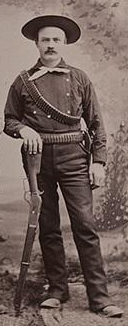 Our hero saw action over the next few years, while his brother Frank moved to Tombstone, AZ and joined up with the Clanton-McLaury Crime Faction led by Curly Bill Brocius. In March 1882, Frank Stilwell was one of the Clanton-McLaury gunmen who killed Morgan Earp and was in turn killed by Morgan’s brother Wyatt Earp at the Tucson railway station.
Blood is blood, and Comanche Jack burned his bridges with the army in his fury over Frank’s death. He quit and traveled to Arizona intent on killing Wyatt Earp for revenge. By the time Jack hit Tombstone, the Earp Brothers and Doc Holliday had fled the territory, and the pair wound up never crossing paths for the rest of their lives.
Come 1885 and Stilwell was back in the Longhorn State, where he was appointed a Deputy U.S. Marshal for the Northern District of Texas. This new career agreed with Comanche Jack, and he thrived, arresting Indian Agency bandit Joseph Leonard, among many other hombres.
The year 1887 found Jack reassigned to the Kansas District, then later that same year he was named the Deputy U.S. Marshal operating out of Anadarko, Indian Territory. Stilwell clashed with many more outlaws like the Sleeper Kid (as in Sleeper, Missouri) and others.
Some time by 1894, Jack became a Police Judge in El Reno, Oklahoma. On May 2nd, 1895, Stilwell married (late in life) Esther Hannah White.
During 1896 Comanche Jack was an Oklahoma witness in the case The United States vs. The State of Texas in which the federal courts decided that Greer County, long claimed by both states, was indeed part of Oklahoma. From there he became a U.S. Commissioner at Anadarko, where he was admitted to the bar and practiced law.
In 1898, Buffalo Bill Cody invited his old friend Stilwell to move to his ranch near Cody, Wyoming, trusting him to look after the ranch while Bill was touring with his Wild West Show. Jack did so and lived in Wyoming until his death on February 4th, 1903, from kidney issues.
 Balladeer's Blog
👏👏
Thank you!
🙏
😀
🤔🤔😏
The many moods of Priti. 😀
😮😮😮😮😮ha ha
What a life!
Gwen.
You said it!
Reblogged this on El Noticiero de Alvarez Galloso.
Thank you, sir!
Anytime
😀
What a great story. As good as any of the westerns I read.
I’m very glad you enjoyed it!
Such piece of history is so interesting. We have seen so many movies about so many of the characters mentioned in this story. Great share.
Thank you very much for saying so!
It is my pleasure. Reading the piece gave me much joy.
You’re very kind!