
It’s Veterans Day, formerly called Armistice Day, which marked the end of World War One on “the eleventh hour of the eleventh day of the eleventh month” of 1918. For Balladeer’s Blog’s final World War One post this year here’s a look at the first seven American pilots of the Lafayette Escadrille.
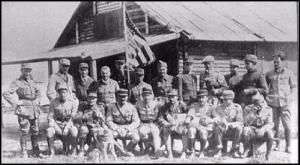
Lafayette Escadrille
QUICK FACTS: The French Foreign Legion connection to this storied squadron of American pilots came about because the United States did not enter the First World War until April of 1917 even though it began in 1914. Many American flyers volunteered to fight for the Allied Powers against the Central Powers.
*** Originally called the Escadrille Americaine, the unit had to drop that name when Germany, the Ottoman Turks and other Central Powers nations complained to the U.S. stating such a name indicated a violation of its official neutrality at that point in the war. The new name was the Lafayette Escadrille in honor of the Marquis de Lafayette, the French aristocrat who served in America’s Revolutionary War.
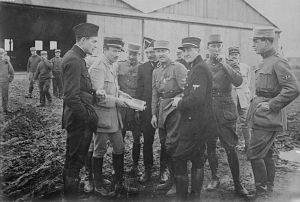 *** This unit was active from March 1916 to February 1918, at which time it was disestablished and its pilots were absorbed into the official United States armed forces because America had by then been one of the belligerent nations for nearly a year.
*** Officers of the escadrille were French, which was standard for the French Foreign Legion.
*** 224 Americans served in the Lafayette Escadrille, with 51 slain in battle and 11 more dying from other causes. 15 pilots became Prisoners of War and 11 became Aces.
*** Two lion cubs became the escadrille’s mascots. The pilots named them Whiskey and Soda.
THE FIRST SEVEN PILOTS OF THE LAFAYETTE ESCADRILLE:
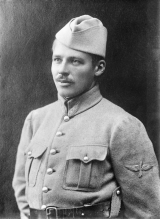 NORMAN PRINCE – This founding member of the unit was a graduate of Harvard University and Harvard Law School. He was an early enthusiast of the new field of flying and earned his pilot’s license in 1911.
Norman shot down five enemy aircraft and had four more probables before being killed in a crash-landing in mid-October of 1916. The French awarded him the Legion of Honor, a military award established by Napoleon himself. Prince also earned the Croix de Guerre and the Medaille Militaire. Continue reading
 Veterans Day is tomorrow, so here’s another World War One post.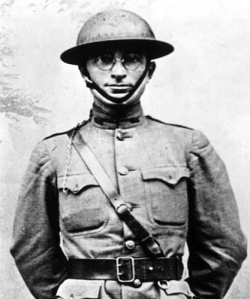
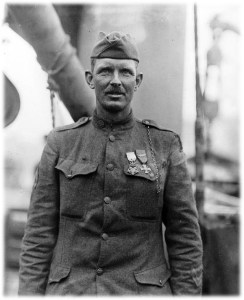
 Balladeer’s Blog examines American Flying Ace Eddie Rickenbacker as we lead up to another November 11th, now called Veterans Day but formerly known as Armistice Day since November 11th, 1918 marked the end of World War One.
 THE IACCACI BROTHERS – In the 1960s young American men would head to Canada to avoid serving in the Vietnam War. During World War One a number of young American men headed to Canada to serve in British Military Units because the U.S. had not yet entered the conflict.
 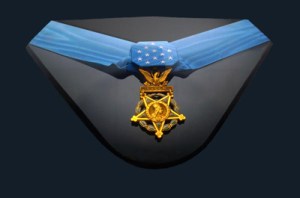 Balladeer’s Blog offers up a Memorial Day weekend post. In keeping with World War One’s “Eleventh hour of the eleventh day of the eleventh month” tradition that spawned Veterans Day in November, here are eleven WW1 figures who were awarded the Medal of Honor.
 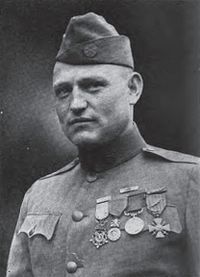 JAKE ALLEX
  Recently, a Balladeer’s Blog reader asked if I would compile a list of my “Best of” stories of the 1930s and 1940s pulp hero G-8 and his Battle Aces. That idea makes perfect sense considering I reviewed all 110 book-length stories of this World War One flying ace who should be as big culturally as Doc Savage, Zorro, and so many other pulp icons.
 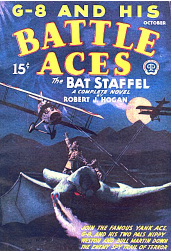 THE BAT STAFFEL (October 1933) – The very first G-8 pulp novel is at the top of my list. Not only does it nicely capture the tone and nature of the series, but it introduces the villainous mad scientist Doktor Krueger. That Teutonic terror would become the archenemy of G-8, Bull Martin and Nippy Weston as the series of novels rolled along.
 With Veterans Day coming up here are links to Balladeer’s Blog’s many World War One posts over the years.
  Balladeer's Blog