
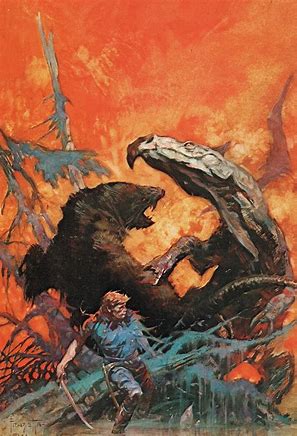
 GULLIVAR JONES ON MARS aka Lt. Gullivar Jones – His Vacation and various other titles and spellings, was published in 1905 and is one VERY odd piece of work. The author was Edwin L. Arnold, whose ineptitude made this novel very unfulfilling as he defeated his storyline at every turn. Before I get into this third and final part of my review of Gullivar Jones on Mars the links to the first two parts are below:
PART ONE – I examined the low-profile feud between fans of Edwin L. Arnold, who maintain that many elements of this novel “influenced” (to say the least) Edgar Rice Burroughs’ later stories about John Carter of Mars, and Burroughs fans. The parallels are many, and I laid them out while also pulling in Arnold’s novel Phra the Phoenician. Click HERE.
PART TWO – I reviewed the first half of Gullivar Jones on Mars, complete with what revisions I would make to correct the way Edwin L. Arnold never failed to sabotage his own work, letting intriguing concepts die on the vine or letting rising tension peter out into lame anticlimax. It’s almost comical how he did that. Click HERE.
GULLIVAR JONES ON MARS: PART THREE OF THREE
 MORNING ON THE ISLE OF BEASTS – We pick up the morning after our hero, U.S. Navy Lieutenant Gullivar Jones, survived the night on the Isle of Beasts – my name for the place, since Edwin couldn’t be bothered to provide names for places or characters much of the time. Continue reading
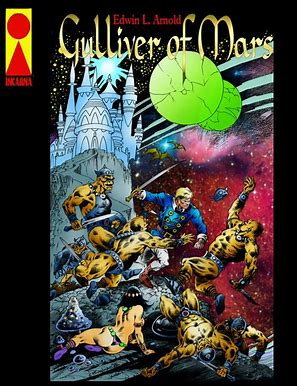 GULLIVAR JONES ON MARS (1905) – Written by Edwin L Arnold. In
 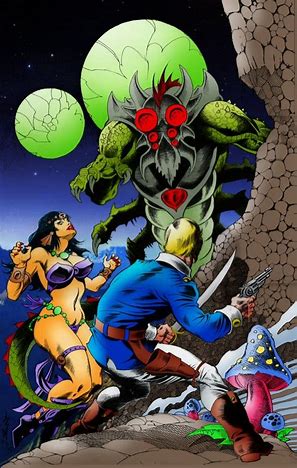 Gullivar Jones on Mars starts out in the late 1860s or early 1870s with U.S. Navy Lieutenant Gullivar Jones, a veteran of the Union forces in the Civil War, in New York City on shore leave. He comes into possession of a Turkish rug with unexplained mystical powers. While standing on the unrolled rug he wishes he was on Mars and the flying carpet transports him there. (?)
  GULLIVAR JONES ON MARS (1905) – Written by Edwin L Arnold, this novel was originally published under the title Lieut. Gullivar Jones: His Vacation. Years later, with the spelling of the lead character’s first name altered, it was published as Gulliver of Mars. Over the years it was revived under a variety of titles. I’m using the title that I prefer – Gullivar Jones On Mars.
  If Arnold had written this story decades later it could have been said that he was intentionally subverting the tropes of heroic sword & science epics. Unfortunately, this novel instead seems to be the victim of ineptitude on the author’s part.
  Balladeer's Blog